AfDB spearheads Africa's quantum leap
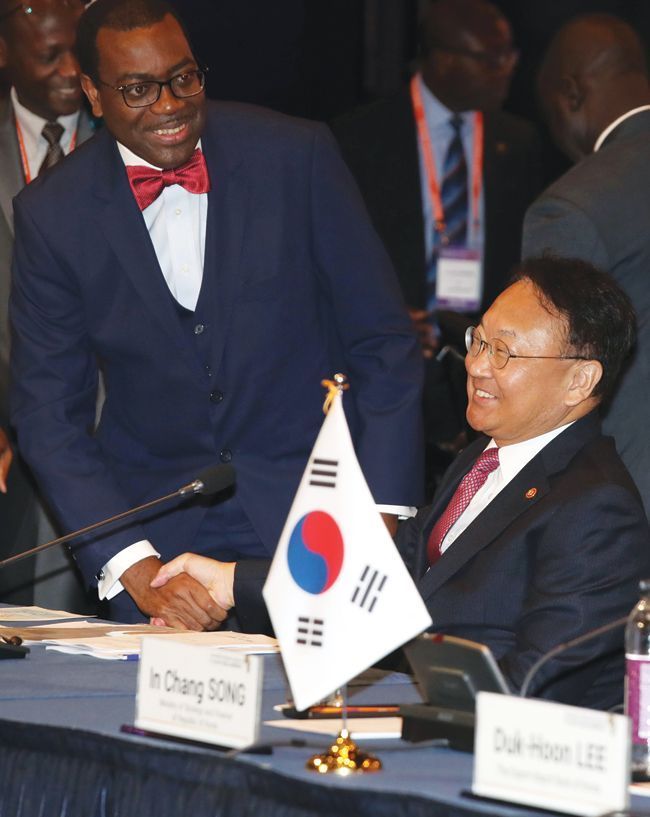
Minister of Strategy and FinanceYoo Il-ho, right, shakes hands with African Development Bank (AfDB) President Akinwumi Adesina while attending the 2016 Korea-Africa Economic Cooperation (KOAFEC) Ministerial Conference, at the Grand InterContinental Hotel in southern Seoul, Tuesday. / Yonhap
By Kim Tae-gyu

President Park Geun-hye attends a welcome banquet for the 2016 Korea-Africa Economic Cooperation (KOAFEC) Ministerial Conference, along with African Development Bank (AfDB) President Akinwumi Adesina at Cheong Wa Dae, Tuesday.
The African Development Bank (AfDB), which is the key pillar of the Korea Africa Economic Cooperation (KOAFEC), has masterminded the development of the continent since its inception.
Established in Ivory Coast in 1964 to boost Africa’s infrastructure construction and social advancement, the international institute has 80 member countries as of last year.
Among them, 54 are African nations while the remaining 26 are from around the world. Korea, also a member, is scheduled to hold the 2018 AfDB annual meeting in the southeastern port city Busan.
President Park Geun-hye also expressed her great interest in Africa as shown by her meeting with AfDB President Akinwumi Adesina at Cheong Wa Dae, Tuesday.
President Adesina is a representative figure in Africa’s efforts to modernize. To address the region’s development challenges, he came up with a bold transformative initiative focusing on five priorities after taking the reins of the entity midway through last year.
The five areas, termed the “high-fives,” are to light up and power Africa, feed Africa, integrate Africa, industrialize Africa and improve the quality of life for Africans.
The first action plan of lighting up and powering Africa is about securing an adequate power supply, which is still a luxury in many parts of Africa, through both conventional and renewable energy sources.
Feeding Africa is aimed at ensuring that the continent becomes a world leader in food and agriculture as it still has plenty of arable land.
The AfDB regards regional integration as a prerequisite to expanding the size of the overall African market and economy. Toward that end, it has pushed for a broad-based free trade area.
Industrialization is a strategic target of making Africa a powerhouse in the manufacturing segment. This is in tandem with the 2016 KOAFEC meeting theme, “Transforming Africa’s agriculture through industrialization and inclusive finance.”
The final priority of the high-fives is to improve the quality of life for Africans ― all the people, not a select few, should enjoy the benefits of growth and development.
As the eighth AfDB head and its first Nigerian, President Adesina will strive to spearhead these efforts during his five-year term.
He previously served as Nigeria’s Minister of Agriculture and Rural Development.
Born to a Nigerian farmer, he got a Ph.D. in agricultural economics at Purdue University in 1988. He then joined the Rockefeller Foundation as a senior scientist. Between 1999 and 2003, he represented the foundation for the southern African area.
He has good relations with the United Nations and its Secretary General Ban Ki-moon.
In 2010, Ban tapped him as one of 17 world leaders for the Millennium Development Goals (MDG).
Earlier this year, Adesina was appointed by Ban to serve as a member of the lead group of the movement designed to scale up global nutrition.