Gov't draws up expansionary budget for 2017
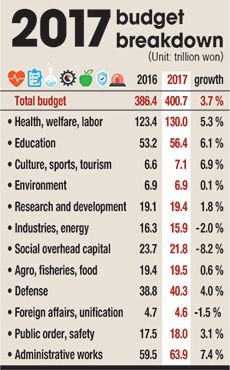
Total spending set at W400 trillion, up 3.7%; welfare expenditure at record W130 trillion
By Yoon Ja-young
The country’s budget will top 400 trillion won ($360 billion) for the first time next year as the government will maintain its expansionary policy to prop up the weak economy.
The budget allocated for welfare stands at a record-high 130 trillion won, while the budget for social overhead capital will be slashed by over 8 percent.
The Ministry of Strategy and Finance announced the plan for the 2017 budget, Tuesday. The total spending will be 400.7 trillion won, up 3.7 percent from this year and the biggest ever. It has doubled from 12 years ago.
The government explained that it has set an expansionary budget for next year.
“In 2017, the country will start seeing huge economic and social changes as the working age population starts to fall. The budget focused on creating jobs and invigorating the economy while trying not to impair fiscal soundness in the mid to long term,” Strategy and Finance Minister Yoo Il-ho said.
The budget for health, welfare, and labor stands at 130 trillion won, or 32.4 percent of the total budget, the highest ever, as the government focuses on creating jobs, providing tailored welfare and getting rid of blind spots in welfare.
It allocates 17.5 trillion won for jobs, up 10.7 percent from the previous year. It includes support for startups and job training as well as fostering balance between work and life for female workers. It also expands the budget for youth employment by 15 percent, allocating 2.7 trillion won.
Pulling up the country’s low birthrate is also among the key goals of the budget. Rental homes for newlyweds and young people will be expanded while all couples suffering from fertility problems will be provided support for in vitro or artificial insemination, regardless of their income.
The government also increased the budget for culture, sports and tourism by 6.9 percent, allocating 7.1 trillion won, and the budget for domestic defense by 4 percent to 40.3 trillion won. On top of strengthening preparations against North Korea’s nuclear and missile threats, the budget will be spent on improving the condition of barracks, such as installing air conditioners. Soldiers will also see pay raised by 19.5 percent, which means their salaries will have doubled compared with 2012. Salaries for government officials will be raised by an average of 3.5 percent next year.
The spending in social overhead capital, however, was slashed by 8.2 percent to 21.8 trillion won, the largest cut ever. The government said it will support only core projects essential for reviving the provincial economy. The budget for diplomacy and unification also decreased 1.5 percent, on increasing tensions with North Korea.
The government expects national tax income to stand at 241.8 trillion won, up 8.4 percent from this year, based on the estimation that the economy will mark 3 percent real growth rate next year.
The government debt is expected to increase to 682.7 trillion won, up 38 trillion won from this year. The ratio of the government debt to GDP will surpass 40 percent for the first time.
The budget will be submitted to the National Assembly on Sept. 2 for approval.