Policy lenders announce reform plans
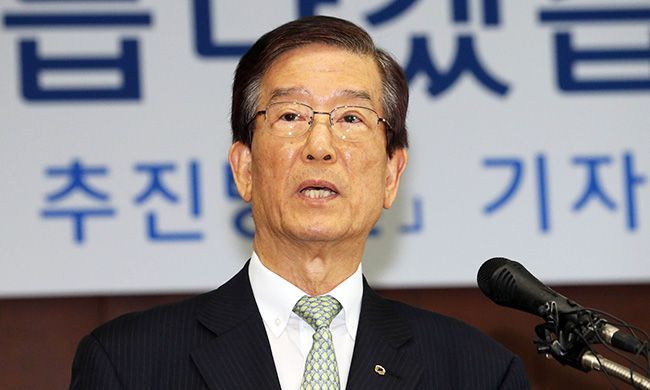
Korea Development Bank Chairman Lee Dong-geol speaks during a press conference at the state-run financer’s headquarters in Yeouido, Seoul, Thursday. / Yonhap
KDB chairman apologizes for failure to control debt-riddled companies
By Nam Hyun-woo
Two state-run banks that have been under fire for their negligence in reining in debt-riddled shipbuilders and shippers announced their reform packages, Thursday, but questions still linger over their plans to “regain the public trust.”
Korea Development Bank (KDB) Chairman Lee Dong-geol said in a press conference that the bank will establish a consultative body comprised of members from within and outside of the bank to enhance its restructuring capacity.
“I took this post only four months ago, but it feels like four years have passed. I’m spending the hardest time in my 40-year career in the financial sector these days,” said Lee, adding that he apologizes for causing public concerns.
KDB also pledged it will strengthen its control over outgoing employees’ reemployment in companies that the bank has shares. The 132 non-financial companies that the bank holds stakes in will not be able to hire former KDB employees.
However, such a plan caused questions because the bank exceptionally allowed reemployment in companies where it has the right to make hiring recommendations, having the largest share and being the main creditor. KDB sent its former ranking official to Daewoo Shipbuilding and Marine Engineering (DSME) to serve as CFO, but did not prevent the company from falling into ruin, with the Board of Audit and Inspection holding KDB responsible.
Lee said that the bank will also make improvements in its credit review system and asset portfolio so that it can “fully fulfill the role of policy lender.”
“By setting up a KDB reform committee, the bank will conduct self scrutiny all over the bank’s business and come up with details by the end of September,” Lee said. KDB will cut the number of its employees by 10 percent until 2021 as a way of taking responsibility for the belated restructuring.
“There were huge faults in overseeing the (shipbuilding and shipping) industries in a broader view and severing the past wrong deeds. We will take the criticisms as an opportunity to improve ourselves,” Lee added.
On the same day, the Export-Import Bank of Korea (Eximbank) also announced aits reform package. Eximbank said it will lower its ratio of loans classified as substandard or below to 2 percent until 2020, as well as downsizing its organization and cutting its budget. Also, as part of “reforming itself,” ranking officials will return their salaries, while all employees will return a part of their salaries, nullifying a pay raise.