Rice consumption halves in 30 years
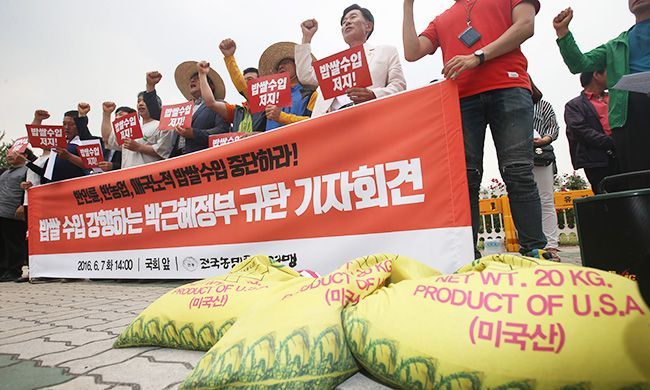
Farmers rally in front of the National Assembly building in Seoul, Tuesday, to urge the government to stop rice imports for meals. / Yonhap
By Yoon Ja-young
Consumption of rice, the staple of the Korean diet, is half of what it was 30 years ago, according to Statistics Korea on Tuesday.
Koreans consumed an average of 172.4 grams of rice a day last year, down 3.3 percent from the year earlier.
When considering that a bowl of rice is typically between 100 to 120 grams, Koreans have on average only a bowl and a half of rice daily. This contrasts with 1985 when the average annual per capita consumption was 128.1 kilograms. This figure stood at 62.9 kilograms last year.
Average consumption of other crops, such as barley, wheat and beans, meanwhile, totaled 8.8 kilograms last year, up 1.1 percent from the previous year.
“Rice consumption has been falling due to Westernized diets and a shift to more healthy meals,” said Kim Tae-hun, a researcher at the Korea Rural Economic Institute (KREI).
Four out of 10 Koreans prefer eating multigrain rice, he said, citing a food consumption survey. Only 30 percent eat pure white rice at their meals.
“About four decades ago, it was the wish of many Koreans to eat rice to their heart’s content. Now, we have to think about what to do with the excess,” said Kim Yeon-hwa, president of the Consumer Network for Public Interest, a local NGO, at a forum.
She cited changing consumer patterns as the biggest reason. “With more people becoming health conscious and being on diets, they are uneasy about eating carbohydrates such as rice.”
Production of rice, however, isn’t decreasing. Rice production totaled 4.3 million tons last year, the largest yield since 2009 thanks to good weather conditions.
The stock of rice is piling up, surpassing 1.8 million tons as of February. That is 2.3 times more than the 800,000-ton stock recommended by the United Nations Food and Agriculture Organization (FAO).
It will increase even further, as the government expects only 4 million tons to be consumed this year. Moreover, the mandatory rice import quota has increased to 409,000 tons. Under the WTO agreement, Korea has increased rice imports in return for not opening the rice market.
The resulting surplus is incurring heavy costs. According to KREI, it costs 31.6 billion won to keep 100,000 tons of rice in stock. This includes a 6.1 billion won storage fee as well as a 22 billion won loss in value due to the aging of the rice and 3.5 billion won in financial costs.
The government plans to induce farmers to cultivate other crops as well as diversifying the use of rice, such as for processed foods and animal feed. It plans to reduce rice paddies to 769,000 hectares this year from last year’s 799,999 hectares, on top of expanding Korean rice exports.
“Many children these days eat bread instead of rice for breakfast because their parents, both of whom are working, don’t have time to cook rice in the morning. I think making bread with rice could be one way to increase its consumption,” said Kim at the consumers’ group.