Growth slows on weak investments, consumption
By Kim Jae-won
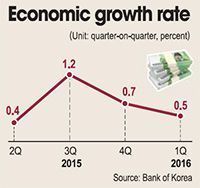
Economic growth slowed in the first quarter on weak corporate investment and sluggish consumer spending, the Bank of Korea said Thursday.
The nation’s GDP grew 0.5 percent in the January-to-March period from a quarter earlier, down from a 0.7 percent gain the previous quarter.
Investments in facilities dropped 7.4 percent in the first quarter, and private consumption fell 0.2 percent, according to preliminary data from the central bank. Exports also dropped 1.1 percent.
Economists said that if construction investment ― which rose 6.8 percent ― was excluded, the GDP would have contracted.
“All of three key elements in the economy ― exports, corporate investment and private consumption ― dropped in the first quarter, showing that both companies and households suffer from financial distress,” said Lim Dong-min, a senior economist at Kyobo Securities.
“Consumers tighten their purse strings because their disposable income is on the same level. Companies also have no room to increase salaries for employees as their overseas sales are dropping.”
Analysts said that economic growth will be slightly higher in the second quarter, but not strong enough to impact sluggish growth.
The latest reading marks a slight increase from an earlier estimate of 0.4 percent quarter-on-quarter expansion released in April. From a year earlier, the local economy grew 2.8 percent, on par with the BOK’s growth outlook for 2016.
The BOK expected that the situations will get better in the second quarter thanks to the government’s measures to boost private consumption, including the extension of an excise tax cut on automobiles.
“For the second quarter, we expect a better performance in domestic consumption on the back of the brisk sales of cars and the effects of the temporary holiday in May,” said Kim Young-tai, director of the BOK’s national accounts division, in a press briefing.
The government extended an excise tax cut program for passenger cars to June and designated an extra holiday on May 6 to give a four-day long weekend, as a way to bolster domestic consumption. According to recent industry data, sales of the country’s five automakers rose 6.4 percent in May from a year earlier.
Separate data also showed that during the temporary holiday period, sales at local department stores rose 16 percent while spending at duty free shops increased 19.2 percent.
The construction industry helped keep the local economy growing, with its output jumping 11.1 percent year-on-year in the first three months. The service industry also expanded 2.5 percent year-on-year in the January-March period.
But, output by the manufacturing industry only gained 1.9 percent over the cited period, while that of the agricultural industry shrank 2.4 percent.