Korea advised to reform financial regulations
By Kim Jae-kyoung
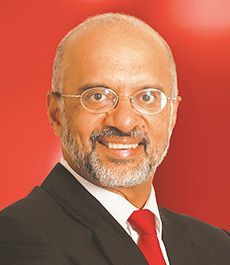
DBS CEO Piyush Gupta
SINGAPORE ― Korea needs to improve its regulatory and tax system to become a leading financial center in Asia, according to Development Bank of Singapore (DBS) CEO Piyush Gupta.
In a recent interview with The Korea Times, Gupta said that Korea should take a cue from Singapore in four key areas ― regulations, taxation, the legal system and business environment ― to transform the country into a place attractive to foreign investors.
“Singapore built a reputation as a global financial hub because it is open but also well-regulated. It is well-known for its transparent and robust regulatory infrastructure, strong legal system, and supportive tax regime,” he said.
“At the same time, the city has a sizeable talent corps, and has over the years, transformed itself into a dynamic, vibrant and fun city which has made it an attractive place to live, work and play,” he added. “These are some strengths Korea can emulate.”
Despite the government’s efforts to make Seoul a financial hub in Asia, Korea has been losing attractiveness as a financial center.
This year, Barclays Capital decided to withdraw its investment banking division; following Citigroup (consumer finance) and Royal Bank of Scotland last year, and HSBC (retail banking) in 2013. UBS has also returned its banking license.
Gupta, who served as Citigroup’s CEO for Southeast Asia, Australia and New Zealand prior to joining DBS in late 2009, said that Korean banks need to better understand the dynamics of markets where they enter when pursuing globalization.
“Korean banks should have a clear, well-defined strategy, know the geographies and businesses you want to be in, and focus accordingly,” he said.
“An understanding of local markets is important, which is why we believe in hiring locally in all the geographic areas we are in,” he added. “It is also important to have a common set of processes, policies and a one-bank culture across the markets.”
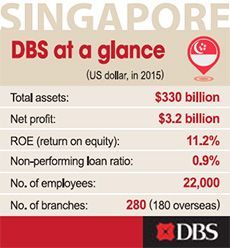
DBS has over 280 branches across 18 markets with a growing presence in China and Southeast Asia. The bank has delivered 28 quarters of income growth
The veteran banker said that digital disruption will change the landscape for the financial industry, expecting that non-traditional players can be a threat.
“Non-bank competitors, such as Tencent and Alipay, are making some of the biggest inroads into financial services in recent times,” he said.
“While this is a challenge, the discontinuity will provide a huge opportunity for banks that can get it right.”
DBS has been trying to combine its services with technologies to meet the shifting demand from younger customers. The lender formed an alliance with IBM last year to beef up its digital strategy, while hiring Neal Cross, vice president of MasterCard Lab, as its chief innovation officer.
It also launched a mobile wallet app in May, which allows customers to use their smartphones to pay for purchases and send and receive funds.
He said that despite challenges triggered by financial technology, or fintech, banks are in good position to be better off.
“Banks have innate advantages that others don’t, such as banking expertise, robust networks and infrastructure, and established risk management frameworks, to name a few,” he said.
He stressed that banks should be more agile in order to become a winner in ongoing transition into the new world of banking.
“If we can marry these strengths with the agility of Internet companies, there is no reason we cannot carve out a befitting space for ourselves in the new world order,” he said.
“I believe we are nearing a defining moment for traditional banks. Some will make the transition, but many may not.”
DBS is a leading financial services group in Asia, with assets of around $330 billion with net profit of $3.2 billion in 2015. Headquartered and listed in Singapore, DBS is a market leader in the city state with over four million customers and 22,000 employees.