$30,000 income - still a pipe dream
By Kim Jae-won
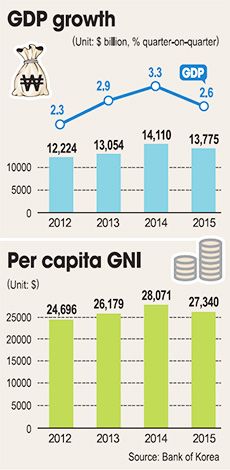
Korea’s gross national income (GNI) per capita dropped 2.6 percent from a year earlier to $27,340 in 2015 on a weaker won against the dollar and slowing economic growth, the Bank of Korea said Friday.
This is the first time in six years that the nation’s per capita income has contracted.
Concerns are growing that the country will not be able to breach the $30,000 mark in the near future. The nation’s per capita income has stayed below $30,000 for 10 years since it first breached the $20,000 mark in 2006.
“The fall in per capita income reflects the won’s weakness,” said Jeon Seung-cheol, head of the bank’s economic statistics department, in a press briefing. “External shocks, such as a drop in exports, also played a key role in hurting the per capita income.”
The won lost 7.4 percent to the greenback last year; while exports dropped every single month hit hard by low demand in global markets due to sluggish growth mainly in China but also in other parts of the world.
However, Jeong said that the GNI per capita gained 4.6 percent to 30.94 million won during the same period, breaching the 30-million-won mark for the first time.
Similarly, personal gross disposable income, which measures people's purchasing power, grew 4.7 percent from a year earlier to 17.57 million won in 2015, while its value in terms of the U.S. dollar slipped 2.5 percent year-on-year to $15,524.
The country’s economy continued to expand in 2015, though at a slower pace. The bank said that the country’s real gross domestic product (GDP) rose 2.6 percent in 2015 from a year ago, down from 3.3 percent in 2014.
The latest reading is the same as the central bank’s earlier estimate, though it revised down growth in the third quarter to 1.2 percent from the previous 1.3 percent, while also revising the fourth quarter reading to a 0.7 percent jump from a 0.6 percent year-on-year expansion.
Increased spending by both the private and public sectors helped Asia’s fourth-largest economy keep growing.
“While the growth of semi-durable goods and services expenditures showed a sluggish pace, the consumption of durable goods expanded significantly,” the BOK said in a press release.
Private consumption gained an estimated 2.2 percent from a year earlier in 2015, compared with a 1.7 percent year-on-year increase in the previous year. Government spending spiked 3.4 percent, also accelerating from a 3 percent rise in 2014.
Exports, which account for nearly 50 percent of the country’s GDP, struggled, only inching up 0.8 percent, compared with a 2 percent rise the year before. A slow growth, partly caused by sluggish exports, has apparently remained a major concern for the central bank, which has kept its key interest rate frozen at a record low of 1.5 percent since June 2015 in an attempt to bolster growth.
The BOK earlier forecast the local economy will grow 3 percent in 2016, down from a 3.2 percent forecast earlier. It has also slashed its growth outlook on consumer prices to 1.4 percent from 1.7 percent.