Choinomics coming to a close
By Yoon Ja-young
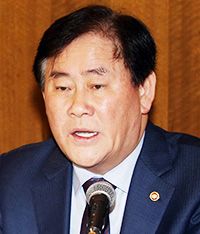
Choi Kyung-hwan Strategy and Finance Minister
With the general elections slated for next April, it is only matter of time before Strategy and Finance Minister Choi Kyung-hwan returns to his parliamentary post.
The incumbent third-term lawmaker of the governing Saenuri Party was appointed as finance minister in July 2014 amid much attention.
“It’s nearing a year and a half since I was inaugurated, but it’s felt like 10 years,” he said at the year-end meeting with the media, Thursday. “I couldn’t loosen up even a minute due to external and internal uncertainties.”
Bestowed with the confidence of President Park Geun-hye, he was one of the country’s most powerful finance ministers. That’s why his economic policies were dubbed “Choinomics,” instead of “Geun-hyenomics” or “Parknomics” after President Park.
The minister, who had started his term following the tragic sinking of the Sewol ferry, cited Middle East Respiratory Syndrome (MERS) as one of the biggest hurdles he’s faced.
“The economy was in bad shape in the aftermath of the Sewol sinking,” he recalled. “It turned for the better toward the end of last year thanks to diverse policies, achieving 3.3 percent growth and creating 530,000 jobs. That momentum was hit by MERS.”
Choi focused on reviving domestic consumption, using a supplementary budget, launching the Korea Black Friday event in late November to kickstart consumption and cutting special consumption taxes. He succeeded in sustaining consumption from a further plunge, and the economy recorded 1.3 percent growth in the third quarter, the highest since the second quarter of 2010.
He also succeeded in sustaining the real estate market. Comparing “wearing summer clothes in midwinter” to regulation of the real estate market, he pushed for deregulation. With the easing of mortgage regulations such as loan-to-value ratio and debt-to-income ratio, liquidity increased in the real estate market.
Apartment transactions in Seoul stood at a mere 75,576 during the year before he took office, but soared to 113,447 in the first year since his inauguration.
Such deregulation, however, also increased household debt which approached 1200 trillion won, the highest ever. There were also concerns that the housing bubble may collapse after a couple of years due to an excessive supply of new apartments.
He also pushed for structural reforms in four areas ― finance, labor, education and the public sector ― to enhance their effectiveness in the economy. International credit ratings agencies pulled up the ratings for Korea, with S&P, Fitch and Moody’s all rating it at AA-.
Such achievements helped Choi rank second from the top in a minister evaluation report by the Institute for the Future of State.
However, it seems that the economy will fail to achieve the three percent growth target to which Choi has been attached.
Despite improving indices, individuals think the economy is turning for the worse, with the business sentiment index falling three points to record 68 in November. Faltering exports are adding to the burden of his successor, whoever it may be.
After all, Choi says there is no need to be too pessimistic about the economy.
“There are many critics within the country, but Korea is fending off crises fairly well,” he said. It’s been 35 years since he started a career in the finance ministry, but he said, “There wasn’t a year when the economy was without trouble. If we all cooperate, we will overcome any crisis and make a hopeful economy.”