KAMCO helps reshape shipping firms

Korea Asset Management Corp. (KAMCO) Chairman and CEO Hong Young-man, right, poses with Oceans and Fisheries Minister Yoo Ki-june after signing an initial agreement in June to help shipping companies hit by financial problems amid oversupply and falling prices in the sector. / Courtesy of KAMCO
By Choi Kyong-ae
Acquiring ships from financially troubled shipping companies will remain one of the mainstay jobs handled by Korea Asset Management Corp. (KAMCO) next year.
As of the end of October, the state-run debt restructuring company will have purchased 35 vessels from shipping firms, including Hanjin Shipping and Hyundai Merchant Marine, for 505.5 billion won ($434 million) since the 2008 financial crisis, according to KAMCO.
“Within this year, we are planning to acquire five bulk carriers from small-and mid-sized shipping firms for 71.1 billion won. Next year, we will spend at least 100 billion won to buy vessels and lease them back to shipping companies when their financial situations are improved,” KAMCO Chairman and Chief Executive Hong Young-man told reporters early last week.
Together with the shipbuilding industry, the shipping industry is still at rock bottom due to oversupply and low shipping rates resulting from low demand. It is widely expected to take several years for shipping and shipbuilding firms to make a meaningful turnaround.
Hanjin Shipping swung to a net profit of 188.4 billion won in the January-September period from a net loss of 384 billion won in the same period of a year earlier. The country’s biggest container company by sales posted heavy net losses for four straight years through 2014, according to a regulatory filing.
“For now, we don’t have a plan to sell our vessels and lease them back from KAMCO,” a Hanjin Shipping official said, adding the company focuses on completing its self-rescue program by shedding non-core assets.
Hyundai Merchant Marine, the second-biggest container carrier, shifted to a net loss of 218.8 billion won from a net profit of 149.8 billion won during the same period, showed a separate filing.
“Global cargo charges do not show signs of recovery at all as multinational shipping companies sell more container carriers in the market amid an extended downturn. Even Denmark’s AP Moller Maersk stopped placing new orders for ships due to falling rates and oversupply,” said a Hyundai Merchant spokesman.
In March this year, KAMCO leased back 33 of the 35 ships it purchased in the past six years to their former owner-shipping companies as their acute financial problems were resolved. The government earned 150.2 billion won in investment gains from the deals, KAMCO said.
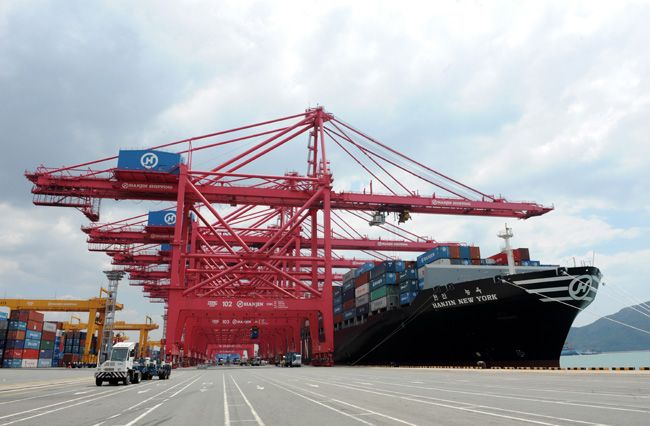
A Hanjin Shipping container vessel waits to be loaded at Busan New Port. Courtesy of Hanjin Shipping
Helping hand to SMEs
KAMCO has also extended a helping hand to small-and medium-sized enterprises, SMEs, which have solid business models but temporarily suffer from liquidity problems.
KAMCO bought 33.3 billion won worth of assets from two SMEs in the January-October period and plans to acquire assets valued at 40 billion won from two to three SMEs by December, a move to give relief to financially troubled companies, KAMCO Chairman Hong said in a press conference on Dec. 1.
After consulting with the Financial Services Commission (FSC), KAMCO has earmarked 100 billion won in its budget this year for acquisition of properties or other assets held by debt-laden SMEs in order to help them stay afloat, the state company said.
“We often find SMEs which went bankrupt due to lack of capital valued at 5 billion won to 10 billion won. They can sell their properties or other assets to KAMCO in order to meet their urgent demands for operating capital and lease them back from us later,” he said.
KAMCO hopes the FSC, which supervises the debt restructuring firm, will allow it to spend more on the sale and leaseback deals not only to revive SMEs but also to increase KAMCO’s investment gains from the deals.
Financially unstable SMEs are not alone. Financial companies in the private and public sector have also benefited from KAMCO funds.
KAMCO is expected to take over 4.2 trillion won worth of bad debts held by private and public financial firms for the whole of this year, up 35 percent from 3.1 trillion won a year earlier.
Looking ahead, meanwhile, KAMCO set up the so-called Unified Nation’s Asset Research Center’ in November last year to start professional studies about ways to manage corporate assets in North Korea after unification and state-owned assets of a unified Korea.
By 2020, KAMCO is targeting to earn 2 trillion won a year in sales and manage assets worth 200 trillion won under its control by winning more government projects. In 2014, sales stood at 1.4 trillion won with assets it managed reaching 94 trillion won.