China FTA to trigger fierce competition

Lawmakers from the ruling Saenuri Party and the main opposition New Politics Alliance for Democracy (NPAD) hold talks on the country’s free trade deal with China ahead of a National Assembly plenary session, Monday. / Yonhap
By Choi Kyong-ae
Korea’s passage of the free trade deal with China will give companies across the nation opportunities to expand into Asia’s fastest growing economy, though competition with low-priced Chinese imports likely will intensify at home, analysts said Monday.
On Monday, the National Assembly ratified the free-trade agreement, signed in June between the two countries, lifting tariffs on $73 billion in Korea’s exports to China and $42 billion in China’s exports to Korea.
“Among other things, it’s time for Korean companies to make aggressive forays into China’s domestic market, helped by lower tariffs, rather than using China as a manufacturing base for exports to the U.S. and Europe,” said Kim Young-gui, a research fellow at the Korea Institute for International Economic Policy (KIEP).
China is Korea’s biggest trading partner and Korea is China’s third-biggest partner.
Korean companies such as Hyundai Motor, Samsung Electronics and Hankook Tire have expanded their manufacturing facilities in China in the past decade as they sought high returns on cheap labor. As a result, they exported products made in their plants in China to global markets, which worked well for some time.
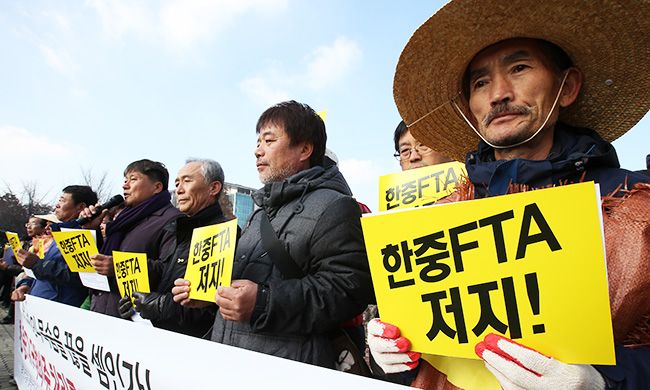
A group of farmers and other civil organizations shout out slogans during a rally in front of the National Assembly in Seoul, Monday, calling for lawmakers not to ratify a free trade agreement between South Korea and China. / Yonhap
But manufacturing costs are no longer cheap in China and local demand for vehicles and high-end electronics products are on the rise as its economy is growing slowly but steadily.
Kim advised Korean exporters to shift their focus to gain a bigger share by selling more products in the world’s most populous country on the back of declines in tariffs.
Lower tariffs not only present opportunities but also challenges to Korean companies.
“Small- and medium-sized companies which have largely sold low-end, low-priced products at home and abroad have to mend their business strategies to combat products coming from China beginning next year,” LG Economic Research Institute economist Kim Young-ju said.
As for the anticipated impact from the market opening to China’s agricultural and fisheries products in the short term, analysts expressed worries saying there should be countermeasures by the government in the long term, though Korea didn’t lift the bar fully for agricultural and fisheries products from China.
In a separate bilateral deal on Saturday, China agreed to increase the quota of Korea’s investment in China’s stock and bond market by 50 percent and accelerate efforts for an early start of direct yuan-won trading in China.
Trade volume between the two countries soared to $235 billion in 2014 from $6.4 billion in 1992 when they established diplomatic ties, government data showed.