Won plunges after Fed hints on rate hike
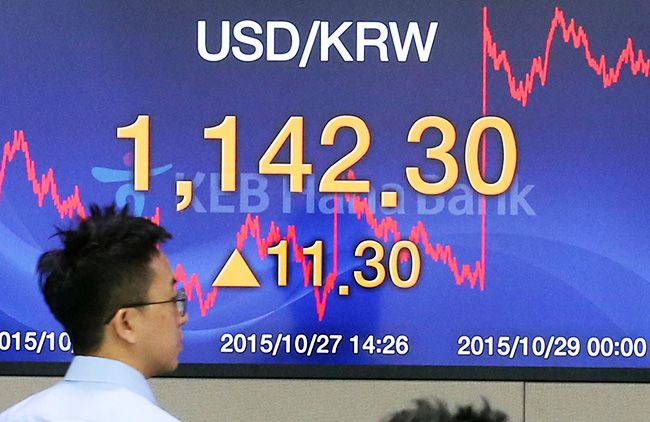
A screen shows that the Korean won closed at 1,142.3 won against the U.S. dollar on Thursday, losing 11.3 won, or 1 percent, from the previous day. The local currency lost its value as the U.S. Federal Reserve indicated a possible rate hike in December. / Yonhap
By Kim Jae-won
The won lost 1 percent Thursday after the U.S. Federal Reserve indicated a possible rate hike in December, dealers said.
The won closed at 1,142.3, losing 11.3 won against the U.S. dollar. The depreciation came a day after the Federal Open Market Committee (FOMC) said it will raise the target range for the federal funds rate when it has seen further improvement in the labor market and is confident that inflation will move back to its 2 percent objective over the medium term.
Economists said the won will lose further value because investors will bet on the Fed’s rate hike no later than December.
“I expect the won to depreciate until December when the Fed makes a decision,” said Lee Jong-woo, head of IBK Securities’ research center. “The Fed seems to be eager to raise the rate because the U.S. economy is growing 2.5 percent, adding more than 150,000 jobs.”
The FOMC said that economic activity in the U.S. has been expanding at a moderate pace, with household spending and business fixed investment increasing at solid rates in recent months. It also noted that the housing sector has improved further, based on data it received since its meeting in September.
Market watchers said the won will not lose its value drastically because demand for the local currency will increase as exporters are enjoying better performance. Korea’s key exporters, including Samsung Electronics, are having surprising earnings in the third quarter thanks to the low currency value.
With little chance the Bank of Korea will cut its key interest rate further, this also helps the won keep its value, they said. BOK Governor Lee Ju-yeol said Wednesday he is watching the Fed’s moves carefully. The chief central banker said the Korean economy will be resilient to a U.S. rate hike because the country continues to post a large current account surplus while it maintains a considerable sum of foreign currency reserves.
The central bank expects the current account surplus of Asia’s fourth-largest economy to reach $110 billion this year. The nation’s foreign reserves reached $367.9 billion in August, marking the sixth-largest in the world. China topped the list, followed by Japan, Saudi Arabia, Switzerland and Taiwan.