Finance minister may quit for assembly run
By Choi Kyong-ae
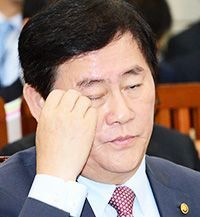
Choi Kyung-hwan
Korea’s Finance Minister Choi Kyung-hwan looks set to run in the general election next year, inviting a barrage of criticism that he abused macroeconomic policies for his own political purposes.
“There are many others who will take care of the country’s economic policies even if I am not in charge of them,” Choi said when asked by lawmakers at the National Assembly on Thursday if he had a plan to stand for the election in April.
Economists and political critics interpreted his response as a strong hint that he was already ready to discard his dual job of deputy prime minister and finance minister by early next year to join the race to become one of the nation’s 300 policymakers.
“If Choi quits his job in the middle of efforts to stimulate the lackluster economy, the government’s overall stimulus measures may be derailed, dealing a heavy blow to the economy already suffering from slowing growth,” Song Chang-seok, an economics professor at Soongsil University, said.
In fact, the government’s aggressive stimulus package initiated in August of last year by Choi under the expansionary policy, dubbed “Choinomics,” has fallen far short of boosting the economy. Easier rules on mortgages and the Bank of Korea’s (BOK) four rate cuts have only helped buoy the property markets in the past year. Exports continued to fall in the January-September period. The BOK expected a 6.4 percent decline in exports to $536 billion for this year from a year earlier.
Also, household debt soared to 1.1 quadrillion won at the end of March, which the BOK Governor Lee Ju-yeol warned on Thursday could turn into non-performing loans in case of rate increases. Heavier debt burden on households has dampened individual spending.
On Thursday, the central bank cut its growth outlook for this year to 2.7 percent from its July forecast of 2.8 percent due to growing external uncertainties, including China’s slowdown. It held its key interest rate unchanged at a record low of 1.50 percent for a fourth consecutive month.
Choi’s likely election run has been widely expected and it is the Park Geun-hye administration that should be blamed for his irresponsibility, said Shin Yul, who teaches political science at Myungji University.
Lee Phil-sang, an economics professor at Seoul National University, went a step further to criticize Choi’s planned exit from the government’s macroeconomic policy headquarters.
“The much-touted Choinomics shot up the prices of houses and home rental costs in the past year, as well as household debt. But economic growth and employment didn’t improve at all in the real economy,” said Lee. “The real concern is that Korea’s economic policies are often influenced for political reasons.”
Choi, named by President Park to his significant posts in July of last year, is expected to quit in December after the budget plan for next year passes the National Assembly by the Dec. 2 deadline.