Greek default may hit Korean exporters
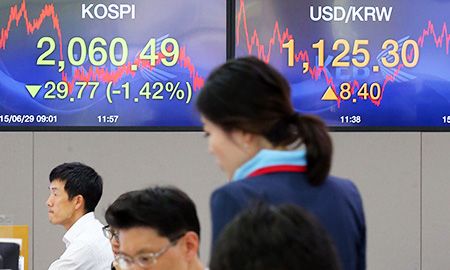
Foreign exchange dealers monitor financial markets at the main office of the Korea Exchange Bank in downtown Seoul, Monday. The nation’s benchmark KOSPI dropped 29.77 points, or 1.42 percent, to close at 2,060.49 on worries over a Greek default. / Yonhap
By Kim Jae-won
The Greek default may hit Korean exporters as shipments to Europe are expected to slow and revenues decline due to a weaker euro, economists said Monday.
They said the government needs to execute its planned supplementary budget as soon as possible and the central bank should cut its key interest once more to boost local demand faced with increasing global uncertainty.
Greece has called for a national referendum on July 5 over the debt repayment plan suggested by its troika creditors of the European Union (EU), the European Central Bank (ECB) and the International Monetary Fund (IMF). The country is highly unlikely to meet repayment obligations the IMF set for Tuesday.
“The main impact on Korea from heightened global uncertainty related to Greece would be export growth, with shipments to Europe possibly slowing and revenues being impacted by a weaker euro,” Frederic Neumann, a senior economist at HSBC told The Korea Times.
Neumann said a Greek default strengthens the case for the planned supplementary budget and another rate cut in due course, with a view to support local demand amid rising global uncertainty.
Finance Minister Choi Kyung-hwan announced last week that the government will set up a supplementary budget in the second half, expected to be at least 15 trillion won. Choi said the funds will be used to boost local demand hit hard by the outbreak of the Middle East Respiratory Syndrome in order to keep the nation’s economic growth rate above 3 percent this year.
The Bank of Korea cut its interest rate to a new record low of 1.5 percent earlier this month from 1.75 percent. Its next rate-decision meeting is scheduled for early July.
Lee Jong-woo, head of IBK Securities’ research center, said a Greek default will have limited impact on Korean economy and its financial markets because the country has an immune system for such a financial crisis.
“Korea experienced a similar crisis in 2012, and the (current) default looks weaker than the previous one,” said Lee.
The senior analyst said European countries already absorbed some of the shocks from the default in advance by keeping their key interest rates low. He also said European lenders have little exposure to Greece, reducing risk to capital outflows from Korean markets.
Neumann also said Greek jitters will have only a marginal impact on the Korean economy because it is in much better shape than before, although the default could lead to short-term financial volatility in the nation.
The government said that it has a wide range of contingency plans to cope with any trouble that may arise if a settlement is not reached between Athens and its international creditors.
“Market stabilization measures will be taken swiftly in line with preset contingency plans,” said Vice Finance Minister Joo Hyung-hwan at the macroeconomic and financial policy meeting.
He said that a Greek default cannot be ruled out, judging by the current direction of negotiations and a fast approaching deadline. The vice finance minister said if Greece defaults, it could lead to more volatility that can pose some challenges for Korea’s financial market.