2ndary lenders to lower rates Regulator expects burden on poor to be eased; spending to be boosted
By Choi Kyong-ae
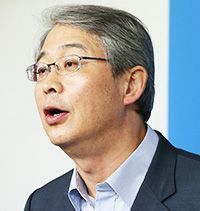
FSC Chairman Yim Jong-yong
The government will lower “murderous” lending rates charged by private lenders and expand low-rate loans to lessen the burden on low-income borrowers, the Financial Services Commission (FSC) said Tuesday.
“These measures are aimed at helping low-income, low-credit people reduce their debts and increase spending,” FSC Chairman Yim Jong-yong said in a press briefing.
The top financial regulator will seek to revise the law involving loan companies within this year to cut interest rates at those secondary lenders to 29.9 percent from 34.9 percent, Yim said.
“If the rate ceiling falls below 30 percent, 2.7 million borrowers will not have to pay 460 billion won (about $420 million) in combined interest,” he said.
The move comes as spending is shrinking and economic growth is affected by the spread of Middle East Respiratory Syndrome (MERS).
“Interest rates have continued to fall in the market. But there are still many low-income, low-credit people suffering from high borrowing costs at secondary lenders such as savings banks and leasing firms,” Yim said.
The upper rate once reached a whopping 66 percent in 2007 but has been brought down progressively.
Although the benchmark interest rate is now 1.5 percent, non-banking lenders such as Rush and Cash, Sanwa Money and J Trust ― all from Japan ― have not lowered their rates.
The three have a 40 percent share of the market, and their combined assets reached 4.3 trillion won as of June last year, according to FSC data.
People who have low-credit records and have access only to non-banking lenders will be the main beneficiaries of the planned rate cut, the FSC chief said.
In addition, the government will also inject an additional 22 trillion won to continue to provide state-funded loans to low-income borrowers by 2020, the FSC said in a statement.
The state-backed loans, which carry lower rates than the average rates offered by banks, were scheduled to end this year.
The lack of spending by those in the middle and higher-income brackets is also dealing a blow to the economy. Declining exports and a weak yen remain a headache for export-oriented Korea.
The Bank of Korea and the International Monetary Fund have recently lowered their growth outlook for Korea this year to 3.1 percent from 3.4 percent and 3.3 percent, respectively.
The central bank and the finance ministry look set to lower their growth outlook further in coming months unless the deadly virus is contained in the coming weeks.
As of Tuesday, Korea reported three new MERS cases, bringing the total number of confirmed cases to 175 which include 27 deaths. About 2,800 people remain under quarantine.