Korea, Central America start FTA talks

Trade, Industry and Energy Minister Yoon Sang-jick looks at documents before announcing the launch of Korea-Central America free trade agreement negotiations with his counterparts from six Central American countries — Guatemala, El Salvador, Honduras, Nicaragua, Costa Rica and Panama — at the meeting held in Houston, the United States, Thursday. / Courtesy of the Ministry of Trade, Industry and Energy
By Yoon Ja-young
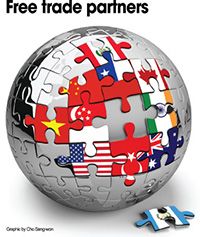
Korea has started official negotiations with six countries in Central America about a potential free trade agreement (FTA). The deal is expected to benefit both Korea and Central America as the export items are complementary, officials said Friday.
Trade, Industry and Energy Minister Yoon Sang-jick and his counterparts from Guatemala, El Salvador, Honduras, Nicaragua, Costa Rica and Panama held a meeting in Houston, the United States, Thursday, where they declared the official start of negotiations.
The six Central American nations form a regional bloc called SIECA, short for Secretaria de Integracion Economica Centroamericana, based on an agreement signed in 1960.
“With the Korea-Central America FTA, we will contribute to nurturing the growth potential of developing countries by meeting diverse development needs in the region, on top of increasing trade and investment. We will set an example of an FTA that benefits both,” Yoon said.
The ministry explained that Central America is a market with huge growth potential. Their gross domestic product (GDP) totals $209.8 billion and the population stands at 43.5 million.
The government expects that the signing of the FTA will help Korean firms get the upper hand in the market, as Korea would be the first Asian country to sign a deal with the six countries. Currently, China has signed an FTA with Costa Rica, and Taiwan has reached a deal with Panama, El Salvador and Honduras.
Trade between Korea and the six Central American countries isn’t notably large yet, totaling $5 billion in 2014.
However, the figure has doubled over the past 10 years. Around 200 Korean companies have invested in the region, creating 150,000 jobs.
Korea’s main export items into the region include automobiles, electronics and textiles, while it imports coffee, tropical fruit and metal. As the export items are complementary, the FTA is likely to benefit both parties.
The ministry expects the deal to increase Korea’s GDP by 0.0257 percent. Korea’s exports to the region are expected to increase by between 10 and 51 percent, and imports by 34 to 69 percent.
The ministry explained that there is a need to diversify trade and investment amid the sluggish global economy. Businesses also have been seeking opportunities to participate in diverse economic development projects in the region.