Minister pledges to boost communication with foreign investors

Bosch Korea CEO Frank Schaefers listens to the speech by Industry Minister Yoon Sang-jick during the forum in the Plaza Hotel in Seoul, Friday. / Korea Times Photo by Shim Hyun-chul
By Park Si-soo
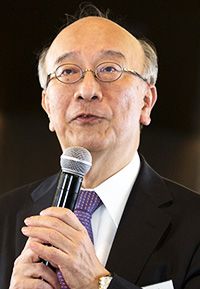
Koro Bessho, Japanese ambassador

Sergio Rocha, GM Korea president

Kim Hyo-joon, BMW Korea CEO
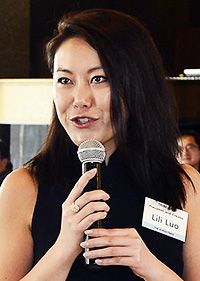
Lili Luo, Tribeluga president
Industry and Trade Minister Yoon Sang-jick promised Friday that the government will be more attentive to voices from foreign companies here.
To that end, he said he will asked President Park Geun-hye to regularly host a meeting with major foreign investors.
The minister also said the government will work harder to make itself more transparent and its policy more consistent so that foreign investors will be able to have a stable business operation and make more investment in Korea.
Yoon added his ministry will strengthen cooperation with other ministries and state regulators to create a more business-friendly environment.
“There is a regular meeting of the President and foreign investors that takes place once a year. As an industry minister, I will ask the President to have the meeting more than one time a year to have a better communication network between the government and foreign investors,” the minister said during the “Foreign Investors Forum” at the Plaza Hotel in downtown Seoul, hosted by The Korea Times.
The comment was made in response to a question from HSBC Korea CEO Martin Tricaud about the government’s solution to tackle adverse sentiment against foreign investors here.
“We are well aware that foreign companies have made a great contribution to the Korean economy in many aspects. The government is trying to reduce the adverse sentiment with various measures. I believe things will get better continuously,” Yoon said.
Christoph Heider, secretary general of the European Chamber of Commerce in Korea, called on the minister to come up with ways to address difficulties facing foreign companies as a result of frequent conflict with tax and customs authorities.
“I am aware that there are many conflicts between foreign companies and tax authorities. I think such conflict will intensify as their business expands continuously,” Yoon said. “Regarding the issue, our ministry is trying to find a breakthrough in cooperation with the National Tax Service and the Korea Customs Service.”
The revision of related rules will be completed within this month, he said, adding this will help ease the difficulties of foreign companies to some extent.
Citing an ongoing litigation involving a BMW Korea’s affiliate, CEO Kim Hyo-joon asked for the central government’s intervention for peaceful and swift settlement of the dispute caused by what he called “conflict of interest” between Seoul City and other municipal governments.
The minister agreed with Kim’s idea, saying his ministry will cooperate with other state bodies to tackle the issue. But he did not elaborate on the legal dispute involving BMW because it is a pending dispute at the court.
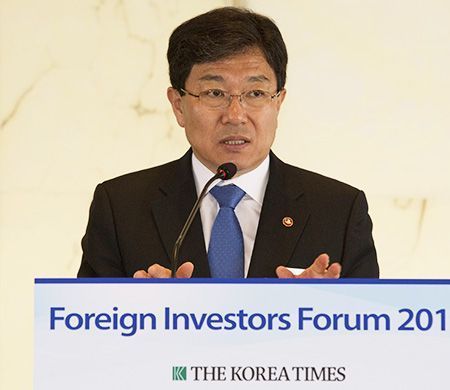
Minister of Trade, Industry and Energy Yoon Sang-jick answers a question from the audience at the Foreign Investors Forum at the Plaza Hotel in downtown Seoul, Friday. / Korea Times photo by Choi Won-suk
GM Korea CEO Sergio Rocha seemed determined to vent his frustration about regulatory shortcomings to the minister. He said the government’s lack of transparency, coupled with tough environment rules and hard-line labor union stance, make it difficult for GM to run business in Korea.
“There is no perfect paradise in terms of investment,” the minister answered. “One thing I can tell for sure is that the government is working hard. Our ears will remain open to your voices anytime and anywhere.”
Regarding a question about how to attract Chinese investment from Tribeluga President Lili Luo, the minister said the government plans to launch various campaigns in cooperation with Chinese counterpart to draw attention of major private companies and investors there. The next target would be China’s public companies and joint ventures established there, he said.
“Korean companies are very aggressive in expanding business in China, but it’s not the case when it comes to Chinese firms’ investment in Korea,” Yoon said. “To boost it, we will seek cooperation of the Chinese government.
He also pledged to carry out labor market reforms to address deeply-rooted, market mal-practices and revitalize the labor market.
“The range of ordinary wages will be stipulated, in order to prevent labor-union disputes and transition from the conventional, excessively seniority-based compensation system to a performance-based bonus system,” he said. “The current long-working hours will be improved as well. More companies will allow employees to work under flexible working hours for better labor conditions.”