Korea asked to focus on existing foreign investors

Industry Minister Yoon Sang-jick speaks at the Foreign Investors Forum 2015 at the Plaza Hotel in downtown Seoul, Friday. He said he will ask President Park Geun-hye to meet with foreign investors here more than once a year to create a more business-friendly environment. / Korea Times photo by Choi Won-suk
Companies call for consistency and predictability in policies
By Choi Kyong-ae
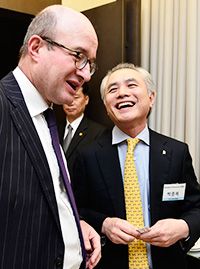
HSBC Korea President and Chief Executive Martin Tricaud, left, laughs while talking to Standard Chartered Bank Korea President and CEO Park Jong-bok during a tea meeting of VIP guests before Foreign Investors Forum 2015 started on Friday at the Plaza Hotel in central Seoul. / Korea Times photo by Shim Hyun-chul
Foreign business leaders Friday urged the Korean government to make a bigger effort to have foreign investors currently operating here expand their investments, rather than trying to attract new companies.
“The government needs to focus more on encouraging foreign businesses that are already here to expand investment, rather than attract new companies and investors. This makes sense because it is much easier to do,” Barbara Zollamann, secretary general of the Korean-German Chamber of Commerce and Industry, said at an investment forum organized by The Korea Times.
They also advised the government to be more“consistent and predictable” in carrying though on policies. They stressed the importance of“predictability and consistency” for attracting greater investment.
Other participants called on the government to ease regulations or lift obstacles that discourage foreign companies from investing in Korea, Asia’s fourth-biggest economy. They also said the government needs to set guidelines for changes in regulation and the law, as well as show consistency in foreign direct-investment-related policies.
“The biggest interest was for a clear description of regulations and laws. Here in Korea, lawmakers propose a law and it comes into reality, but there is not a proper description how to follow it. This interpretation on regulation has to be cleared up for legal security,” Audi Korea Managing Director Johannes Thammer said.
For example, Audi Korea faces several laws that give its investors’ an obligation to report damages here, but there is not a clear description of how companies should follow the law, he explained.
“This shows me sometimes that the system in Korea is not that mature.”
GM Korea Chief Executive Sergio Rocha and Renault Samsung Motors CEO Francois Provost joined Thammer in explaining their difficulties in doing business here.
A major challenge for the automotive industry is labor cost, Provost said. “How to find a good balance with the unions in order to keep our competitiveness is difficult when labor costs now in Korea are considerable.”
Rocha said, “We have global regulations that control carbon dioxide worldwide. All countries are looking for flexibility to protect their auto industries. We talked about 110 grams (per kilometer) for example. The Korean government reduced it to 97. But 97 grams does not mean 97 here. It means almost 83 grams for mini cars, which is not achievable.”
What is even worse is that this regulation has not been totally validated with the cost to auto industry. Also the regulations have not yet been published here in English, the GM Korea chief said.
In other efforts to make Korea more attractive as an investment site, David-Pierre JALICON, chairman of French Korean Chamber of Commerce and Industry, said, Korea “should maintain a good balance between domestic and international markets because the attractiveness of Korea as a platform is only possible if the domestic market here is attractive, too. The government needs to make sure the current development is able to maintain growth within the domestic market first.”
Multinational companies and foreign business lobbies led by the American Chamber of Commerce in Korea (AMCHAM Korea) have asked for “predictability” and “regulatory transparency.”
Although Korean ministries are making more of an effort to seek the views of stakeholders when rules and regulations are developed or changed, concerns in this arena remain. Too often, new or changed rules that affect companies’ ability to do business are enacted in Korea too quickly, without sufficient notice to or involvement of stakeholders, including the foreign business community.
AMCHAM Korea President Amy Jackson made that argument when she met Korean officials and business leaders.
Most of the 150 participants ― composed of Trade, Industry and Energy Minister Yoon Sang-jick, government officials, foreign business lobby chiefs, CEOs of multinational firms and ambassadors to Korea ― in the Foreign Investors Forum 2015 held at the Plaza Hotel in central Seoul showed a keen interest in the question-and-answer (Q&A) session which lasted for about 30 minutes.
Minister Yoon answered questions from four participants, including Rocha, largely on regulations they hope to be improved, and rising labor costs they see as a big obstacle to additional investment.
Many participants said the forum was informative, helpful and were impressed by Minister Yoon’s sincere attitude to addressing these problems. They also pointed out the lack of time for the Q&A session with the minister, “who is very open to helping and investigating the problems.”
“It was meaningful to share issues and concerns between many foreign investors and policymakers. It would be better if we had more Q&A time,” Canadian aluminum company Novelis Asia Director Chung Chi-hyang said.