National Pension, companies at odds over dividends
By Yoon Ja-young
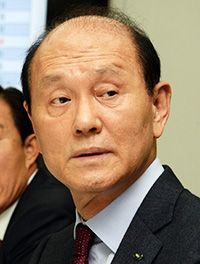
Choi Kwang NPS chief
The state-run National Pension Service’s call for conglomerates to pay greater dividends to shareholders is facing fierce opposition from business circles.
The state pension fund is entitled to exercise its right to intervene in management of major companies as a major shareholder, but experts say that it is not an adequate cure.
The fund management committee of the National Pension Fund held a meeting Thursday to discuss a diverse agenda, including measures to pressure businesses with low dividend payout ratios to increase their payouts. Chaired by the health and welfare minister, the committee is comprised of representatives from pension subscribers, the business community and financial experts.
However, the meeting ended with business representatives walking out, saying the proposed measures will interfere with corporate management.
The National Pension is a huge investor in the Korean bourse, taking 6 percent of the total market cap. It is a major shareholder with more than a 5 percent stake in 266 firms.
Dividends from those shares take a huge part of the pension’s investment return, and it hopes to get more dividends as Korean companies’ dividend payout ratio is still extremely low compared with other major economies. It hovers around 17 percent, much lower than the average of 43 percent in developed economies.
The government has been pressuring businesses to increase dividend payouts, on determination that greater dividends will increase household income and boost consumption. It has exercised both a carrot and a stick policy, giving tax benefits for those increasing dividend payouts while penalizing those who are not. It also plans to request more dividend payouts through the National Pension, which is a major shareholder in the leading conglomerates.
Lee Jung-sik, deputy general secretary of Federation of Korean Trade Unions, who is also a member of the fund management committee of the National Pension Fund, said the National Pension has not been properly fulfilling its role as a major shareholder.
“The move doesn’t simply aim at swelling the dividend payouts in the short term. We want to induce businesses, which have been paying dividends far below the industry average, to give the proper amount and bolster the stability of the pension fund as well as enhancing its profitability,” he said.
He added that if the pension fund neglects its right as a major shareholder, it will be like “helping the businesses with the people’s money.”
However, some experts say such pressure will cause problems.
Professor Shin Jung-soon of Ewha Womans University points out that Korean businesses have low dividend payout ratios due to the industrial structure. While non-cyclical products, which are not affected much by the economy, tend to give generous dividends, Korea’s leading industries are sensitive to global economic conditions. He explained that while financial companies, utilities and daily consumption goods, which tend to have higher dividend payout ratios, take only 27 percent of the KOSPI, cyclical products such as IT and industrial goods take 56 percent. That contrasts with the United Sates, where non-cyclical shares take 36 percent of the bourse and cyclical shares take only 27 percent.
“When considering that shareholders expect stable dividends, at least as much as the dividends paid the last time, it is difficult for Korean companies to maintain a high dividend payout ratios,” he said. He explained that businesses should not increase dividends on “temporary profits” that depend on economic conditions.
“For corporate growth, it is better to reserve the earnings for corporate investment, but shareholders take dividend payouts seriously. It is important to determine the dividend payouts that will maximize the corporate value,” Shin said.
Professor Cho Sung-bong at Soongsil University said the National Pension should focus on the flow of the profit for a long-term perspective, instead of securing cash in the short-term. He said the government seems to be seeking to “temporarily boost the economy by raising cash and increase consumption, instead of improving the overall income flow of the shareholders.”
“It isn’t appropriate to mobilize the voting rights of the National Pension for such an economic effect,” he added.