Rising household debts emerge threat to economy
By Choi Kyong-ae
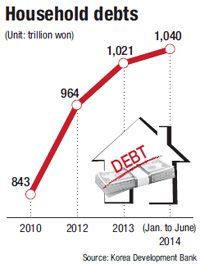
Fast-growing household debt may deal a heavy blow to the Korean economy as the government’s stimulus packages are not boosting property prices as much as expected, economists said Wednesday.
The country’s household debts reached a whopping 1.04 quadrillion won (about $994 billion) as of the end of June, up from 979.6 trillion won a year earlier, according to the Bank of Korea.
“In July, the finance ministry announced packages of stimulus measures mainly to boost the nearly moribund real estate market. But the pace of household loans’ growth is much faster than that of home prices’ gains, which is the opposite of what the government sought,” June Park, an economist at Eugene Investment and Securities, said.
The measures were designed to allow potential home buyers to borrow more from banks at lower interest rates. The ministry raised the loan-to-value (LTV) ratio to 70 percent nationwide. The ratio was previously at 50 percent for transactions in Seoul and the metropolitan area and 60 percent for the rest of the country.
LTV ratio is the proportion of a loan to the total value of a property. For instance, a potential buyer of a home valued at 500 million won ($477,000) will be able to borrow up to 350 million won from a bank regardless of his residential area.
The debt-to-income (DTI) ratio was also eased to 60 percent from 50 percent in Seoul and Incheon, and other cities in the Gyeonggi Province. There were no regulations for other provincial cities. DTI ratio is the proportion of borrowings from the overall value of salaries.
This month, the central bank also took a step to support the government’s stimulus drive. It cut the benchmark interest rate by a quarter percentage point to a record low of 2 percent.
Helped by lower rates, customers are expected to take more loans from banks not only to pay higher rental expenses but also to buy a house in the short term, economists said. Home transactions have been on the rise in some areas since July.
In the long term, however, the stimulus plans won’t likely drive up house prices. Households which carry heavy debt will tighten their belts if the government becomes less aggressive in the stimulus programs, the U.S. Federal Reserve increases rates or the Chinese economy slows, they said.
“If home prices show signs of a decline, those who bought a house on heavy mortgage may sell the house to pay back the debt or drastically cut their spending, said Park. “And, decreased spending could result in prolonged slump and low growth.”
Given the aging of the population, chances look slim that real estate prices will rise as much as new home buyers hope, he said. Korea has become one of the most aging countries due to its declining birth rates in recent decades.
In other words, household debt could grow into a potential time bomb that could hurt the Korean economy, Park Ju-young, an economist on the Korea Development Bank’s (KDB) economic research team, said.
Mortgages accounted for 42 percent of total household debt at the end of June this year. The ratio is expected to rise further for the time being due to lower rates and higher house rental costs under the ‘jeonse’ system.
Jeonse is a housing rental system unique to Korea. Tenants usually rent a house for two years without paying monthly rent after paying a hefty deposit. On the termination of the contract, the landlord repays the security deposit without interest to the tenant.
But these days, landlords increasingly prefer receiving monthly rent over the lump-sum deposit as they are finding fewer places to invest the deposits due to lower interest rates. So it is getting harder for tenants to find a jeonse house, pushing up the jeonse prices. Tenants borrow more to pay higher jeonse prices.
Moreover, the growth of disposable income has fallen, leaving people unable to pay off household debt. The ratio of the country’s disposable income to debt jumped to 161 percent in 2013 from 141 percent in 2007, according to KDB data.
To avoid any major consequences from soaring household debt, she asked the government to provide measures to boost household income among other things.
“While keeping household debt at acceptable levels, the government should generate jobs and make policies that could help the low-income bracket and the self-employed people earn more,” Park at KDB said.