Korea University takes lead in Asia-focused MBA program
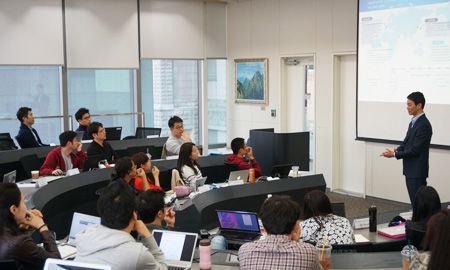
Park Keun-wan, a special speaker from AMOREPACIFIC, speaks about the company's global strategy during an Asia business insight class of Korea University’s MBA program at the school campus in Seoul, March 26. / Korea Times photo by Choo Sung-ho
By Choo Sung-ho
With the Asia-Pacific region emerging as one of the world’s most lucrative markets in recent years, the demand for learning the characteristics and culture of Asian countries has increased. However, many global business schools offer programs focusing mainly on companies based in Europe and North America, while only briefly introducing the world of business in Asia.
In response to the academic needs among those seeking to learn more about Asian markets and companies operating in them, three leading business schools in Asia — Korea and Fudan universities and the National University of Singapore (NUS) — launched the “S-cubed Asia” MBA program in 2008 in a bid to nurture Asian business experts.
“Since the S-cubed program, which lasts one-and-a-half years, introduces various business aspects that are not covered by U.S.-style MBA programs, future entrepreneurs who plan to do business in the Asian region will get the most benefits from this program,” said Yoo Yong-keun, an associate professor at Korea University Business School.
“Over three semesters, which last six months each, students registered at each of universities have the opportunity to study in three cities: Shanghai, Seoul and Singapore each semester. Once they finished their studies, they will receive dual degrees, one from their home university and the other from their preferred schools.”
The program not only offers basic management courses, but also provides a few Asia-specific courses designed to give students an in-depth understanding of the Asian business market.
Among the specific courses, a case method-focused course called “Asia Business Insight” can help students build strong understanding of business strategies of Asian companies succeeded worldwide. The best part of this course is that students get an opportunity to visit companies in China, Korea and Singapore and learn how the cases they learned in class can be applied in the real business world. The classes consist of special lectures, case development group projects and field trips.
On Mar. 26, this reporter visited Korea University Business School to attend a class and see how the course helps students develop business insight.
During the one hour class, Park Keun-wan, an invited speaker from AMOREPACIFIC, Korea’s largest cosmetics firm, gave a lecture on the company’s global strategy of making inroads into new markets. About 20 students from China, India, Korea and Singapore attended the guest lecture.
Park explained how the company’s positions each brand in the global cosmetics market as well as its strategy in the Asian region. He said AMOREPACIFIC has different strategies for each Asian country by targeting different customer segments.
The class was a little theoretical and felt like attending an information session of AMOREPACIFIC, but students familiar with the brands showed interests and actively participated in the class discussion.
Professor Yoo Yong-keun stressed that the lecture was just a brief introduction to the company and the main part of this course was to visit company factories and build relations with company officials.
He said students are going to visit some selected Korean companies such as LG Electronics, Hyundai Motor and Doosan Heavy Industries later in the semester. “Through a series of special lectures given by employees of Korean companies in class and on site, students will be able to gain a better business insight into Korean firms.”
Huang Wangjun, 30, a student from Fudan University in China, said the biggest benefit of this program is she can gain experience in the three countries. Prior to her MBA, she worked as a sales assistant at Ericsson for six years.
“Honestly, I don’t intend to get a job in Korea or other countries after this program because I want to work in China. I just applied for this program to get a new experience of living in other Asian countries and to upgrade myself in order to change my career following graduation,” Huang said. “Studying abroad is very refreshing for me because I had only studied in China. So far I am quite satisfied with Korea University’s facilities and curriculum.”
Kim Hyung-woo, 32, a former salesman at Pfizer, said he wants to change his career from pharmaceuticals to retail or hospitality after completing the S-cubed program.
“This program is an Asia-oriented MBA program, which is quite unique and special for those interested in working in Asian countries. I am looking for an opportunity to work at companies based in China or Singapore after studying,” Kim said.
When asked whom he would recommend this program to, professor Yoo said the course would be beneficial for those who run a family business and plan to enter China or Singapore.
“Students planning to get a job in China or Singapore can take advantage of this program. All three universities have their own career centers that provide support and guidance to students. They are also allowed to access other universities’ online career resources. There were a couple of Korean alumni who got a job in China and Singapore after the program.”