Unfinished work in BOK
By Kim Rahn
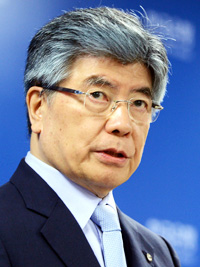
Kim Choong-soo Former BOK Governor
Bank of Korea (BOK) Governor Kim Choong-soo retired Monday after a four-year term, leaving his reform drives unfinished.
The outgoing governor was reportedly widely unpopular among insiders at the BOK, particularly those who opposed his radical reform measures. He has personally gone on record to admit how unpopular he is with some employees of the central bank.
Similarly, he has come in for criticism within the broad financial industry, for being poor at communicating with the market.
Nevertheless, it is undeniable that the reforms he implemented in the conservative organization are credited with elevating the BOK’s global status through his personal active participation in several major international forums where he was among several distinguished key speakers. He spent about a quarter of his four-year term on overseas business trips.
Kim also keenly encouraged his subordinates to acquire international exposure through various international exchanges. The number of BOK employees that participated in exchanges with international organizations and other central banks rose from five in 2009 to 13 in 2013. That of joint studies with foreign scholars also increased from one in 2010 to 65 in 2013.
“I believed BOK staff can contribute to the country’s development when they have not only internal but also global competitiveness,” he said in his farewell speech.
Kim, who has so far held senior positions in nine organizations, reformed the BOK’s traditional personnel system, which included among other things the appointment of outside experts to major posts, appointment of the first female deputy governor and placing a premium on performance over seniority in deciding promotions.
A former BOK worker said on condition of anonymity, “It is true the organization had a structural problem with promotion congestion of workers who had served for 20 to 30 years.”
But many people did not like the way the changes were made.
Lee Ju-yeol, the man to succeed Kim today, reportedly complained in 2012 before leaving the bank as a senior deputy governor that, “The BOK’s 60-year-old values and standards had been set aside and many people were confused.”
Kim was however defiant in defending his record, insisting he never sought to court praise in discharging his duties. “It might have been better if I were a head who satisfied all members of the organization, but I’ve never tried to do so. I did my best to set a goal and achieve it. I never hesitated,” he said.
“It is natural that people who have worked for an organization for a long time do not want unaccustomed work, so it is difficult to gain their support in pursuing reform. Also, repeating everyday work does not bring development. That’s why once-excellent organizations rarely last long.”
Communication controversy
Under Kim’s four year stewardship, the BOK’s monetary policy sometimes moved against market expectations.
In September 2010 for instance, he hinted at raising the base rate only to keep freezing it for an extended period of time. Critics claimed he buckled to the government’s demand to delay the rate increase until the G20 Seoul Summit ended.
In April last year, the BOK froze the rate when the market and the government wanted a cut for economic stimulus. But it cut the rate the next month, and the market criticized him for poor communication.
However, Kim rejected any claim of external pressure on the decision and further rebuffed the criticism of “wrong timing.” He said communication and forward guidance is not a usual communication tool but a means of economic policy.
“Some understand communication as a prediction of next month’s monetary policy, arguing why the rate is not changed this month but next month,” he said.
“It is not a central bank’s role to present the change of the short-term rate conclusively. Also, monetary policy takes effect months after the decision, so the long-term level of the rate is important. It is abnormal to carry out a monetary policy from a short-term perspective.”