Emerging market woes hit KOSPI
Ripple effects likely to be ‘short-lived’
By Kim Rahn
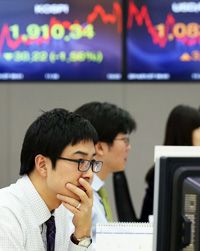
Dealers at the Korea Exchange Bank watch monitors at the lender’s dealing room in Seoul, as the KOSPI falls amid woes over financial turmoil in emerging countries, Monday. / Yonhap
The Korean stock market plunged Monday amid growing concerns over financial turmoil in emerging nations, especially in Argentina, as well as the U.S.’s additional tapering of its quantitative easing programs.
Experts and government officials say the Korean market will see downturn for a short time as the emerging countries’ troubles have hit financial markets around the world since last week, but the trouble is unlikely to have a direct influence on Korea.
The benchmark KOSPI once dipped below 1,900 right after the stock market opened, reaching 1,899.76. It marked the first time this year the index went down below 1,900.
It later posted a slight gain and closed at 1,910.34, 1.56 percent down from Friday.
Foreigners led the selling, dumping Korean stocks worth 520.9 billion won.
The tech-heavy secondary bourse KOSDAQ also dropped 2.46 percent to 507.51.
These followed declines in the U.S. and European markets last week, which resulted from worries about Argentina’s possible default. As the U.S. Federal Open Market Committee is forecast to decide on further tapering of its bond purchase programs at its meeting on Tuesday and Wednesday, it is concerned emerging markets may see more vulnerability.
Analysts and officials at financial authorities say it is unlikely that Argentina’s financial crisis will directly affect the Korean economy, as trades with Argentina account for only 0.2 percent of Korea’s total trade volume.
Instead, they pay attention to possible contagion of the crisis to other emerging nations, including Brazil or China. Some say capital may flow out from emerging markets and Korea, too, as many investors categorize Korea as an emerging country.
“If the financial trouble spreads here and there around the world, Korea may not be regarded as a safe haven anymore, unlike it was last summer,” Samsung Securities researcher Kim Yong-gu said.
Analyst Park Hyung-joong at Eugene Investment & Securities said, “Although the U.S. and European economies are recovering, their demands for imports are not growing fast. In this situation, if emerging markets’ financial turmoil slows down their growth, it will be negative to Korean exporters.”
However, Daishin Securities economist Lee Kyung-min said, “The KOSPI rose in mid-August when Southeast Asian countries suffered financial troubles, as investors saw Korea’s fundamentals as strong. This situation can make the Korean market look relatively attractive.”
Financial authorities say the market volatility is within the expected level, but they are closely watching the situation.
Finance Minister Hyun Oh-seok ordered finance-related ministries and public organizations to strengthen monitoring on emerging markets and pay more attention to risk management.
Vice Finance Minister Choo Kyung-ho said the ministry expected the KOSPI’s decline as stock markets in many countries including the U.S. plunged around 2 percent Friday amid concerns over emerging markets.
“Stock markets in major Asian countries dropped around 2.5 percent, but the Korean market saw a 1.5-percent drop, having relatively small volatility,” he said.
Choo said officials see little chance of the turmoil in emerging nations attacking Korea as Korea has good fundamentals, including a current account surplus and sufficient foreign reserves.
But he added the nation needs to keep watching how fast and how large the volatility will become, as there is possibility that the turmoil in Argentina will affect its major trading partners in South America and then further expands to the U.S. and eventually to Korea.
“We are checking contingency plans for various scenarios to cope with any signs of market turbulence,” he said.
The Financial Services Commission will also keep monitoring the global market during the Seollal holiday from Thursday through Sunday.