Vacation policies and leisure activities of major economies
By Kim Bo-eun
Korea is just beginning to realize the importance of upholding vacation policies in the workplace and is gradually taking measures to ensure workers get some rest. However, for decades, developed economies in the West have been treating vacations as an essential part of their work culture.
Vacation policies of major economies
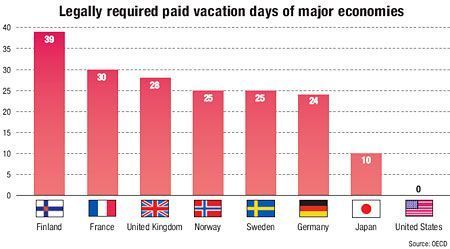
Some countries stipulate vacations as a right and duty of employees. Germany, known as the world’s top international tourism spender, gives a minimum of 24 days of paid vacation to employees who have worked for six months. The number of vacation days may increase according to the workers’ age and circumstances.
France, meanwhile, gives 30 days of leave to employees who have worked for a full year. For every month of work, employees get 2.5 vacation days. Workers under the age of 21 are given additional days off.
The United Kingdom gives 28 days of vacation to its workers. Employers encourage workers to take their vacations, and heads of departments at corporations can be subject to disadvantages if their workers are found not using their vacation days.
On the other hand, some countries do not have specific vacation laws. The United States, for example, has no federal regulations on employee vacations, and employers provide employee vacations at their discretion. In addition, the vacations are often unpaid.
Japan is another one of few developed nations that do not have an established vacation culture. Like Korean workers, only about 40 percent of Japanese workers use up all of their vacation days. However, since enforcing legislations in 2006, Japan has been encouraging workers to use up all of their vacation days.
Leisure activities in major economies
Countries where vacations have long been an important part of life have large and well-developed leisure industries. In such countries in Europe and the U.S., workers usually spend their vacations on family trips, outdoor leisure activities, and performance and visual arts activities.
Countries in northern Europe are known to have the most developed leisure activities. In Finland, for example, leisure is a central part of people’s lives; people work only 40 hours a week and take six weeks of vacation a year. The country’s natural environment composed of lakes and forests has contributed to the development of outdoor recreational activities. Households spend 10 percent of their incomes on such activities.
The Swedish take four weeks of vacation in the summer. Some 60 to 70 percent of the population is middle class; and because of the narrow income gap, most of the population enjoys leisure activities. In addition, public offices close at 4:30 p.m., giving employees much room for leisure.
In Germany, even the chancellor or head of state, takes four weeks of vacation in the summer. The media is discouraged from reporting about the chancellor’s vacation. Outdoor leisure, sports and the arts are big industries.
Norwegians hike, cycle, ride boats and enjoy marine sports in the summer and ski in the winter. Norway’s population of some 4.8 million own 400,000 private yachts, illustrating the popularity of marine leisure. Norwegians are also increasingly taking trips abroad.
In Russia, employees take two vacations per year, two weeks at a time. Russians often spend their summer vacations in dachas or country cottages. They also often attend performances at the Bolshoi Theatre.
In the Czech Republic, corporations usually give workers four to five weeks of vacation. The middle class enjoys weekend getaways at chatas, a type of vacation house. The beaches along the neighboring Croatia are a popular destination because the Czech Republic is a landlocked country. Skiing is the country’s most popular winter sport.
Leisure activities in Korea
Korea remains markedly behind other developed countries in terms of the scale of the leisure industry because it does not have an established vacation culture.
The household spending composition in Korea also differs from those of other developed economies. While northern European countries have established welfare and social safety systems, which has allowed people to spend a significant portion of their incomes on leisure activities, Korea does not, and thus, people spend much of their incomes preparing for retirement, paying for their children’s education and paying debts, leaving little for recreational activities.