Lufthansa seeks to be 'Korean-European' airline

Christopher Zimmer, general manager at Lufthansa Passenger Airlines in Korea. / Courtesy of Lufthansa Korea
German airline offers Korean travelers localized services with European touch
By Lee Hyo-sik
Germany is known for its serious, pragmatic and hardworking people. The country’s weather, characterized by year-round clouds, snow or rain, reflects its people’s optimism.
However, Christopher Zimmer, general manager of Lufthansa Passenger Airlines in Korea, is not your typical German. He is very much optimistic of his company’s and the global airline industry’s futures, despite the constantly increasing oil prices, intensifying market competition and other market risks.
“The airline industry has been facing a lot of challenges. It will continue to do so in the future,” Zimmer said in an interview with The Korea Times. “Carriers are consistently under pressure to cut costs and operate more efficiently. But this is the nature of the airline industry, which is very vulnerable to outside factors. It will continue to grow, despite all the difficulties.”
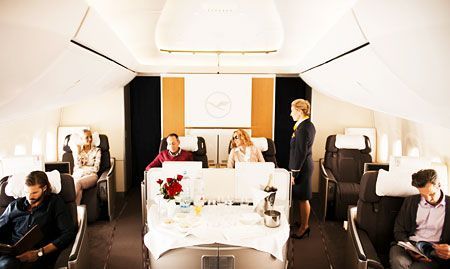
A first-class cabin at Lufthansa’s A340-600 plane
Localized products and services
Lufthansa’s presence in Korea has expanded significantly in the past 47 years, the general manager said, adding that the carrier will introduce innovative, localized products and services to attract more Korean travelers heading to Europe.
Lufthansa, which entered the Korean market in 1966, runs a daily flight between Incheon and Frankfurt, and six weekly flights between Busan and Munich. It operates an A340-600 aircraft on the Incheon-Frankfurt route and an A340-300 on the Busan-Munich route. About half of the passengers on these routes are Korean nationals.
The German carrier employs more than 100,000 workers worldwide and flies to 285 destinations in 102 countries from its hubs in Frankfurt and Munich.
“We want to be a ‘Korean-European’ airline by providing localized services and products with a European touch,” said Zimmer who came to Korea in February 2012. “We strive to offer localized services to Korean customers to make them feel as comfortable as they are at home. At the same time, we want them to have the exclusive European feeling on their way to Europe or vice-versa.”
Among the carrier’s localized services are Korean language services. Korea is one of Lufthansa’s eight official languages and there are more than 70 Korean-speaking flight attendants. Korean in-flight meals were developed by famous Korean hotel chefs in Seoul.
Korea is an important market for the German airline, Zimmer said. “Like other European carriers, we want to become a major carrier in Korea and other Asian nations because Europe is currently not doing well. Asia has been outperforming other regions in growth.”
To secure more Korean passengers, Lufthansa plans to boost its online sales and marketing activities. “Our early bird program, which sells tickets for those planning a trip in advance at heavily discounted prices, has been very successful. We will also continue to work with bloggers to help us promote our innovative and price-competitive products.”
Incheon International Airport has been another reason why Lufthansa has been expanding its operation in Korea, the general manager said.
“When I first arrived at Incheon Airport, I was very surprised at how efficient the airport functions. It operates very smoothly and offers users an extremely pleasant experience because its immigration and check-in processes are very fast and hassle-free,” he said. “Its state-of-the-art facilities also make the air travel much more enjoyable.”
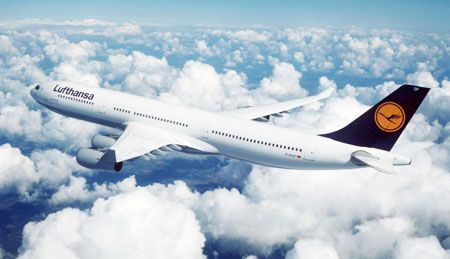
Lufthansa’s A340-600 aircraft flies between Incheon and Frankfurt
Extensive network
According to Zimmer, Lufthansa is the only European carrier serving Korea’s two main gateways — Seoul and Busan — and connecting them with the firm’s two main hubs — Frankfurt and Munich.
“One of our strengths is the vast network, which allows smooth connections and convenient schedules from Korea to more than 170 European destinations. This is what differentiates us from most of our competitors,” he said. “We excel not only by our extensive network but also in terms of airport facilities such as lounges. Together with our Star Alliance partners, we offer our passengers access to more than 900 lounges at airports around the globe.”
Over the next five years, Lufthansa will spend 17 billion euro to add 168 new highly-efficient and quiet aircraft to its fleet.
“Not only the fleet, but also in-flight and ground facilities and services will improve gradually. We are investing more than 150 million euro in new lounges and facilities,” Zimmer said. “ Lufthansa has been designated as the airline with the world’s best first-class lounge this year by Skytrax. Newly updated in-flight meals and seats are also receiving positive feedback from customers.”
Lufthansa is also prioritizing environmental protection by introducing fuel-efficient aircraft. For example, its new Boeing 747-800 planes are 15 percent more fuel efficient and 30 percent quieter than the older models.
The company has recently launched a low-cost carrier called Germanwings, which travels to various destinations in Europe. The budget carrier offers three types of fares, each with a different service package for business and leisure travel. Since January 2013, Lufthansa has combined its short-haul operations outside its main Frankfurt and Munich hubs with Germanwings. Germanwings is expected to carry about 18 million passengers this year.
However, the company does not have immediate plans to establish a low-cost carrier in Asia, despite the region’s booming budget airline market.
“We do not plan to set up an Asian subsidiary. We just cannot do everything. We first need to concentrate on our core European market,” Zimmer said. “In Asia, we will introduce a new-class ‘premium economy’ to our long-haul flights. This will substantially narrow the gap between the economy and business classes. The seats will appeal particularly to both business and leisure travelers seeking additional comfort at little additional costs.”