More employers expected to hire MBA graduates

Michelle Sparkman-Renz, director of research communications at the GMAC
By Kim Da-ye
If you expected the collapse of investment banks and sluggish recovery of the global economy to mean fewer jobs and lower salaries for MBA graduates, you are mistaken. Recent research by the Graduate Management Admission Council (GMAC) shows that the opposite is true.
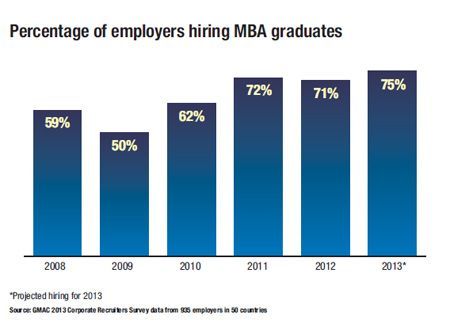
This year’s survey of more than 900 employers located in 50 countries around the world found that 75 percent of them plan to hire recent MBA graduates. This is higher than the 71 percent of respondents that actually hired B-school graduates in 2012.
Employers also expect to pay MBA graduates more this year. The expected median salary jumped to $95,000 this year from $90,000 last year in the U.S. This represents a $43,000 premium compared to a median salary for holders of bachelor’s degrees, according to the survey. The GMAC did not have salary statistics for Asia-Pacific companies, but found that 37 percent of them plan to increase base salaries for MBA candidates above the rate of inflation from 2012.
There can be a disparity between projected and actual results, but the GMAC interpreted this year’s survey outcome as a positive sign that the job market continues to improve for MBA graduates. Last year’s survey showed that 79 percent of companies were going to hire MBA candidates, but that 71 percent ended doing so. In 2011, 67 percent of respondents said they were going to hire MBA graduates, but 72 percent of them ended up recruiting from business schools.
The positive trend is quite clear. The portion of the firms that hired MBA graduates in 2012 is more than the 64 percent that did so before the global financial crisis hit the job market hard in 2008 and 2009. In 2009, the percentage dropped to 50 percent, a study of the GMAC’s past annual corporate recruiters survey reports found.
“We do see companies saying they are going to hire fewer bachelor degree holders. And fewer companies are telling us they are hiring directly from industry while they are hiring more MBA talents,” said Michelle Sparkman-Renz, the director of research communications at the GMAC, in an interview with The Korea Times.
“To me, it’s a signal that they make strategic hiring with very specific needs.”
According to the GMAC survey, the portion of the companies around the world that want bachelor’s degree holders inched down to 74 percent this year from 75 percent in 2012. The percentage of employers that plan to hire those with experience directly from industry remained the same at 77 percent during the same period of time. In the meantime, the demand for those who have Master’s degrees in business-related subjects other than MBA including management, accounting and finance all went up.
When the data is broken down according to region, the trend was more vivid in Asia than in the U.S. In Asia, 61 percent of the companies said they plan to hire MBA graduates this year — up from 54 percent in 2012. The percentage of employers seeking bachelor degree holders dropped to 69 percent from 79 percent in a year. The portion of those that plan to hire directly from industry climbed down to 71 percent from 73 percent.
“Companies told us in open comments that they want MBA graduates because they bring fresh ideas onto the table and because they want to make sure they have a talent pipeline in their organizations to follow,” said Sparkman-Renz. The director added that in Asia Pacific, the organizational goals are clear — they want to improve performance and productivity and expand their customer base.
The GMAC survey also found a surge in demand for MBA graduates in sectors that haven’t historically hired MBAs. Nearly 90 percent of companies in the healthcare and pharmaceutical sector said that they intended to hire MBA talents — a figure higher than the 77 percent of firms that actually hired business school graduates in 2012. The majority of companies in this sector are located in the U.S., the GMAC report said.
Another boost in demand for MBAs came from the energy and utility sector. In 2012, 69 percent of surveyed energy firms hired MBA candidates, and in 2013, 86 percent planned to recruit from business schools.
“Managerial expertise is something that can be utilized in the healthcare sector and the energy industry. In addition to the finance and accounting sectors, businesses need analytics, soft skills and strategic thinking, and these are what MBA graduates are leading with,” Sparkman-Renz said.
In another survey of MBAs and other graduates with Master’s degrees in business related subjects that came out at the same time as the recruiters research, 60 percent of jobseekers in the class of 2013 reported to have received an offer at the time of survey — down from 62 percent last year.
The report points out that the class of 2013 graduates who have already found a job had to work harder to get a job offer than those who graduated the previous year. Job seekers in the class of 2013 submitted a median number of 10 resumes and attended three job interviews for a return of two job offers, compared with the class of the previous year that submitted a median number of three resumes, had two job interviews and secured two job offers, the report said.
Furthermore, the survey showed that taking an internship or participating in work projects is the method that “yields the most job offers.”
In the U.S., Europe and Asia Pacific excluding China and India, internships were ranked first among effective job search methods, followed by business schools’ career services.
“I think the importance of internships is still a pretty new concept for some employers and students. That’s what students should focus on,” said Sparkman-Renz.