Economics of mine reclamation
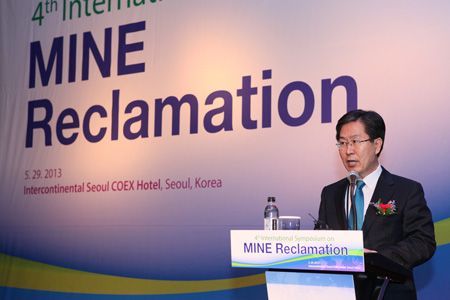
Kwon Hyuk-in, CEO of Mine Reclamation Corp., delivers a speech at the fourth International Symposium on mine reclamation in southern Seoul, May 29. / Courtesy of Mine Reclamation Corp.
Korea aims for share in potentially huge market
By Kim Da-ye
Mining may be a forgotten business in Korea, but the global rush for natural resources is more intense than ever.
In North America, there is much hype surrounding the massive reserves of natural gas trapped in shale. In China, coal remains a major source of energy while demands for rare earth elements that are essential for many modern technologies, including smartphones and rechargeable batteries for electric vehicles, continue to soar.
Mining, however, isn’t just about extracting valuable resources. A huge part of the business is rehabilitation of the closed mines to minimize environmental damage. The rehabilitation process includes restoring the forest, purifying water and soil and preventing the mined area from sinking. Mine Reclamation Corp. (Mireco), a state-run entity in charge of dealing with mine damage in Korea, estimates that the domestic mine rehabilitation industry earns some 100 billion won ($89.4 million) a year, and the global market generates $7.6 billion annually.
The Korean government expects that the market for mine rehabilitation will only grow. As resource-rich developing countries become richer, their citizens would pay more attention to environmental protection and mine damage.
“When a country’s gross national income reaches around $4,000, people start paying attention to mine damage, according to our estimates. The global mine reclamation industry is expected to grow six percent a year,” said Park Byung-chan, the head of the coal mining department at the Ministry of Trade, Industry and Energy.
Although the global rush for natural resources has been a pie in the sky for Korea, which has few resource reserves, Mireco’s aim is taking a good share of the global mine rehabilitation market.
In Korea mine damage has been dealt with differently from other countries. While developers are in charge of rehabilitating closed mines in most countries, such efforts have been led by Mireco, a state-run entity established in 2005. It is closely linked to the history of the Korean mining industry — the government closed down coal mines because of low profitability, so it has been taking care of the economy and environment of these regions with closed mines.
Kwon Hyuk-in, the CEO of Mireco, claims that Korea is the only country to set up a state-run company solely dedicated to dealing with mine rehabilitation, and this would help Mireco operate abroad.
“Governments wouldn’t easily trust private firms to carry out the rehabilitation jobs. Because we are a state-run company, foreign governments take us seriously,” said Kwon.
Mireco had its first overseas project in 2010 and has since entered 25 countries including Mongolia, Chile, Malaysia and Vietnam. One of the major overseas projects is investigating the state of mine damage in Mongolia and setting up an IT system to monitor it. The firm earned 2 billion won in 2011 and 15.6 billion won in 2012 from its projects abroad. These amounts are indeed tiny.
“The mining boom in Mongolia has many related issues — land and environmental damages, soil degradation and biodiversity losses. There is a huge potential for the market for the mine reclamation business,” said Tulga Buya, the Mongolian vice minister of the environment in a speech delivered at a symposium hosted by Mireco. “We have been learning about similar experiences from foreign countries where the mining sector is well developed,” he said.
When entering overseas markets, Mireco closely cooperates with the Korea International Cooperation Agency (KOICA), an official development aid arm of the foreign ministry. When the KOICA gives aid to developing countries, those that have a substantial mining industry but do not have a rehabilitation capability would ask for Mireco’s services and then pay Mireco with the aid money. After all, Mireco’s current overseas earnings come from the Korean government’s own pocket.
To expand its business beyond the recipients of KOICA’s aids, Mireco tries to get their own developed technologies accepted as the global standards. Kwon said that Korea was chosen as the administrator of the mine damage subcommittee at the meeting of the mining committee of International Organization for Standardization (ISO) held in Germany last month.
Mireco boasts that five Korean-style rehabilitation technologies are globally competitive. They include removing harmful heavy metals from mining wastes; purifying waste water with bacteria, the air and limestone; measuring land subsidence using optical cables as sensors; purifying soil polluted with heavy metals; and building a database of a mine’s features.
Another unusual feature of the Mireco’s mine reclamation model is that because it is a state-run agency, it also takes care of the economy of the region with closed mines. For example, Mireco is the largest shareholder of Gangwon Land, a casino-integrated resort located in Jeongseon, Gangwon Province. The resort, built upon a closed mine, has the country’s only casino that allows Korean residents to gamble. It has been raking in money since its opening in 2001, feeding the whole region.
The state-run company held a global mine reclamation symposium at the end of May and took foreign guests to the abandoned mine area in Kangwon Province for a field trip. The itinerary included a visit to the casino-integrated resort.
“One of the Korean model’s strengths is Kangwon Land. We not only restored a polluted area but also came up with economic measures to revive the local economy of the abandoned mine area. Foreign guests would be impressed by that,” said Kwon.