'Expect the unexpected'
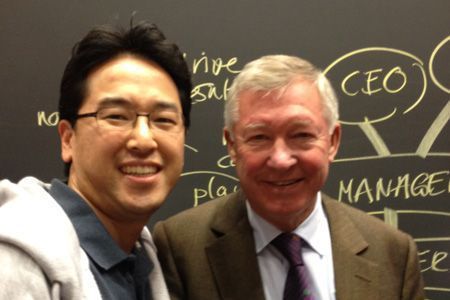
June Lim, left, product manager at Zynga and a graduate of Harvard Business School, poses with Sir Alex Ferguson, the former manager of British soccer team Manchester United, after a special lecture given by him at HBS on Oct. 9, 2012. Courtesy of June Lim
By Yoon Sung-won
June Lim graduated Harvard Business School (HBS), one of the most sought-after business schools in the world, in 2012. Before HBS, Lim built his academic background as a technology specialist by majoring in industrial engineering at Yonsei University in Korea, and worked as a small business marketing manager at Microsoft Korea for approximately three years.
Inspired by the lessons at HBS, Lim started a real estate business for about two years while he took time off from the school. Currently he is a product manager at Zynga, a global social network game developer.
In an interview with The Korea Times’ Business Focus section, Lim explained how his education at HBS helped him build a specialist career and advised future MBA students how to maximize their experience at a business school.
Q HBS is known to be one of the global business schools where only a small number of Koreans gain admission. How did you prepare for the admission process?
A Among applicants who acquired their bachelor’s degrees in Korea, only three to four get admission to HBS every year, and it’s true that the number is relatively small compared to other business schools. But when you add in Koreans who finished undergraduate courses in the U.S. after middle and high school education in Korea, it can be said that more Koreans are entering HBS in recent years.
Getting ready for HBS is very similar to applying to any other business school. You need minimum Graduate Management Admissions Test (GMAT) and TOEFL scores if you are not a U.S. citizen or did not attend undergraduate school in the U.S.
I believe the essay is the most important part of the application process. Professional achievements in renowned companies or a high GPA from top universities will be an advantage. However, many people I’ve met at the business school did not have a GMAT score over 700, which is considered mandatory to apply for top schools, especially among Korean applicants. What is more important is knowing who you are and what you want to do, and I think the essay is the best way to express those based on your life stories.
Q How did the lessons at HBS differ from those of other business schools? And what was special about its classes?
A I think HBS is very well known to use “case methods” in all classes. All concepts and theories are introduced through real business cases, and professors simply facilitate debate between the students. The greatest thing about HBS is that almost all of the cases used in class are written by HBS professors. Professors go through an extensive research process when writing a case and often have a very good relationship with the case protagonists. It differs by professor or what class you take, but it would be safe to say case protagonists come to class more than half of the time. Students get to hear behind-the-scene stories from them and also get to ask questions they had while reading the case. It truly is a great opportunity to hear from a wide spectrum of great minds — listening to Jack Welch’s thoughts on leadership and learning from Sir Alex Ferguson about how he has created one of the most valuable sports teams in the world.
Q What was your strongest impression at HBS?
A I was amazed by HBS professors’ dedication to teaching. They usually have a lot on their plates — sitting in board meetings, consulting for companies, doing research, etc. But they spend a lot of time especially at the beginning of the semester to memorize all the names of more than 90 students in a class. All the professors have large seating charts of their class on their office walls and some go as far as to memorize students’ backgrounds, such as where they came from and what they did before business school. Furthermore, professors do everything they can not to miss a class. When there is a forecast of heavy snow, professors will sleep at a nearby hotel to attend morning classes. One professor almost broke his nose by accident the night before a class, but still showed up next morning after getting treated in an emergency room, which amazed many students including myself.
Q Were there any particularly memorable lessons you would like to introduce to our readers?
A Professor Clay Christensen is a superstar at HBS and I learned a lot from the class he designed — “Building and Sustaining Successful Enterprise.” The class talks about why successful companies have a hard time maintaining their position for a long time, and proposes various theories that can be applied to diagnose and solve problems. For instance, when Intel was facing a challenge from AMD, his theories in disruption played a big role in deciding to introduce the Celeron processor. I find it amazing that many of companies’ decisions and behavior we see in newspapers can be explained using his theories and framework.
Q What led you to decide to work in your current workplace, Zynga? And how did your experience at HBS contribute to your career path?
A Zynga is not very well known in Korea but it is the largest social gaming company in the world. I decided to join Zynga because, first of all, I wanted to experience the mobile gaming industry which has grown fast and will continue to grow, especially in emerging markets. Also, I learned from Zynga’s data-driven approach. Zynga is known as a big data company disguised as a gaming company. Lastly, the company creates products which target the global market.
My MBA at HBS also helped me in starting my own company. Learning about entrepreneurship using many cases does not guarantee success, but has certainly helped me in keeping core principles such as controlling the negative cash flow at the back of my head and not making mistakes that are commonly made by entrepreneurs, and drive them out of business.
Q What would you advise for those who decide to take an MBA course in the future?
A I think it’s important to remember that an MBA is not an ultimate goal but rather a means to an end. Two years will go by really fast and knowing what you want to do after getting your MBA beforehand is really helpful. Once you know what you want, you’ll find lots and lots of resources, including conferences, classes and market research data, and come across people who will help you. It is a privilege as an MBA student to reach out to professors and the alumni network, and you’ll be surprised that most of them will be more than happy to help you out. Take advantage of that. For instance, I had a lot of interest in entrepreneurship and companies in Silicon Valley. Whenever I had a chance to visit the Bay Area, I reached out to HBS alumni working at the companies I was interested in, and could at least have coffee with most of them.
On the other hand, I think it’s also important to expect the unexpected and be ready to be flexible. The two years will be full of new lessons. People often use the expression “drinking from a fire hose.” You can open opportunities that you have never imagined before. I didn’t know that I would be able to meet with so many entrepreneurs and venture capitalists before going in, and these experiences allowed me to start a business after my first year of MBA.