Know what women want
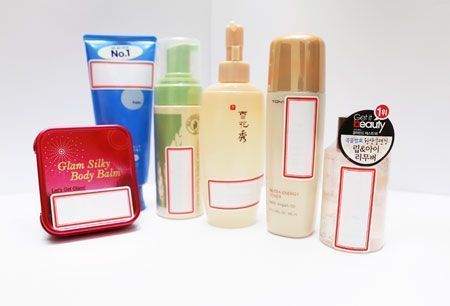
Korea Times photo by Yoon Sung-won
How cable TV program ‘Get it beauty’ became
powerhouse in Korea’s 7-trillion-won cosmetics market
By Kim Da-ye
On a recent Sunday afternoon, a television show that may define this summer’s must-have sunscreen products was being shot at a CJ Entertainment and Media studio in Gayangdong, western Seoul near Gimpo International Airport.
The staff brought onstage five sunscreen tubes that were wrapped in tapes of different colors to conceal the brands. They also distributed transparent plastic containers containing small portions of those products to the 50 members of the audience called the “Better Girls.” The three hosts and Better Girls would try the sunscreens for texture and scent without knowing their brands and prices.
The crew is filming the “Blind Test,” the flagship section of “Get it beauty,” a late-night show that focuses purely on improving appearance with makeup and skincare. The show is aired on OnStyle, a cable TV channel owned by CJ E&M.
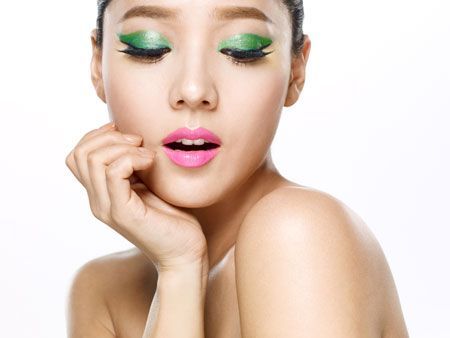
Eugene, the main host of “Get it beauty,” is now known as Korea’s “beauty mentor.” She has delivered lectures and wrote a book on make-up and even launched her own cosmetics brand. / Courtesy of CJ Entertainment & Media
“This isn’t sticky at all,” said Eugene, an actress and the main host of “Get it beauty,” as she rubs her hands against each other. Eugene, a former girl group member, donning a yellow sleeveless peplum dress, is more stunning in person than she appears on the screen.
“I like the second one. It’s the first time I have immediately liked a certain product,” said Kim Jung-min, also an actress and a supporting host, whose outgoing personality cheers up the mood in the studio.
The result of this particular test was already determined, as the real test was carried out a week ago on a sunny day at a tennis court. Forty members of a tennis club applied the products and were exposed to the sun between 12 p.m. to 3 p.m. They were then tested by dermatologists for how dry and red their skin was.
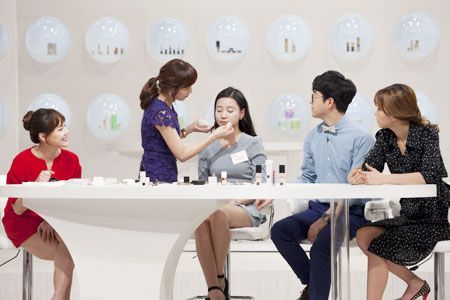
A make-up artist applies makeup on a “Better Girl,” a member of the audience.
As the trial session ended, the production staff brought five boxes marked from one to five. (The products aren’t identified in this article because the episode is yet to be broadcasted.) Hwang Min-young, a beauty editor for Allure magazine and also a supporting host, took out a tube from the fifth box and explained the product’s special features — he cannot mention the brand name under the broadcasting regulations, but the results would be uploaded onto the show’s website. As he revealed the price — the highest among the five — the audience sighed loudly.
The winner of the test is from a brand famous for sunscreens, while the second comes from a relatively little-known brand and has the cheapest price tag. Kim shouts, “Wow!” celebrating the unexpected result. “Because of its low price, you can apply it all over the body too,” Eugene commented.
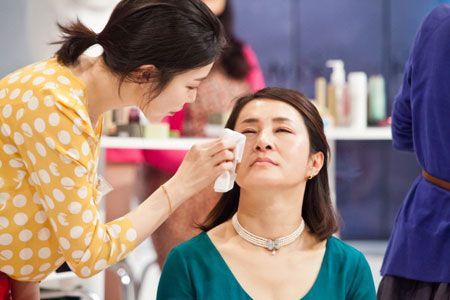
A daughter puts makeup on her mother’s face in an episode aired around Parent’s Day.
The results of a blind test often cause quite a stir in the cosmetics market. When a product is featured in this show’s blind test and is ranked the first or even among the top three, its sales skyrocket. That made the “Get it beauty” TV show one of the most influential forces in Korea’s 7-trillion-won cosmetics market. “The sales of the products featured in the blind test at least doubled or tripled after the tests were broadcasted,” said a manager at Tony Moly, a low-price cosmetics brand.
The manager said that today’s popularity of inexpensive cosmetics brands was triggered and fueled by “Get it beauty,” which proved in a series of trials that low-price products can outperform luxury ones. Many Tony Moly products have been featured in the blind test and awarded first places, for example, the Nutra-Energy Toner and the Floria Whitening Capsule Essence. “The show changed consumers’ perception toward low- and mid-price cosmetics,” she said.
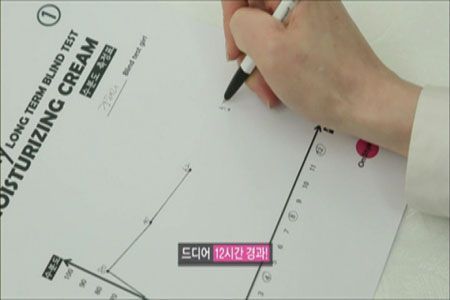
A researcher records the moisture level on a tester’s skin for the program’s long-term trial on various moisturizing creams.
Knowing what women want
The success of “Get it beauty” derives largely from two factors: it understands increasingly rational consumers who thoroughly research before buying a product, and it knows exactly what women want.
Last year CJ E&M developed a content value index that indicates how the audience evaluates the quality of a TV program and to which advertisers may refer. “Get it beauty” of OnStyle was ranked second after the entertainment show “Infinite Challenge” of MBC.
The show was credited for helping cosmetics consumers become more knowledgeable and make rational decisions rather than being influenced by brand names.
“When I was in my 20s, I preferred expensive cosmetics from luxury brands, but now I don’t. I buy both luxury cosmetics and inexpensive ones. For example, I want to get that [second-ranked] sun cream,” said Park, a 33-year-old sock designer and the mother of a 13-month-old baby who joined the show as a “Better Girl” on that Sunday.
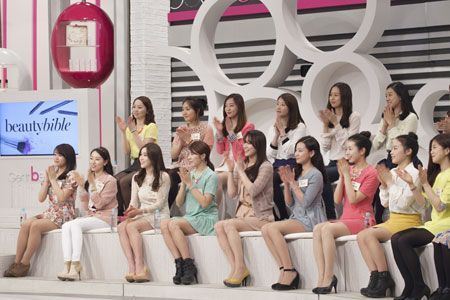
The audience of “Get it beauty” known as “Better Girls” actively participate in the show by trying out products and giving comments.
“When I watch the show, I become curious about what the products that won the blind test would be like. I’ve used some of the first-ranked inexpensive products, and they were really nice. Many successful purchases boosted my trust in the program.” Park said she spends 100,000 to 200,000 won on cosmetics a month. One of the first-ranked products she has bought is a Face It Velvet Skin Primer by The Face Shop, a mass-marketed brand of LG Household & Health Care.
The Tony Moly manager agrees with Park. “Korean consumers in the past preferred imported products from luxury brands. But when inexpensive, local products beat luxurious ones in the blind tests, consumers realized that prices are greatly inflated.”
While general consumers know the show for its blind test section, its fans like the show for the makeup and skincare tips that they couldn’t easily find otherwise. Park said that she liked the learning process where women in similar age groups share beauty-related concerns and find solutions together.
The blind test takes only a small part of the show. The larger portion of the show time is for makeup artists sharing their know-how for specific occasions such as modifying day makeup for a Friday night-out after work.
“Girls at my age either study or groom themselves. The latter has become very important nowadays, and we are very much interested in fashion and cosmetics. It takes a lot of effort to find related information in books or magazines. When it’s on TV, it’s easy to understand and follow,” said Kim Hyun-ji, a 21-year-old university student living in Seoul. Kim joined the show as a “Better Girl” on that Sunday, and she said it’s her second time to attend the show as a member of the audience.
“There is hardly anyone who does not know about the program. When a classmate attends the show and tells other students about her experience, everybody wants to do the same, so they apply to be part of the show online.”
Choi Ah-young, another “Better Girl” and a third-year college student, volunteered to test makeup made for those with acne. She said she’d been frequently checking the website and seized the moment and applied when the show was looking for those willing to test anti-acne programs for four weeks.
Many programs broadcasted on OnStyle are based on existing foreign programs, but “Get it beauty” has purely Korean-developed content. When asked how the production team finds out what women want nowadays, Choi Yun-jung, the producer of the show, said thatprobably because the team consists of only women — a total of 18 members in their 20s and 30s.
“Our program targets women aged from 20 to 34. The production team members are all young women, so we know what our target audience is interested in. There would be hardly any production team that consists of only women. I guess that differentiates the show from others,” said Choi.
Credibility is key
Once the results of blind tests are out, they spread quickly through the web of information outlets. Some companies write the results into press releases that become part of news articles. Bloggers republish the results on their websites. Cosmetics brands put a “Get it beauty” label next to the winning products both on their high street stores and online shops. Some brands even keep products broadcasted on “Get it beauty” together at a separate shelve.
There are many beauty awards and similar tests done by fashion magazines, but they are hardly as powerful. “Get it beauty” is the first TV show to test cosmetic products for their qualities with their brands and prices hidden. The test has also evolved to make the results more accurate.
The production of the blind test starts with selecting five products for the final assessment.
The members of the production team search for products that have been launched in the past year, discussed much by their peers or bloggers and searched frequently on the Internet. They make a list of 30 to 40 products, and the staff goes out to department stores or high street outlets to test them in person. They take notes and photos, which sometimes draws the attention of sales assistants. They avoid revealing their identities because cosmetic firms may try to intervene once they know that their products are under scrutiny of the production team. “We tell them we are bloggers writing about cosmetics,” said Choi.
The list is narrowed down to 10, which would be reviewed partly by experts and partly through online surveys. Choi said that the program has 30 makeup artists as advisors who carry out their own blind test to choose the final five products. Sponsors cannot interfere in the process. “When a product is ranked fifth in a blind test, it doesn’t mean that the product is the worst. It means it’s the fifth best,” said Choi.
“It takes a month to prepare for a blind test.”
Since Choi took the helm of the production this year, she has diversified the ways the blind test is done into three: the standard method carried out by the “Better Girls” at the studio, the “guerrilla” test and the long-term evaluation.
In the guerilla test, the production team finds an occasion that would need a particular type of cosmetics or skincare. For example, in the second episode of the program, the team visited actors in the musical “Grease” and made them try and rate lip and eye makeup removers.
For the long-term assessment, the program has recruited 25 “Blind Test Girls.” The girls recently tried moisturizing creams for how long they help the skin remain moist. The 25 girls stayed together for 12 hours and had their skin tested for moisture.
“The range of the products we can test at the studio by applying them on the back of the hands and on our faces is limited. We wanted to expand the range, so we came up with longer-term trials,” Choi said.
Controversy over product placement
“Get it beauty” runs up to 50 minutes and deals with grooming and makeup the entire time. Because the program avoids drastic methods such as plastic surgery, it involves a lot of cosmetic products. Except those for the blind test, the products used for makeup tips and other kinds of experiments are provided by companies that are eager to expose their goods on the influential show.
Cosmetics brands have to pay to place their products on the program, and the rates for that are known to be relatively high — it costs 16 million to 76 million won per episode compared to 300 to 500 million won for a 24-episode TV drama, according to local media reports.
The increasing use of product placement — a marketing strategy of indirectly exposing a brand by having its product used within TV programs or films — has been criticized by audiences, and “Get it beauty” isn’t free from such controversy. Back in June 2011, the Korea Communications Standards Commission ordered the program to apologize to the audience for encouraging them to buy a sponsor’s product.
In one instance, discussing slimming products of a particular brand, one of the hosts said, “I pigged out one night, and I thought going to sleep right away would let fat build up. When I apply this product, it can prevent fat from accumulating.” Slimming products’ effects, in general, haven’t been proved.
The watchdog regularly makes warnings against product placement, and numerous programs have so far received disciplinary actions. But “Get it beauty” received particular attention because of its nature. Such a controversy also led some consumers to believe that the blind test results are also influenced by sponsors. The producers have strongly denied that.
“The sponsorship team never gets involved in the production of the blind test. When cosmetics brands contact us regarding the blind test, we tell them it’s not within our domain,” an official in the business department at OnStyle said.
“Get it beauty,” however, doesn’t always have a control over maintaining its credibility. The “Get it beauty” logo is now seen on everything practically cosmetics-related, including magazines, high street cosmetics stores, online shops and even pharmacies. The brands that have placed products in the program also put the logo on the featured products even though they have not been featured in the blind tests. This practice may confuse consumers.
“Depending on the terms of sponsorship, some sponsors can use the logo and some cannot. Using the logo is, in principle, not allowed. We are monitoring to find any misuse of our logo,” the business department official said.
In another case, last year CJ O Shopping, a TV home shopping affiliate of CJ E&M, created a cosmetics-focused home shopping program called “Shopping Get it beauty” that copied some elements of “Get it beauty.” The business department official said, “As far as we know, ‘Shopping Get it Beauty’ is no longer aired because the audience can confuse it with ‘Get it beauty’ and because the ‘Get it beauty’ brand is being commercially misused.”
As the audience and consumers pay more attention to the commercial aspect of “Get it beauty,” the production team is certainly under pressure to improve the contents. Furthermore, celebrity-hosted programs that imitate some of the show’s elements — including singer Son Dam-bi’s “Beautiful Days” aired on the MBC Music cable channel — are popping up and competing against it.
One cosmetics company official commented that “Get it beauty” isn’t as influential as it was in 2012 and 2011 because it deals with similar topics repeatedly, and the blind test is no longer sensational in terms of novelty. “Exposure in the program used to be a big issue, but nowadays it doesn’t always lead to an increase in sales,” she said.
The production team of “Get it beauty” endeavors to maintain the show’s unrivaled reputation. The introduction of long-term trials of cosmetics is part of such efforts.
Choi said she tries to make the program easier to understand and follow. She also tries to add a story to the show. For example, in the episode broadcasted near Parents’ Day, mothers and daughters joined as “Better Girls” and shared what they want to do together before the daughters get married. One part of the episode was applying matching makeup for a mother and her daughter in a professional photo shoot.