No winners, only losers
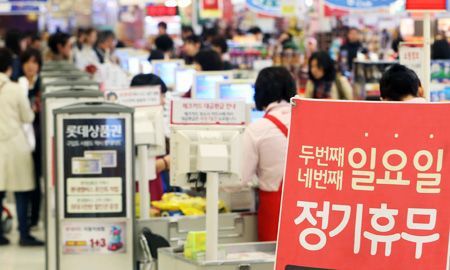
A sign notifying that the second and fourth Sundays of each month are off stands at a discount store in central Seoul. A year has passed since the twice-a-month closure went into effect. This was designed to protect mom-and-pop stores and traditional markets. But studies found that the measure has caused more harm than good to the parties involved. / Yonhap
Forced discount store closures hurt stakeholders
By Kim Bo-eun
It has been a year since regulations were put in place forcing discount chains and their affiliated supermarket chains to close twice a month. The idea was to protect mom-and-pop stores and local markets, which had been losing customers to the retail giants. Evaluation after a year, however, suggests that the measure has had a scarce effect, and has rather brought losses to all parties involved.
No winners, only losers
The measure was intended to encourage customers to shop for their groceries at smaller stores or local markets when the discount chains closed on the second and fourth Sundays of every month. But surveys show that only a minority of customers are actually doing so.
In a survey jointly conducted by The Korea Economic Daily and research firm Macromillembrain on 500 people aged 19 and over, only 19.6 percent responded that they go to traditional markets when discount chains are closed. Meanwhile, 41.6 percent said they prefer to stock up on groceries at discount stores on Saturday, the day before the retailers are required to close.
In an effort to attract more customers amid falling sales due to closure regulations, retailers have been offering incentives for shoppers to come on Saturdays. Offering greater varieties of discounted goods and multiplying customer points have certainly attracted more shoppers on the days before they close.
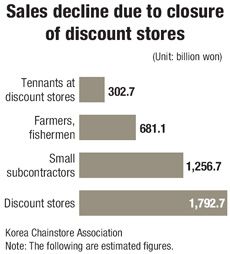
But their total sales have dropped miserably. According to the Korea Chainstores Association, the three major discount chains — E-mart, Lotte Mart and Home plus — incurred losses in sales of some 1 trillion won because of the mandatory closures over the past year.
Further, due to expected clashes with local merchants, the retail stores have also been holding back from opening new outlets. Only two new outlets opened this year, compared to 25 last year.
But local markets haven’t seen much improvement either.
According to the merchant association of Yeongcheon Market in northwestern Seoul, its increase in sales since the nearby Lotte Mart started closing twice a month has not been significant.
“There has been a slight increase in sales, but it hasn’t been remarkable,” said Lee Pyeong-joo, head of the association. “There have also been other efforts by the Seodaemun-gu office to promote traditional markets in the district, which may have contributed to this slight increase.”
Lee said a better alternative would be to regulate the kind of products that retail chains can sell, referring to a measure that was essentially scrapped a month after it was announced in March.
Seoul city had proposed a measure to ban discount chains from selling 51 items, most of which were fresh goods. However, it announced earlier this month that the measure would only apply to newly opening discount stores that face conflicts with local markets and smaller merchants.
“The items retail chains can sell should be regulated. They should let products such as ramen or alcohol be sold at traditional markets,” said Lee.
In contrast to expectations, the forced closures neither benefit mom-and-pop stores nor giant retailers. And subcontractors and consumers have become victims.
Jayunchon, a bean product producer that supplies discount stores, has let go around 100 of its employees over the past year due to falling sales.
“Sales have dropped by around 10 percent,” said Hong Yun-pyo, director of Jayunchon.
“Retailers make two to three times more profit on Sundays, because that’s when most working couples come to shop for their week’s groceries. So when the retailers close on Sundays twice a month, they are subject to huge losses in sales,” he said, explaining the devastating effect on suppliers like Jayunchon.
Farmers have been subject to losses as well. An organization of suppliers to retail giants is pushing forward with a constitution appeal as well as an injunction to revoke the revised Distribution Industry Development Law, which requires retailers to close on all national holidays.
Consumers are also negatively affected by the measure.
“I usually like to drop by the discount chain supermarket on my way home from church on Sundays. But when it is closed I either go without buying or go to a convenience store, which is more expensive,” said Kim, a 26-year-old office worker.
“Honestly, I don’t even know where the closest local market is, and I don’t think there are any close by,” she said. “The regulation seems pointless.”
Win-win strategy needed
The revised Distribution Industry Development Law enacted Wednesday requires discount chains to close on all national holidays, including two Sundays a month. However, the revision allows a change in the days they close if they reach an agreement with local merchants.
Cities in Gyeonggi Province have been making progress in negotiating with local market merchants and setting up a strategy in which the involved parties can benefit.
Since the end of last year, retail chains in Paju have agreed to close on the Sunday that falls on the five-day market held by local markets in the city.
This allows retail stores to operate on Sundays if they do not overlap with the five-day market period. Local markets benefit when retailers are closed. The retailers provide local markets with sales-promotion products worth 48 million won a year, as well as paying them public utility fees amounting to 18 million won.
Suyu Market in northern Seoul has a Lotte Supermarket inside the marketplace. The supermarket sells processed products and fresh products that are not commonly sold at the Suyu Market. Other fresh products are sold by merchants at the market. Lotte Supermarket delivers not only goods bought at its store, but also those from merchants at the market.
However, such efforts are not enough on their own, analysts say. Other measures also need to be taken.
“This issue cannot be addressed solely by regulating retailers’ operating hours. Rather, efforts should be made to make local markets more competitive, to attract more customers,” said Yu Byoung-gyu, executive director at the Hyundai Research Institute.
“The shopping environment should be enhanced, as should the quality of products and services sold there,” he said. “The government should support local markets so that customers can buy high-quality products with confidence.”