'Conference to help build trust'
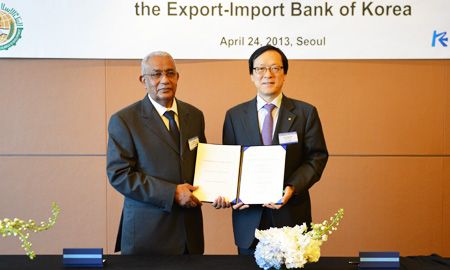
Korea Eximbank Chairman Kim Yong-hwan, right, poses with Abdel-Rahman Eltayeb Ali Taha, CEO of the Islamic Corporation for the Insurance of Investment and Export Credit, part of the Islamic Development Bank Group, during the MENA Conference 2013 after signing a memorandum of understanding on information sharing and joint financial support for projects. / Courtesy of Korea Eximbank
By Kim Rahn
Sponsors and contractors in the Middle East and North Africa (MENA) value the trust built through long-term relationships, so it is important to offer meeting opportuinities between them and Korean developers, said Kim Yong-hwan, chairman and president of the Export-Import Bank of Korea (Korea Eximbank).
The bank’s MENA conference was one such effort, along with other activities such as annual visits to power and infrastructure agencies in the region.
“We have to make endless efforts. We visit there, and also bring them to Korea and arrange meetings with Korean developers,” Kim said.
He said such efforts have enabled Korea Eximbank to issue $200 million worth of bonds in riyal last year.
Ten energy agencies and nine financial institutions from MENA participated in the conference, despite North Korea’s recent provocative acts, showing how much importance they attach to relationships with South Korea.
“The participants are all heavyweights in MENA, so Korean companies will benefit from this meeting,” Kim said.
In contracting mega-sized projects, the role of export credit agencies (ECAs) like Korea Eximbank has become huge ― in 2008 just after the global financial crisis, funding from ECAs and multilateral development banks (MDBs) accounted for 9 percent of such projects, but now reaches 26 percent, he said.
“It is an international trend: investment banks used to be funding sources, but they are not now after being hit by the crisis. ECAs and MDBs have filled the vacancy,” Kim said.
The chairman said MENA sponsors, including those from Saudi Arabia, said they were not previously aware of Korea Eximbank’s co-financing activities, but now they’ve learned and would place project orders with Korean companies if such financial support is available.
Speaking of the desalination industry, Kim said the sponsors view Korean companies such as Doosan, Samsung and Hyundai as lacking up-to-date technology for sea water reverse osmosis (SWRO). “But they said Korean firms have high-quality technology in other areas such as construction, so they would give more chances to them so that they can develop SWRO technology, too.”
Taking advantage of its experience supporting overseas projects for the last 37 years since its establishment in 1976, Korea Eximbank has intensified its financial support for projects in the MENA region and expanded cooperative networks with major agencies there.
At last year’s conference, 20 deals were made between sponsors from MENA, developers from Korea and international investment banks.
Earlier this month, officials of the bank visited some 30 government agencies, infrastructure companies and financial institutions in four Middle Eastern countries ― Turkey, Saudi Arabia, UAE and Qatar.
In the UAE, the bank signed a memorandum of understanding (MOU) with General Holding Corp., the country’s state-run company with nine affiliates in energy, chemicals, steel and construction. One of its affiliates, Emirates Steel Industries, is expected to continue to place orders for steel manufacturing facilities with Korean companies.
In Saudi Arabia, where 75 percent of Korean firms’ development projects in the Middle East took place last year, the bank suggested new business models to state-run Saudi Arabian Mining Company (Ma’aden), Saudi Electricity Company and ACWA Power International.
Last September, the bank held a Korea Eximbank Seminar for Ambassadors Representing Middle East and African Countries, for diplomats from 21 nations, including South Africa and Nigeria.
It also co-hosted the Korea-Africa Economic Cooperation Conference in October with the Ministry of Strategy and Finance and African Development Bank.