Banking groups' profits halved
By Kim Rahn
The nation’s four major banking groups are expected to be hit by “earnings shocks,” with their profits estimated to have halved in the first quarter due to a myriad of negative factors, such as falling interest margins and rising loan-loss reserves.
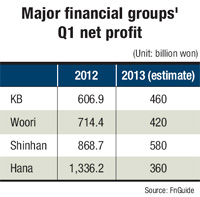
According to earnings outlook reports compiled by FnGuide, a local financial information provider, four financial groups ― KB, Woori, Shinhan and Hana ― are forecast to record a net profit of 1.82 trillion won ($1.6 billion) between January and March, about half last year’s 3.52 trillion won.
KB Financial’s net profit was 606.9 billion won in 2012 but is expected to decrease by 24.2 percent to 460 billion won this year.
Woori, which recorded 714.4 billion won last year, may see a 41.4 percent drop to 420 billion won.
Shinhan’s profit marked 868.7 billion won but is forecast to be 580 billion won this year, down by 33.1 percent.
Hana recorded a remarkable 1.33 trillion won in net profit following its takeover of Korea Exchange Bank in February of last year. However, it is forecast to earn just 360 billion won this year, a 72.8 percent decrease.
Others expect actual profit may be even lower than the estimates. “We are collecting those firms’ first quarter performances, and it seems their performances will be poorer than expected. One company says its profit is more than 100 billion won less than the stock companies’ estimate,” a Financial Supervisory Service official said.
Market watchers say the major cause of such a poor performance is the small net interest margin (NIM), a key gauge of lenders’ incomes gained from interest rates.
“With the base rate lowered twice last July and October, the NIMs of the banks, which are biggest arms of the financial groups, have kept falling. Companies have not been seeking loans from the banks either because of the sluggish economy,” said Kim In, a researcher at Eugene Investment & Securities.
The financial groups have had to set up a large allowance for bad debts, as companies such as Ssangyong and STX, which had huge loans from the banks, faced restructuring due to liquidity crises, Kim said.
“Credit card arms of the groups were also forced to reduce commissions as the government pressured them to do so in an effort to relieve the financial burdens on small firms and shops,” he said.
Kim said the situation was unlikely to improve soon. “They will not be able to reduce the allowance for bad debts. It is also almost impossible for them to reduce other expenses, such as labor costs.”
He expected interest rates to slowly increase in the latter half of the year. “The banks’ NIMs are unlikely to rise, but at least they may not go down but remain flat from the third quarter,” he said.