'Tyranny of GDP should end'
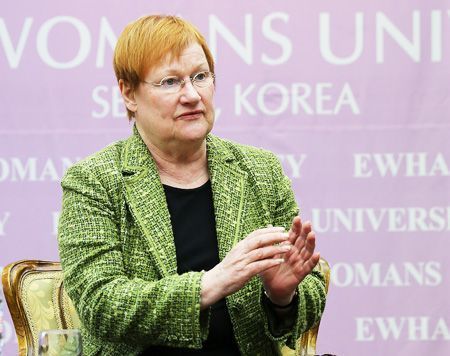
Tarja Halonen, the former president of Finland, answers to a question during an interview with Business Focus at Ewha Womans University, Seoul, March 25. / Korea Times photo by Yoon Sung-won
Former Finnish president reiterates welfare is investment
By Kim Da-ye
Gross domestic product, the value of goods and services produced in a country, is not a perfect indicator of economic development, a former president of Finland said.
“We need to measure the economic — but also the social and environmental — dimensions of development,” said Tarja Halonen, Finland’s former president, in an interview with The Korea Times’ Business Focus. Halonen is the first female president of the Nordic country, serving for 12 years from 2000 to 2012. She was a very popular president, with an approval rating that peaked at 88 percent in 2003.
In terms of GDP, Finland’s economy is smaller than Korea’s. According to the 2012 estimate by the International Monetary Fund, Korea has the 15th-largest economy in the world with a GDP of $1.15 trillion won, while Finland has the 41st with $247.19 billion.
However, Halonen feels GDP is not a sufficient measure of a country’s well-being. She states that the welfare system, a crucial part of the Finnish economy, should also be taken into account. “Counting the GDP is not enough. It’s not the only important issue. I am very happy that the United Nations has created its own indices on welfare. Just like all the Nordic countries, we also invest in people, and doing so will guarantee economic growth in the future,” said the former president.
Nevertheless, Finland has some advantages. It was ranked the third-most globally competitive among 144 countries in 2012 by the World Economic Forum (WEF). Meanwhile, Korea was ranked 19th. Finland was also ranked the fourth-most innovative country by the WEF, while Korea was ranked 19th.
Welfare is investment
In Korea, the word “welfare” carries a somewhat negative connotation. It is often associated with massive government spending, increased sovereign debt and loss of economic competitiveness in the long term.
Halonen has a different perception. “A welfare state is good in order to achieve sustainable development because it’s an investment in people,” Halonen said. “In order to create economic growth, you need financial capital as well as human capital.”
The welfare state Halonen refers to isn’t just about providing sufficient monthly allowances for the elderly or comprehensive health care. She said that the basis of welfare is education.
In 2009, Finnish students placed first overall in the Program for International Student Assessment (PISA), an assessment of students from 71 countries. Korean students came in second in the assessment’s reading, mathematics and science sections. The PISA is conducted by the OECD.
Furthermore, Finland has the second-best quality of education, right after Switzerland, according to the WEF’s Global Competitiveness Report for 2012–2013, while Korea’s is ranked 44th.
Judging by the numbers only, Korea doesn’t spend less on education or welfare than Finland does.
This year, Korea has allocated 97.4 trillion won to welfare, health, employment and housing support; 49.8 trillion won to education; 5 trillion won to culture, sports and tourism; and 34.6 trillion won to defense.
In comparison, according to Statistic Finland, the Ministry of Education and Culture in 2013 has a budget of 6.6 billion euros, while the Ministry of Social Affairs and Health has more than 12.5 billion euros. The latter ministry provides social and health services, income security, insurance, occupational safety and gender equality. The country’s budget for education and welfare combined easily dwarfs the country’s defense budget of 2.78 billion euros.
Korea’s government debt-to-GDP ratio also appears to be healthier than that of Finland.
In Korea, the debt owed by central and municipal governments more than trebled from 148.1 trillion won in 2003 to 468.6 trillion won in 2012, which is 37.9 percent of GDP.
In Finland, the central government’s debt as a percentage of GDP peaked at 66.7 percent in 1996, but steadily declined to as low as 29.3 percent in 2008. It climbed up to 41.6 percent in 2011 after the global financial crisis. One big trend is that the percentage of the general government debt, which includes liabilities of municipal governments, soared from 12.5 percent in 1990 to 93 percent in 2011.
Investment in women
To achieve a successful welfare system that does not compromise economic competitiveness, Halonen said the government should provide equal education for men and women. But what if a significant portion of the educated women decide to focus on their families and give up work? That’s where the difference between Finland and Korea lies.
According to the WEF, in 2010, Finland’s women-to-men ratio in the labor force was 0.95. The country was ranked 11th among 144 countries in terms of female participation in the labor force _ the countries that had a higher ratio were all African nationals expect Lithuania. In the same year, Korea had a women-to-men labor force ratio of 0.72 and was ranked 94th in female labor force participation.
“We have estimated that when women entered more freely into the labor markets in the Nordic countries in the 70s, it contributed to a growth of 40 percent of the GNP,” Halonen told the students of Ewha Womans University during the school’s chapel service last Monday. The former president received an honorary doctoral degree from Ewha in April 2002 and has visited the institution three times since.
In order to fully reap the benefits of educational spending, Halonen said that the government and society should help with child care. The key to successfully balancing child rearing and a career for women is the right spouse, Halonen said. “You have to choose a suitable spouse who understands you and encourages your career and is ready to share your duties at home,” Halonen said.
When women and men both want to have a career and a family, the state and society should step in, firstly by providing parental leave that usually lasts one year. The former president said that mothers should take the first three months off, and then they or their husbands can take further time off afterward. Although women usually choose to stay at home, Halonen said that some companies have “daddy’s month” policies that guarantee full child care leave when fathers take time off to be with their children.
Halonen said that another way the state and society can support women is to provide their children daycare and meals. “The very simple solution is that when children are at school, they have warm school meals without making them pay for it. That way, you don’t need to worry when your child is at school,” Halonen said.
Employment quotas should be for both genders
Finland was among the first to adopt a gender-quota system in state-owned companies. In 2004, the Finnish government decided that 40 percent of the board members of state-owned companies should be women. According to a report by the European Women’s Lobby, the portion of women on such boards in Finland jumped from 30 percent in 2004 to 40 percent in 2006 and further to 45 percent in 2011. As of 2011, in the self-regulated private sector, women made up 26 percent of the board in the largest companies and 18 percent in all listed companies.
“Equality between men and women is a human rights issue, but it is also smart politics,” Halonen said. “Many studies indicate that companies that are led both by women and men yield better economic results. Also, the working atmosphere is better than in companies led only by one gender. These results apply also to the public sector.”
To ensure gender equality, Halonen said that the gender quota system should apply to men as well, especially in areas where men are underrepresented. One example is the education sector, which is currently dominated by female teachers.
Halonen recalled when a male member of the parliament doubted the effectiveness of the gender quota. “I told him, ‘My dear, it may be good for your son. He started laughing. The gender quota should be done both ways,” said the former president.
Halonen also recalled that when she ran for president in 2000, there were more female candidates than male candidates. “Nobody mentioned it, but everybody knew that the election was about gender. When I became elected, I received thousands of letters written by small girls who said, ‘Wow, I want to become president, too.’ A little boy also wrote a letter, asking ‘Is it true Mme. President that boys no longer can become president? I said that it’s not true, and that boys can also become president,” Halonen said, laughing.
“Now that we have a male president again, I tell girls that once is not enough.”