Economic slump hitting self-employed hard
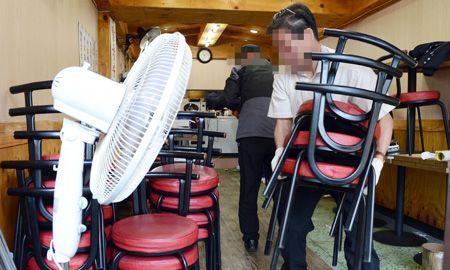
Owners of a restaurant in Seoul remove chairs and tables from the premises after the business failed. / Korea Times file
By Kim Rahn
Shin Ji-chul and Kang Ja-young, a couple in their 60s, run a small restaurant in northern Seoul. They started it two years ago after closing a cafe they had previously owned after Shin retired following 20 years at a pharmaceutical company.
They put up all their savings of 250 million won for the business and pay 2 million won in rent every month.
The business seemed to be a success at first but the number of customers has dropped.
“I think the economic slump has affected people’s eating patterns. We sell a bowl of ramyeon with two rice balls at 4,000-5,000 won, and people are unwilling to pay that amount these days, seeking cheaper snacks,” Kang said.
The couple used to have three part-time employees but recently cut the number to two. “When opening this place, we expected to earn over 3 million won a month. But it’s more like 1 million won these days. And the building owner said he wants to raise the rent when we renew the contract in June,” she said.
Many people, especially baby boomer retirees like Shin and Kang, look to start their own businesses such as restaurants, cafes, bars, bakeries or convenience stores. However, reality is harsh, as seen in this couple’s case.
The sluggish economy may be one of the reasons for the difficult situation for the self-employed with public consumption at a low level.
But experts point to competition among too many self-employed people as causing their own problems.
In 2010, the self-employed accounted for 28.8 percent of the total workforce, much higher than the OECD average of 15.9 percent, according to a report by Hyundai Research Institute (HRI) last year. Self-employment here includes self-employed people and unpaid family members working for them.
“It is the fourth largest figure among OECD member nations. As self-employed people make less money than salaried workers on average, the high ratio of self-employment means the quality of employment is low,” said HRI researcher Kim Gwang-suk.
Another report by the Samsung Economic Research Institute also showed that Korea saw a 2.29 million oversupply for self-employment when compared with other OECD nations with similar per capita income to Korea’s.
The oversupply has peaked and is finally coming down as the number of self-employed people in January dropped by 21,000 from a year before, according to Statistic Korea. It was the first year-on-year reduction in 18 months.
Business shutdowns have followed one after another amid the oversupply. According to a report by KB Research last October, 47 percent of 5.83 million self-employed people shut their businesses within three years of opening between 2001 and 2012. Only about a quarter maintained their operations for 10 years or more.
Kim of the HRI said baby boomer retirees start their own businesses without enough preparation and that leads to failure.
“Most of them still have to pay childcare expenses or tuition for their children. So, if they don’t get another job a couple of months after retirement, they look to open their own business. Without enough time to consider which business suits them, they rush to start bakeries, pubs or fried chicken restaurants. Competition grows and their earnings drop,” he said.
As part of the solution, Kim said those wanting to open their own business should not recklessly do so but wait until they learn know-how of the industry.
“For example, those wishing to open a restaurant can work for other restaurants for six months to a year and learn about the business before starting their own. The government also should help existing self-employed people hire more workers rather than increasing the number of new small businesses,” he said.