Inspired by women, inspiring women
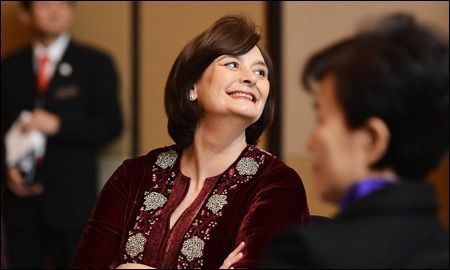
Cherie Blair, center, attends a fund raising event, organized by the Asian University for Women (AUW), at the Millennium Seoul Hilton hotel, central Seoul, Jan. 31. Blair, a lawyer and the wife of the former British Prime Minister Tony Blair, is the chancellor of the university, in Chittagong, Bangladesh. At right is Kang Kum-sil, a former justice minister. / Korea Times photo by Shim Hyun-chul
Cherie Blair talks about family, career and charity
By Kim Da-ye

Cherie Blair hugs her husband, Tony, outside No. 10 Downing Street in London, shortly after his election as Britain’s prime minister, in this May 2, 1997, file photo. / AP-Yonhap
Cherie Blair, a successful human rights lawyer and the wife of former British Prime Minister Tony Blair, made it clear that she has no intention of entering a career in politics.
“I was actually very lucky, because I had all the politics I wanted in my life through my husband. And I have no desire to start all over again from a backbench MP (Member of Parliament),” Blair said in an interview with Business Focus.
Instead, Blair has found alternative ways to promote issues she is passionate about, mainly through charities and philanthropy. She was awarded a Commander of the British Empire (CBE) this year for her services to women’s issues and charity works.
One of her latest interests is the Asian University for Women (AUW), a women-only university located in Chittagong, the second-largest city in Bangladesh. Blair has been the chancellor of AUW since 2011, after serving two years as the institution’s patron. The liberal arts university provides free higher education to some 500 students from parts of Asia that lag behind in women’s rights.
Blair visited Korea last month to attend the Special Olympics held in PyeongChang, Gangwon Province, and to help raise funds for the AUW. The following interview took place in a stately executive suite on the top floor of the Millennium Seoul Hilton Hotel on Mt. Nam, central Seoul.
When The Korea Time’s Business Focus reporter arrived, Blair was sitting on the sofa wearing a sleeveless navy dress with a colorful shawl around her shoulders. She greeted the reporter warmly and invited her to sit beside her on the sofa.
What drew Blair into the chancellor position at AUW is deeply rooted in her personal experience.
“I was the first person in the family to go to university. The idea of education transforming the life opportunities of young girls, I lived that dream myself,” she said.
Now a multi-millionaire with her own charity, the Cherie Blair Foundation for Women, Blair candidly recalls the difficulties she went through as a young girl.
Both of her parents were actors. Her father left the family when she was eight and her sister was six. Her mother and paternal grandmother together raised her and her sister. Her father, even after success on the stage and the screen, barely supported the family. He later fathered six more children and married three more times. Blair called him “a successful actor and a successful womanizer,” adding that he was “a very charming man. I am very fond of him.”
In her autobiography “Speaking for Myself,” Blair describes her childhood in a financially struggling working class family in Liverpool. She excelled in her studies, and that helped her become recognized as one of the most influential women in the world. In 2004, business magazine Forbes ranked her the 12th most powerful woman in the world.
Blair studied law at the London School of Economics and Political Science (LSE) and graduated with first class honors, the grade equivalent of summa cum laude in the U.S. or a GPA of 3.7 to 4. She came in the top of her year in the bar exams and became a barrister.
Having always been the odd one out in her family as well as in society, Blair feels close to the young women at AUW. Some of the students come to the university though they know it will jeopardize their chances of finding a suitor.
“My daughter has just qualified as a barrister,” Blair said. “When I was qualified, about 10 percent of the law students were women. When she was qualified, it (the ratio of women to men) was 50-50. Over the course of 30 years, things have changed. But the students at AUW who we are reaching out to are certainly nearer to my situation rather than my daughter’s. I feel an affinity with them and perhaps they can relate to me.”
In addition to serving as the institution’s chancellor, Blair has given fellowships to 10 students each year since January 2010.
While at Downing Street, she wrote a book about British prime ministers’ wives. She relates an anecdote about Dorothy Macmillan, the wife of Harold Macmillan, who led the country between 1957 and 1963. Dorothy Macmillan told her daughter not to go to university because that wouldn’t help her find a husband. “That attitude, we still see it around the world,” said Blair.
Blair said that women in developing countries should be given opportunities not just for primary and secondary education, but also for tertiary education. Access to tertiary education, she believes, will boost women into the ranks of the elite and allow them to become leaders. The liberal arts emphasis of AUW is what the young women from the suppressive countries need, she added.
“We try to give the students confidence. If you are young women from Afghanistan, Cambodia or some other countries, you are told you shouldn’t have confidence. Absolutely, you must believe in yourself,” she said.
Blair was the first prime minister’s wife to have her own career in Britain. “When we first got married, we were both lawyers,” she recalls. “Then he gave up law in 1983 to become a politician. At that time, because I was still a lawyer, I ended up earning more than he did. From 1983 right to 2007, I was the bigger earner.”
While she remains a part-time barrister, Blair sees herself as a businesswoman who is self-employed and is running a nonprofit business, the Cherie Blair Foundation for Women.
In the U.K., lawyers are divided into two classes. Barristers speak on behalf of clients in the courts while solicitors deal closely with clients by giving them legal advice and preparing documents. Barristers, supposed to be self-employed, form a type of cooperative, which is a de facto law firm and is called a chamber. Blair is a founding member of the high-profile Matrix Chamber. At work, she practices under her maiden name, Booth.
When asked why the Cherie Blair Foundation focuses on business matters such as female entrepreneurs and technology, Blair said that “lawyers and businesses aren’t that distant from each other” because barristers are self-employed. She added that she believes financial independence for women is very important.
Her career focus and drive are related to her mother’s role in her life. “At 14, she had to leave the school because her own mother died, her father was a miner and she had a 10-year-old brother.
She made a sacrifice then, and she had to make a sacrifice again in her 20s when my father left her,” Blair said. “My mother had to go to work while raising the two daughters. I saw her struggle to make the ends meet. She made sure that my sister and I have the opportunity ... She has done a fantastic job.” In her autobiography, Blair describes how her mother worked three shifts between 10 a.m. and midnight at a fish-and-chip shop to support her family.
While serving as a barrister and the first lady, Blair raised four children. The youngest son, Leo, was born in 2000 during Tony Blair’s leadership. She became pregnant again in 2002, but it ended in a miscarriage.
Blair said that technology was crucial to juggling her career, charity works and child care. She also, of course, had nannies to help rear her children.
“Without technology, I would have never been able to keep going with my career when my husband became prime minister, and even before that, when I had three children and a job,” Blair said.
“I was a very early convert to technology, and I was the first chairman at the bar information technology committee in my country. And I feel fortunate women like me could use technology to cope with being both a mother and a career woman.”
Blair’s visit to Korea was a success for the AUW, which has now expanded its network to include the education and business sectors here.
On Feb. 1, the university signed a memorandum with Ewha Woman’s University for future cooperation. Both universities are going to run exchange programs for professors and students while the Korean women-only university will provide scholarships every year to selected AUW students who wish to pursue post-graduate degrees.
The AUW currently offers only undergraduate programs although many students wish to pursue a master’s degree. The “Ewha Global Partnership Program” will enable them to do so by covering awardees’ total cost of education, including tuition, living expenses and airfare.
Another outcome of Blair’s trip to Korea is the partnership with the Export-Import Bank of Korea, or Korea Eximbank, which will provide AUW students with summer internship opportunities. The bank will cover costs associated with internships such as travel and housing.
Behind the achievements is Kim Young-joon, a Korean-American lawyer who chairs the Asian University for Women Support Foundation, a fundraising body.
Blair continues to travel around the world to publicize and get support for the AUW, whose students are all on scholarships.
“The passion they have that they want to change the world is very inspirational,” she said.
“I don’t want to see that thirst for change to be quenched.”