Korea posts 1st surplus in culture account
Experts say economy becomes service-oriented
By Kim Rahn
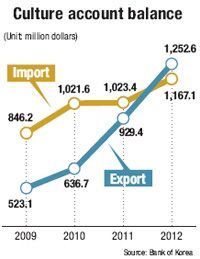
Korea posted a first-ever surplus for its culture account on the back of soaring exports bolstered by “hallyu” or the Korean Wave, the central bank said Tuesday.
According to the Bank of Korea (BOK), the country exported cultural content worth $1.25 billion in 2012 and imported those worth $1.16 billion, resulting in an $85.5 million surplus.
This is the first time for the country to see a surplus in that account since it began compiling related statistics in 1980. The account tracks data of imports and exports of films, television programs, animation, music and games.
Korea saw deficits of more than $300 million in the sector every year for a decade but exports rose significantly in 2011, reducing the deficit to $94 million, and the balance finally turned to a surplus last year.
“The earnings for dramas, music videos and songs almost doubled from 2010 to 2011 in line with the boom of idol K-pop groups’ overseas concerts,” said Samsung Economic Research Institute research fellow Seo Min-soo.
The BOK data also showed hallyu content was the main cause of the surplus. Until 2010, Korea imported a lot of Hollywood films and American pop music. Yoo Jin-ryong, dean of the Catholic University’s Hallyu Graduate School, said the surplus shows Korea’s economic structure is changing to become more focused on the services industry.
“Previously, most Korean cultural content wasn’t competitive, except for online games. But as K-pop has gained popularity in recent years, especially with singer Psy’s mega hit ‘Gangnam Style,’ the Korean culture industry has become confident that its content is competitive enough to succeed in the global market. Such experience and confidence will help continue the surplus,” he said.
Brazilian Joyce Mourao learned about Psy last year, as his “Gangnam Style” became an international hit. She downloaded the song from iTunes and watched the music video on YouTube.
“I like the rhythm, although I don’t know what the lyrics mean. I’m awaiting his next song and I may try listening to other Korean pop songs,” she said.
Mourao’s download was one of over 4 million digital sales of the track. It is said that Psy earned about 8 billion won ($7.3 million) from the song sales alone, not counting advertising revenue and other income from appearances abroad.
Not only K-pop but also Korean films are gaining more popularity overseas, recording $37.8 million in exports last year, up 8.4 percent from a year before, according to the Korean Film Council.
Experts forecast such growth in the nation’s culture industry exports will continue.
Han Koo-hyun, president of the Korean Wave Research Institute, sees a growth engine not only in K-pop but also films. Last year, Korean films drew more than 100 million moviegoers here, with “The Thieves” and “Masquerade” each surpassing 10 million viewers, while director Kim Ki-duk’s “Pieta” won the Golden Lion award at the Venice Film Festival.
“Among hallyu businesses, movies have been a weak sector, falling behind soap operas and K-pop. But now that area is expected to grow rapidly this year not only domestically but also abroad,” Han said.