Preventing blackout
.jpg?w=728)
/ Courtesy of KEPCO
KEPCO CEO Cho Hwan-eik talks about rate hikes, nuclear power plants
By Kim Da-ye
In the CEO’s meeting room at Korea Electric Power Corporation (KEPCO), an electronic screen hangs between two glass windows. Beyond the windows lies a view of southern Seoul.
At around at 2 p.m. last Wednesday, red digits on the screen, indicating the consumption of electricity across the country, hovered around 71 million kilowatts. Yellow digits, indicating the amount of backup power — the maximum supplying capacity minus the consumption — stayed at about 9.4 million. The amount of backup power compared to demand was more than 13 percent. This would be adequate in case of emergency.
“It indicates that people are supporting the energy-saving campaign better than we expected,” said KEPCO president and CEO Cho Hwan-eik. KEPCO, the country’s largest state-run company, supplies more than 90 percent of Korea’s electricity consumption.
The country has seen unprecedentedly high demands for electricity in the last couple of years, and the government has only avoided blackouts by the skin of its teeth.
As part of a nationwide effort to conserve energy, government buildings and other public structures have kept the indoor temperature at 18 degrees Celsius this winter. On Jan. 10, a nationwide drill in case of a blackout was carried out, saving 7.7 million kilowatts in just 20 minutes.
Then came a crucial decision — increase in power rates by an average of 4 percent on Jan. 14. The price for households went up 2 percent and that for industrial use rose by 4.4 percent. The rate climbed 5 percent for streetlights and 3 percent for agricultural consumption. KEPCO said the increase was intended to stabilize the supply and demand. On Wednesday afternoon, it seemed to be working.
January’s price increase — executed less than a month after Cho took the helm of KEPCO — was seen as sudden and surprising.
Cho wouldn’t confirm if the latest hike is the last one planned this year. That decision is ultimately made by the Ministry of Knowledge Economy. He did confirm, however, that it is the last in the round of the hikes caused by the surge in fuel prices. KEPCO raised the rate by a total of 19.6 percent over the past 17 months: 4.9 percent in August 2011, 4.5 percent in December, 4.9 percent last August and 4 percent this month.
“If the oil prices suddenly surge, there will be reasons for another round of increases in electricity charges. There are always variables in the market, and I cannot make a promise on the future,” Cho said.
Experts and the media have tried to figure out why Korea increasingly faces power shortages. Cho names four factors: changes in the weather, a heavy reliance on electricity, closure of power plants, and the fact that Korea is a peninsula, which makes it difficult to import energy.
After one of the most gruelingly hot summers in recent memory, the harsh winter came earlier than expected, placing further strain on the power suppliers. Furthermore, because electricity is now cheaper than fuel, households as well as greenhouses and cattle sheds are being heated with electricity.
Six of the 23 nuclear reactors in Korea went offline this winter for repair or for having falsely certified replacement parts. Korea Hydro and Nuclear Power, an affiliate of KEPCO, has been blamed for the problems, as some of its officials were found to have given out contracts in return for bribes and to have used counterfeit parts.
Although the worst crisis seems to be over, the KEPCO CEO remains cautious. He said that another crisis might occur in late February and early March when the weather gets milder and people are less conscious of power shortages.
Next winter, Cho said, the country might face another crisis, but the supply should stabilize after that as the suspended nuclear reactors will be running again and new nuclear plants will be completed.
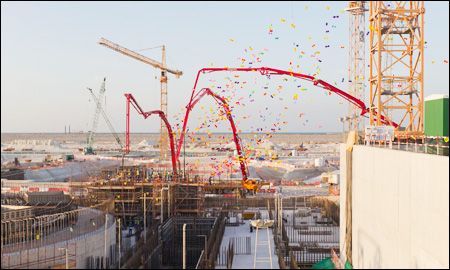
A groundbreaking ceremony for the United Arab Emirates (UAE)’s first nuclear power plant is held at the construction site in Braka, Nov. 21, 2012. / Courtesy of KEPCO
Korea should continue exporting nuclear plants
As well as supplying electricity, KEPCO generates revenues by constructing power plants. As Korea’s electricity consumption is expected to decrease over the long run, overseas projects have been identified as KEPCO’s new growth engine.
The company is working on 27 projects in 14 countries. Eleven of the projects are related to electricity generation, 12 to developing resources and 4 to energy transmission.
The Lee Myung-bak administration has encouraged exports of nuclear power plants, and KEPCO has collaborated on those efforts.
Since the massive earthquake in Japan in 2011, however, concerns over the safety of nuclear plants have restrained some countries from building new plants.
Although the newly appointed Cho was cautious in answering most questions, he was confident in saying that the efforts to export nuclear power plants should continue.
The first business trip he took as the KEPCO CEO was to the United Arab Emirates (UAE) to check the construction of the plants implemented by Korean companies. Although Cho had observed many large projects as the head of the Korea Trade-Investment Promotion Agency (KOTRA), he said that he was astonished by the scale of the UAE project.
According to Cho, the amount of the ready-mixed concrete used for the nuclear power plants is twice as much as that for the construction of Burj Khalifa in Dubai, the world’s tallest building, which was also built by a Korean company, Samsung C&T. He added that 100,000 tetrapods — normally used for breakwaters — have been used in the UAE project.
“I visited the construction site on the day when depositing concrete for the first nuclear reactor had to be finished,” Cho said. “It was late at night, and lights were on as though the site was bustling with nightlife. Workers from Central, Southwest, and Southeast Asia, all wearing helmets, were pouring, spreading out and setting concrete. Koreans, as the operators, were in charge of the site. That’s what the nuclear plants symbolize. I hope that passion will continue.”
By the end of 2012, nearly 25 percent of the construction of the first and second nuclear reactors has been completed. More than 6,800 Koreans are currently working at the site.
The UAE project is the first export of a nuclear plant from Korea. Korea is now approaching Turkey, Vietnam, South Africa and Saudi Arabia with offers to execute similar projects.
The latest efforts are centered on Turkey, which plans to build a nuclear power plant in Sinop, near the Black Sea. Korea is competing against China, Canada and Japan, though overseas media outlets have reported that the real competition is between China and Canada, with the former having a better chance.
The outlook for Korea’s bid is grim, as the Turkish energy minister said late December that the conditions suggested by Korea aren’t appropriate and are less attractive than those set by the competitors.
Cho wouldn’t discuss details, but said, “Turkey is well aware of our efforts to win the deal as well as of our strengths.”
Delicate position
Cho joined KEPCO at a delicate time. Power shortages have become a political issue, electricity prices are controversially low and the company has experienced chronic losses. Furthermore, the country itself is in transition: the new president will be inaugurated next month.
Heads of state-run companies tend to be replaced when the administration changes. However, Cho, who has been at KEPCO for just over a month, is expected to stay. After the former head, Kim Jung-gyeom, stepped down after a year and two months, industry sources said that the firm took a great deal of time in screening various candidates and choosing Cho.
Cho has been credited for the smoothly executed, if somewhat unexpected, hike in electricity charges, apparently overcoming the tension between KEPCO that needs to get out of chronic losses and the government, which wants to keep inflation down.
The role of the KEPCO CEO is naturally quite political. As the sixth-largest company by market capitalization on the KOSPI market, KEPCO is supposed to seek profit, but as a public entity, it cannot make too much profit from providing public goods.
On Jan. 10, when a possible rate hike was made news for the first time, analysts published reports that KEPCO may record a profit this year because fuel prices are dropping and the value of the Korean won is rising.
“If the exchange rate of the won against the dollar or oil prices does not surge, KEPCO’s turn from net loss to net profit for the first time in six years seems certain,” said Yoon Hee-do, analyst at Korea Securities & Investment, in a Jan. 10 report.
Cho, however, refused to make a forecast on the firm’s earnings. “Improving the earnings is, of course, a CEO’s goal,” he said. “But it’s not yet the time to confidently say we are going to make a profit this year.”
When he took the helm of KEPCO, he vowed to turn the corporations’ rigid culture into a flexible and open one, and to promote communication. Cho said that, for example, he would not hold regular morning assembles in the auditorium and make elevators previously dedicated to executives and VIPs available to everyone. In his meeting room, the rectangular table was replaced with a round one.
One important task for Cho to keep KEPCO’s spirit high will be his handling of the debate over whether the company should remain the sole seller of electricity.
In 2001, KEPCO had its monopoly over producing electricity broken and six power generating companies — all being affiliates — were set up. KEPCO buys electricity from them via the Korea Power Exchange.
KEPCO still remains the country’s only body responsible for the transmission, distribution and sale of electricity. Various media outlets reported that the presidential transition team is mulling opening up the sales part to the private sector, in order to stabilize supply. Pledges by President-elect Park Geun-hye include “removing inefficiency in the monopolistic structure in the electricity and gas sectors and creating a reliable market led by fair competition.”A professor who advocated opening up the electricity market is now a key member of the transition team. KEPCO’s labor union has voiced strong opposition to the idea.
When the issue was brought up, Cho did not take a side.
“Will electricity price be cheaper if the market is open to competition? We need to think about it,” Cho said.
“Electricity is a public utility, and it’s scarce. Because it’s a public utility, we have been campaigning for saving energy. KEPCO is devoted to the public interest, so provides electricity at low rates. Think about whether any private sellers of electricity would ask you to save energy.”