Trying to topple McDonald's
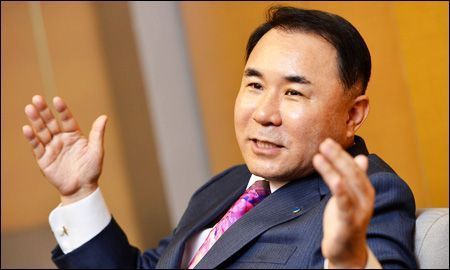
Korea Times photo by Shim Hyun-chul
Genesis BBQ franchise CEO Yoon Hong-geun aims to become world No. 1
By Kim Tae-gyu
A Korean company is striving to defeat McDonald’s during the second decade of the new millennium and become the world’s largest franchise brand in the lucrative fast food industry.
It is a life-time dream of Yoon Hong-geun, founder and chief executive officer of Genesis, Korea’s No. 1 food franchise company whose flagship brand is BBQ, the business bellwether in the fried chicken restaurant sector.
It may sound like blue-sky thinking but the 57-year-old said that his 20-year entrepreneurial career is all about achieving what is at first regarded as wildcat schemes.
“After establishing Genesis in 1995, I declared I would draw 1,000 stores to the BBQ brand in three years. Back then, people said that it was a wild-goose chase but I achieved this goal in the late 1990s,” Yoon said in a recent interview with Business Focus.
“Then, I said that the number of stores would reach 3,000 soon, an expectation few believed. Now the number is just shy of 4,000 and we make up a substantial proportion of the market.”
As of this December, Genesis operates a total of nine franchise brands including BBQ and GNS BHC and has about 3,800 stores under its wing.
BBQ and BHC account for around a third of the fried chicken restaurant market on the back of their brand power ― established on a reputation of using exceptional materials. In particular, its approach of frying chickens in extra virgin olive oil, the best available, earned it great popularity.
It was included in Korea’s top 100 brand list in 2005 by local consultancy Brand Stock. The entity has climbed fast in the rankings to reach 38th place this year.
It opened stores in 30 nations including China, Spain, the United States, Japan, Fiji, Iran and Australia and is set to launch others in 26 countries where the Seoul-based outfit has already found a partner and signed a contract.
The company chalked up 970 billion won in sales last year and 12 billion won in operating profits.
Catching up with McDonald’s
Still, many think that it is an overly ambitious plan for a firm with annual turnover of less than 1 trillion won to catch up with the world’s market leader McDonald’s in just eight years.
McDonald’s has up to 33,000 stores in 119 countries across the world.
The U.S. giant, which is a perennial leader in the Fortune 500 companies in the food services segment, racked up $27 billion in sales last year with profits of $5.5 billion.
For Genesis to topple McDonald’s, the former is required to jack up its sales by more than 30 times under conditions in which the latter stands still in terms of its revenue.
“Our goal is to raise the number of stores to 50,000 by 2020 to record 50 trillion won ($46.6 billion) in sales on royalty revenues of 2 trillion won. In other words, we will jockey to expand by 50 times by then,” Yoon said.
“Such fast growth is impossible for manufacturers. However, a franchise can do this. In particular, our unique way of entering other countries could be a great help in gaining ground at such a pace.”
Genesis has a set formula for entering into offshore markets: It finds a local partner to take charge of the opening of new BBQ stores in the targeted country, an operation the company calls a “master franchise.”
“Setting up 50,000 chicken restaurants may sound like a wild idea. But it is not ― if we open 1,000 stores in 50 countries that we enter, the total is 50,000. As BBQ reached a benchmark in four years in Korea, eight years is enough to do so in the other nations,” he said.
“The number might be far more than 1,000 in big markets such as China and the United States. Then, 50,000 might be a conservative target.”
He added that its Chinese venture would gain major momentum next month when Genesis is expected to team up with a large-sized Chinese group so as to create a joint venture.
The world’s most populous nation is the first foreign soil, which Genesis tapped into in 2003 and now there are 150 BBQ stores in a total of seven Chinese cities.
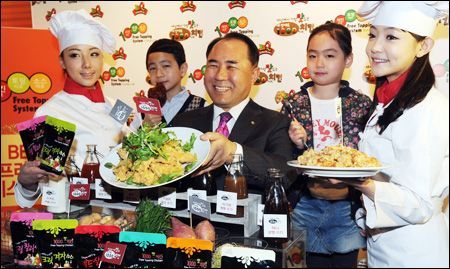
Genesis Chairman Yoon Hong-geun, center, shows a new menu at a BBQ store in Seoul early 2011. Under the so-called free-topping system, customers can select their own toppings and sauces. / Korea Times photo by Shin Sang-soon
Why 2020?
Yoon said that he fixed the year 2020 for a good reason ― it will mark a quarter century since the debut of Genesis.
“McDonald’s rose to supremacy in about 50 years after its start. I hope to halve the period to 25 years,” he said.
After attaining the grandiose goal of becoming the global No. 1, he is not likely to be content and he showed a glimpse of his future plans beyond 2020 ― he vies to build a business empire.
“My immediate object is to accomplish the 2020 objectives. After that I want to expand the business horizon beyond the dining franchise into such territory as finance, construction and a new format of distribution,” he said.
“It took quite a long time for Samsung Electronics to reach the 75 trillion won mark in sales but it took merely three years to double it. Likewise, we will be able to clock fast growth once we get bigger.”
If Yoon realizes all his dreams of building up a business group, he will be remembered as one of a very small number of entrepreneurs to create a conglomerate in Asia’s fourth-largest economy in recent years.
After 2000, just two managed to achieve this ― Park Hyeon-joo of the Mirae Asset Financial Group and Kang Duk-soo of the STX Group.
Other groups such as Samsung and Hyundai Motor, dubbed chaebol, were established decades ago and are now managed by offspring of the original founders.
Chicken and capitalism
Yoon regards chicken as the meat that provides the most profitable yield.
“In order to get 1 kilogram of beef or pork, 7 kilograms and 4 kilograms of grain are needed, respectively. For chickens, it is just 1.7 kilograms. Therefore, it is a very cost-efficient source of protein,” the CEO said.
“Chickens are also environment-friendly in contrast to the pollution created by cows. Of 7 kilograms of grain, 6 kilograms are excreted with associated methane, one of the major causes of the greenhouse effect.”
In addition, he noted that chickens have less fat, calories and cholesterol than beef and pork while also being richer in protein.
The usefulness of chicken is amply demonstrated in Korea too as their consumption has increased at a much faster speed compared to that of beef or pork.
According to data from the government and related associations, each Korean ate 8.6 kilograms of chicken in 2007, but the figure rose to 9 kilograms in 2008, 9.6 kilograms in 2009, 10.7 kilograms in 2010 and 11.2 kilograms last year.
The upward trend is expected to continue down the road.
His love affair with chickens gained great recognition this year because the Korea Chamber of Commerce and Industry conferred Genesis with the Presidential Prize of the distribution industry this month.
“I am very happy to garner this great honor this year,” he beamed.