Fighting challenges head-on
By Kim Tae-gyu
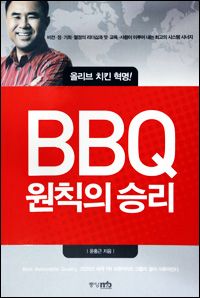
“BBQ, Victory of Principles” written by Yoon Hong-geun
In founding Genesis and catapulting it to become Korea’s foremost dining franchise company, Yoon Hong-geun by no means lacked challenges ― some of them were potentially deadly to the firm.
In his autobiography titled “BBQ, Victory of Principles,” Yoon exemplified the three most serious challenges in his 15-year-old career.
The first took place in late 1997, just a couple of years after Genesis’s debut in 1995, when the country and its neighbors were hit hard by the Asian Financial Crisis.
Consumers were reluctant to spend money and the worsened sentiment began negatively affecting chicken restaurants including BBQ, the firm’s flagship brand.
“In the aftermath of the crisis, the won plummeted against the dollar to cause the prices of imported feed to jump by big margins. As a result, the cost of soared,” Yoon recollected.
“But consumers refused to open up their wallets to order fried chicken. Many were panicked by the perfect storm.”
Yet, Yoon saw some opportunities beyond the lingering difficulties. He thought that budget-sensitive people would eventually consume affordable chicken rather than relatively expensive pork or beef ― anyhow they needed a source of protein.
“The head office of Genesis BBQ, contractors of the stores and suppliers of chicken agreed to give up 10 percent of their revenue respectively to compensate for the 30-percent rise in costs,” Yoon said.
“As a result, we could provide fried chicken at the same price for almost half a year despite the rise in expenses. We also started TV ads at a time when all the others cut expenditure on marketing.”
Such aggressive strategies paid off. It could buy prime time at a very low cost as few were ready to channel money to ads. In line with its heightened awareness, more and more people ordered BBQ chicken.
In addition, many early retirees in the wake of the crisis opted to open a BBQ store, which jacked up the Genesis presence across the country.
Typhoon
The second hardship followed soon midway through 1998 when a typhoon and resultant heavy rain almost swept the facilities of its sole supplier of chicken near Seoul.
When Yoon visited the place, its workers had fled due to safety concerns and many of the chickens were dead. His lieutenant reported that the supply of chicken would be cut off for at least a month.
Yoon called all Genesis employees there and cleared and quarantined the place around the clock. In five days, the facility was back on track.
“For five days, we could not supply chicken to our stores and that cost us up to 5 billion won. But we could minimize the period of recovery and could realize our customers’ affection toward us,” Yoon said.
“And after that, the facilities were revamped to be less vulnerable to flood and we diversified the supply chain of chicken.”
Avian influenza
The third and the most lethal threat was the spread of avian influenza (H5N1), which caught the country off guard in late 2003.
TV screens and newspapers kept showing the culling of chickens and rumors swirled that people affected by the illness would die as there was no vaccine.
Understandably, people stopped eating chicken at a time when such news reports were available that a million might die in Korea alone due to the epidemic.
Fried chicken restaurants including BBQ experienced rapidly shrinking sales, which showed no signs of subduing. The overall damages to the chicken dining business were estimated at near 1 trillion won.
A government agency assured that avian influenza could not survive if chickens were cooked but people did not buy the explanation.
Yoon came up with an idea aimed to make Koreans believe that eating cooked chickens would not infect them with avian flu.
“Genesis and other fried chicken brands formed an association to declare that it would give 2 billion won to anybody who suffered from avian flu after consuming Korean chickens,” he said.
“Plus, we have carried out various marketing campaigns. In a few weeks, people started eating chicken again and all of a sudden, demand outstripped supply.”
Mr. Chicken
His head is full of chicken. On business trips, he mostly eats meals containing chicken at famous restaurants in order to benchmark tastes. He said that it is a tough job for people to accompany him overseas because “they frequently have to eat meals made with chicken for days.”
There are some people who are also crazy about chicken ― researchers at its R&D center in Icheon, Gyeonggi Province.
“Some of them even taste raw chicken to check the freshness. They are not allowed to drink or smoke since their tasting is one of our cornerstone assets,” Yoon said. “I also sometimes eat raw chicken for the same reason. It is quite a difficult mission.”
Yet, Yoon and the researchers do not swallow raw chicken due to health concerns.
Next to the state-of-the-art research center stands Chicken University, comparable to Hamburger University at MacDonald’s, where BBQ store owners learn the spirit and recipes of the franchise.