'Entering the age of access'
Korea Times photo by Shim Hyun-chul
New consumer trend changes notion of property
By Bahk Eun-ji
Hong Eun-hee, a 42-year-old housewife rented a Sorento R, a Hyundai Motor sports utility vehicle (SUV), as her second car a few days ago mainly to take her two children to school.
Although she needed a spacious vehicle such as the SUV, she couldn’t afford to buy a new one because her husband already has a sedan for his daily commute. Therefore, the couple decided to rent a car under a three-year contract ― they paid 8.29 million won as an initial deposit, and then 756,000 won per month.
If they purchased the same vehicle, they would have to pay 606,000 won per month over three years. At a glance, the cost is less than renting a car, but there are extra expenses: 1.75 million won in acquisition tax, 2.6 million won for three years of insurance, 1.56 million won for automobile tax and other various expenses for car maintenance.
“Considering the cost of traffic accident repairs and the extra cost of insurance, renting a car is the better choice,” Hong says.
Age of access
The car rental business has long been established in the Korean market, mostly for corporate clients, but long-term contracts for individuals are fast growing as a new business trend.
American economist Jeremy Rifkin, known for his research into the impact of science and technology on the economy and society, wrote in his book, “The Age of Access,” that the role of property is changing radically.
He observes that capitalist economies are founded on the idea of exchanging property in markets, rather than owning it.
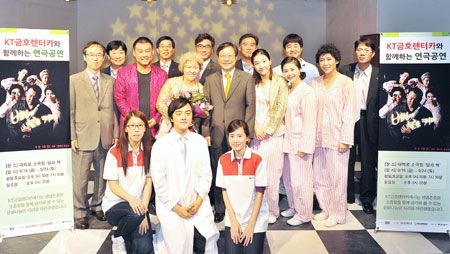
KT Rental CEO Lee Hwi-soo, center in the second row, poses with actors of a theatrical troupe dubbed Mushroom Play, for which the company provided 30 million won last year, at a theater in Hyehwa-dong, Seoul, on Sept. 16, 2011. The firm has carried out social activities for many years through supporting culture and art activities. Courtesy of KT Rental
“Consumers are just beginning to make the shift from ownership to access,” Rifkin stated.
He also pointed out that ownership is based on the idea that possessing a physical asset or piece of property over an extended period of time is valuable.
“Now, however, the speed of technological innovation and the dizzying pace of economic activity often make the notion of ownership problematic,” he continues.
“While cheap, durable goods continue to be bought and sold in the market, more costly items such as appliances, automobiles, and homes will increasingly held by suppliers and accessed by consumers in the form of short-term leases, rentals, memberships, and other service arrangements.”
As Rifkin pointed out, consumer trends and their propensity is changing how people perceive property and the market. Korean consumers have been making a shift from ownership to access. Here in Korea, there is an individual who read this trend and established a business to complement it.
Insightful leader
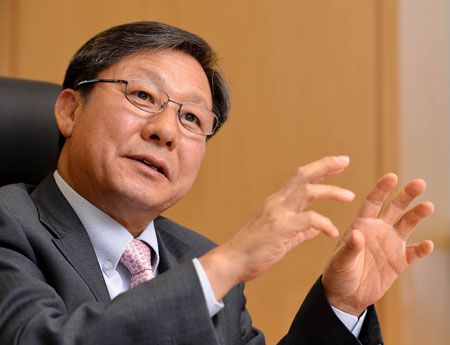
KT Rental CEO Lee Hwi-soo, has run a Seoul-based rental company since 2009 and spearheads the new access trend as the foremost player in the industry here.
“Change in the propensity of consumers has long existed in the United States and European countries, but it was only about two decades ago when Korean people considered renting property seriously instead of possessing it,” he said in a recent interview with Business Focus.
“Recognizing the huge growth potential of this sector, I suggested that a company should take over Kumho Rent-a-car in 2010 in the same vein.”
KT Rental was formerly Korea Informatics Telesis INC, founded in 1986 mainly for leasing telecommunications equipment to government and public organizations. Since 2004, the company has run a car leasing business and after affiliating with Kumho Rent-a-car in 2010, changed its brand to “KT Kumho Rent-a-car.”
Now the Seoul-based outfit owns about 70,000 cars to rent to both individuals and corporations ― indisputably the largest scale in Asia’s fourth-economy.
New format
In line with consumers’ changing attitude toward property including vehicles, long-term car leasing has taken on a new format. The rental company purchases automobiles and customers rent these for a certain period. After the duration of a contract, a customer can either sign a contract extension or return the vehicle.
It can be more economical than purchasing a car individually, considering the costs of running a car including insurance and the various taxes on it.
“It is a natural change in the market,” the CEO said.
“With the rapid progress of technology, consumer’s behavior is also changing rapidly. The general life cycle of products is two or three years at the most, and this includes automobiles,” he added.
Lee pointed out that vehicles are regarded as individual assets because they cost a lot of money. Due to this, once people buy one, they use it for at least five years and sometimes more than 10 years.
“Trend-conscious consumers, especially young people, want to enjoy new and cool products, namely, the latest automobile models. If someone resorts to renting, they can enjoy new models every couple of years at minimal cost,” Lee said.
‘Rent a smart life’
Under the slogan, “Rent a smart life”, the company says that consumers can enjoy change in the notion of consumption, in other words, shifting the emphasis from ownership to access, Lee said.
Supplementary services they provide such as free Wi-Fi access, up-to-date navigational equipment and so on keep the firm competitive in the market, he said. Major customers of KT Kumho Rent-a-car are other conglomerates or financial institutions that need to provide vehicles to their employees.
Those companies renew contracts with rental companies every three years, and the bidding for these contracts is highly competitive.
“I thought we should provide high quality vehicles with differentiated services in order to avoid a price war,” Lee said.
The CEO pointed out that the stiff competition for cutting prices might result in low-quality services. Hence, he decided to add other services for the convenience of consumers.
Competitive edge
The different kinds of additional features accompanied with communications technology from KT is one of the company’s most significant differentiators, according to Lee.
Furthermore, its well designed marketing network is another key to success _ the company has 140 branches directly controlled by the head office. This means that a reliable level of service is available to customers wherever they are.
“The quality of service, of course, is much better than those of our rivals because our employees take care of the cars and customers from carrying out repairs to helping settle costs after traffic accidents,” he said.
The company purchases around 25,000 new vehicles every year, which costs more than half a trillion won. Not surprisingly, the company is the single largest customer of Hyundai Motor and Kia motors.
“We can enjoy bulk discounts based on our buying power. That’s why we have a competitive edge in terms of the wide selections available at reasonable prices,”
The CEO also noted that they are planning to make inroads into the second-hand car market more actively in 2013 with a stable supply of vehicles.
Overseas venture
The company has also strived to expand its business abroad. It recently opened a second branch in Hanoi, the capital city of Vietnam. Lee sees the Vietnamese market as fairly lucrative, because a lot of Korean companies already operate in the country.
“It is profitable enough if we can take care of vehicles from those companies. Vietnam is a bridge to enter other Asian countries such as India, Laos and Cambodia,” Lee said.
He noted that he hopes to run a rental car business for Korean companies and then gradually also for Vietnamese companies.
The cleanliness of the cars and sophisticated service provided attracts many customers in Vietnam, even though the company’s rates are around 30 percent higher than rival companies. A camper van rental business is also about to open in New Zealand next year, Lee said.
Lee’s philosophy
The CEO strongly emphasized enabling employees to enjoy their work.
“I always tell employees to think of the company as a school. What I mean by that is that they once had to pay tuition fees to learn when they were students, but now they can learn and be paid at the same time. It is totally up to how determined they are,” Lee says.
He also requires employees not to be self-centered but put themselves in each others’ shoes, which he thinks will create a more positive atmosphere in the office.
“Moreover, I encourage people not to be afraid of trying new things, namely, new challenges,” he said. “My job is to ensure the company’s stability and make sure employees don’t any feel pressure to immediately suggest and start new plans but help them become confident so they can eventually do this.”