'Borrow and invest'
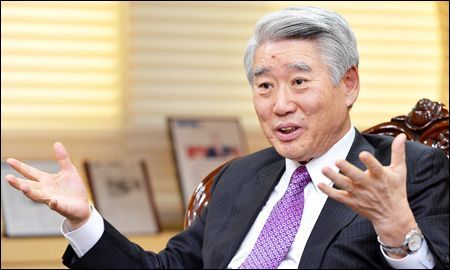
KODIT Chairman Ahn Taik-soo ready to help SMEs
By Kim Da-ye
Signs of slowdown are seen across the Korean economy. The national output grew a mere 1.5 percent in the third quarter from a year earlier while over 23 percent of some 630 companies listed on the main stock market accumulated net losses between January and September.
From the perspective of the Korea Credit Guarantee Fund (KODIT), the clear sign of downturn is elsewhere ― small- and medium-sized enterprises (SMEs)’s unwillingness to borrow and invest, with which the state-run agency strives to grapple.
“Although we are fully ready to support small companies to borrow and invest, those who qualify for our backing rarely ask for help. They are just waiting and seeing until the economy recovers,” said Ahn Taik-soo, chairman & CEO of the KODIT that assists SMEs borrow without collateral by guaranteeing their loans.
Last year, KODIT increased the total amount of general loans it can guarantee this year by 1.1 trillion won to 39.5 trillion won. As the European sovereign debt crisis deepened, the fund extended the amount to 40 trillion won as a preemptive measure against liquidity crises.
If the economy slows down further, the fund can boost the amount to 40.4 trillion won. And if another financial crisis hits, it will negotiate with the government in order to raise the amount even higher.
For instance, at the height of the global financial crisis between the end of 2008 and the end of 2009, the amount of the guaranteed loans jumped nearly 30 percent to 39.2 trillion won from 30.3 trillion won. The figure does not include other kinds of debts worth 7.7 trillion won that KODIT guarantees to stabilize the markets.
But Ahn is yet to see demands meeting KODIT’s enthusiasm. The amount of loans it guarantees hovers around 39.5 trillion won this year, he said, adding that he doesn’t expect it to hit 40 trillion won within this year.
“Because of uncertainties in the global economy, domestic companies aren’t confident enough to make any proactive move. It is regrettable since the problem may be solved if they borrow and invest,” the 69-year-old said.
Ahn is quite pessimistic over the near future of Korea’s economy. With all three global economic powers ― the United States, the EU and China ― losing steam, the U.S. is injecting liquidity into markets through multiple phases of quantitative easing in order to stay afloat.
Such policies would drive down the value of the dollar while ending up leading to the appreciation of the Korean won, thus potentially hurting Korea’s outbound shipments, Ahn said.
Large corporations would be the first to be affected, and subsequently their suppliers, mostly SMEs, Ahn forecasted. His little hope comes from the re-election of U.S. President Barack Obama and the leadership change in China that might result in new policies to deal with the global downturn.
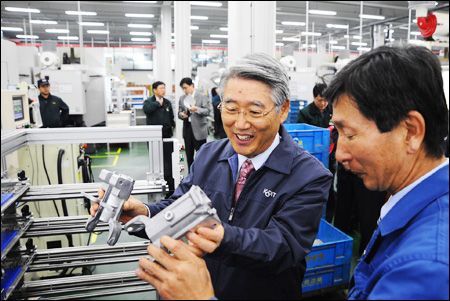
Ahn Taik-soo, the chairman of Korea Credit Guarantee Fund, visits an mid-sized manufacturer and talks to an employee in this Dec. 10, 2008 photo. / Korea Times file
Ahn and KODIT
Ahn has no educational background in economics. He graduated from Seoul National University with a major in politics. He started his career as a political reporter at Hankook Ilbo, a Korean-language daily and a sister firm of The Korea Times.
He later served as a three-term lawmaker ― having been elected in Daegu ― and as a spokesperson for the Grand National Party. He was the chairman of the National Assembly’s finance committee.
While KODIT is little known to the public, it has so far helped some 233,000 SMEs get loans in difficult times. Ahn said that 66 percent of firms listed on the tech-heavy KOSDAQ market and 43 percent of those on the KOSPI bourse have benefited from KODIT’s credit guarantee program.
Simply put, Ahn calls KODIT “the fire fighter for the economy.”
Back in the late 1990s during the Asian financial crisis, Hyundai Engineering & Construction borrowed 1 trillion won with KODIT being its guarantor. By law, the fund can only back SMEs. Hence, it was required to get a separate approval to assist the country’s No. 1 contractor.
Steelmaker Dongkuk Steel Mill and education service provider Edubox are among well-known recipients of KODIT’s help amid the Asian financial distress.
Alumni of its credit guarantee program also includes STX, now a heavy-industries-based conglomerate, Thinkware, a navigation maker and Gamevil, a prominent mobile game developer.
While the current indecisiveness of businesses frustrates Ahn, KODIT in fact receives a lot of calls for help. The problem is they aren’t qualified for KODIT’s guarantee. The institution has 15-level credit ratings, and the companies categorized as the bottom five won’t receive any support.
Those companies typically have debts that exceed operating profits for two consecutive years or longer or cannot afford to pay interests with their profits. Strict risk management is necessary for KODIT because it relies on tax payers’ money.
The country has, in general, shown a low default rate on guaranteed loans. Ahn said that the average default rate of KODIT-backed loans in the last 36 years was 5 percent, compared to Japan’s 7 percent in an unspecified period of time. The rate peaked at 14.6 percent in the middle of the Asian financial crisis, but stayed at around 4.3 percent during the global crisis in 2008 and 2009.
Ahn gives the credit to businesses, saying, “Korean companies had painful experiences during the Asian financial crisis, so all have developed the knacks on how to survive.”
One of the areas KODIT has recently paid much attention to is the construction industry. During the first 10 months of this year, the fund has backed the issuing of securities worth 714 billion won that are based on bonds issued by 320 construction companies. This amount is not included in the 40 trillion won of general loans the KODIT can guarantee.
When asked if builders should still be supported with tax payers’ money while the real estate market is in a cooling-down mode, Ahn replied that the industry must be kept alive.
“The construction industry employs a very wide spectrum of people from suppliers of materials to paper hangers. Reviving the construction industry is necessary to stimulate the Korean economy,” Ahn said.
Banks should do better
Ahn, a former lawmaker from the Grand National Party, now the ruling Saenuri Party, was critical of banks. He once compared them to Shylock, a Jewish loan shark in William Shakespeare’s play, The Merchant of Venice.
According to KODIT, SMEs borrowed 21.1 trillion won in 2009 during the global financial crisis. More than 88 percent of the loans were guaranteed by institutions like KODIT, which alone backed about 42 percent out of 21.1 trillion won. Loans made at the risks of banks were only 2.5 trillion won, around 12 percent of the total.
“The figure shouldn’t stay at a mere 12 percent, but should go up to at least 25 percent. When the country is struggling, banks have to play their roles,” Ahn said.
Because even the rest ― 88 percent ― of the loans backed by non-banking institutions are risk-free to banks, Ahn compared banks’ job to “swimming with the hands on the ground.”
“Banks aren’t state-run entities but private institutions. They have the right and responsibilities to survive, but they think too much about their own safety. They are, after all, fed by the government and the public. They should be more generous with lending with a sense of duty,” Ahn said.
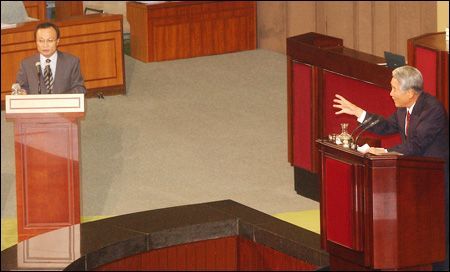
Ahn Taik-soo, right, a former three-term lawmaker of the Grand National Party, now the ruling Saenuri Party, challenges then Prime Minister Lee Hae-chan during an interpellation session at the National Assembly in Seoul, Oct. 28, 2004. / Korea Times file
Innovations
The KODIT chairman is one of the longest-serving heads at state-run organizations. Ahn was appointed to the current position in July 2008 for three years, and reappointed in 2011 for another year. This July, his term was extended another year.
One of the changes he is proud to have made at KODIT is the way of assessing companies’ values and deciding their credit ratings.
Before July 2009, KODIT worked out the amount of the credit it can guarantee based on the borrower’s revenue in the previous fiscal year.
Under Ahn’s stewardship, the assessment is now based on the revenue of the 12 latest months, its potential for future growth and management abilities. The “future-oriented” assessment system was reviewed once again and made more systematic in September 2010.
The new format has received favorable media coverage with some articles saying that the KODIT’s credit rating is more accurate than those of commercial rating agencies.
“We once tested our model with Samsung Electronics’ data. Very surprisingly, the results exactly matched Samsung’s stock prices,” Ahn said.
“Even banks or credit rating agencies do not look into a company’s future value when they decide its credit rating. Our technique is the most advanced.”
When KODIT guarantees a loan of less than 300 million won, it applies the conventional assessment method. For a loan of 300 million or more but less than 1 billion won, the institution will examine the borrower’s potential to grow. For 1 billion or above, it will review the firm’s future value.
“Some companies that could qualify before may not pass the future-value assessment while those who couldn’t before may now receive our support. When we were upgrading the assessment method, we were concerned with default rates, which, in fact, have improved. Continuing to evaluate with the old method would kill companies,” Ahn said.
KODIT has recently come up with a few more innovative products. One is an online market in which banks post their lending terms and borrowers choose the most suitable bank.
According to the Seoul-based institution, there were nearly 20,400 transactions worth over 2.56 trillion won between January 2011 and October this year. The average interest rate of those transactions was 5.56 percent ― 0.66 percentage points lower than the average rate outside the market.
KODIT has also developed the “Ratecaster,” a system that forecasts the interest rate for each company. The system considers financial institutions’ rate decision-making processes as well as borrowers’ financial and non-financial information, and KODIT says that knowing the “appropriate level” of interest rate, borrowers will be able to negotiate better with lenders.
Confident that the Korean credit guarantee program is advanced, Ahn has been promoting it to abroad. As a partner in the “knowledge sharing program” run by the Ministry of Strategy and Finance, KODIT has transferred its credit guarantee “know-how” to Vietnam, Cambodia, Kazakhstan and Ghana.
While KODIT is still in the middle of transferring credit-guaranteeing skills and systems in most countries, Vietnam has so far shown clear outcomes. The Vietnam Development Bank began its own credit guarantee program highly similar to that of Korea in March 2009. Furthermore, some countries including Uzbekistan and Turkey have shown interests in learning the Korean system, KODIT’s press office said.
“Emerging economies must learn our system. The credit guarantee program has contributed immensely to Korea’s growth. The program is a catalyst for the multiplier effect of revitalizing the economy. The emerging countries know from whom they should learn from,” Ahn said.