Reducing outlets
Banks move to cut branch operations amid economic slump
By Kim Jae-won
Korean banks are ramping up efforts to reorganize branch operations because a prolonged economic slump has bitten into their profits and dimmed the outlook for next year’s earnings, bank officials said Thursday.
Major lenders also plan to conduct early retirement programs by the end of this year, seeking to reduce costs as much as possible.
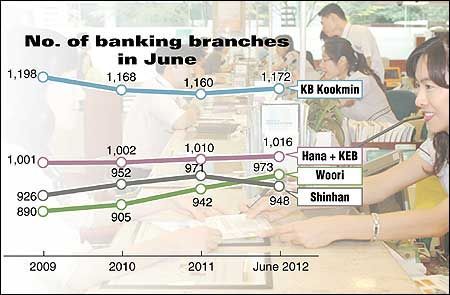
Woori Bank, the nation’s second-largest lender by assets, said it plans to merge some 15 money-losing or underperforming branches this year, a setback to the lender’s aggressive expansion. It has set up about 100 new branches in the last two years, raising its total to 993.
Woori said the decision is part of a plan to set up a low-cost, high-efficiency banking organization.
“Commercial districts change every three to four years. In that case, we merge neighboring outlets to adjust to different customer demands and circumstances,” said Woori chief spokesman Chung Hee-kyeong.
Top player KB Kookmin Bank said it is also conducting an on-the-spot study to pick candidates for in-house merging, mostly branches with low performance, a spokesman for the lender said.
KB said that it will not increase the number of branches next year, after adding 20 this year. It has most outlets in the country with 1,185 as of the end of September.
Other major lenders including Hana Bank and the Korea Exchange Bank are following suit.
Market watchers said the move came because local banks are expected to perform poorly next year as the economy will likely suffer from a continued slowdown. According to data by the Financial Supervisory Service, the number of branches run by local banks totaled 7,636 as of the end of June, up from 7,574 six months earlier.
Early retirement is another key agenda sweeping the industry here. Citibank Korea announced that it will accept applications from employees who want to retire before the end of their guaranteed tenure.
The Korean unit of the New York-based lender promised to pay compensation worth two to three years in salary, according to the number of years an individual has worked but few seem willing to opt for this deal while the economic downturn continues to deepen across the country.
Citibank said that it conducted early retirement programs in 2007 and 2008, when 133 and 299 employees left the company, respectively. The lender said it will announce the list early next week.
“The early retirement program is the big issue in the local banking industry. Employees are wondering whether it is time to leave the workplace with handsome compensation,” said a director of a European foreign lender on condition of anonymity.
However, Standard Chartered Bank in Korea, which let more than 800 employees leave through an early retirement program last year, has no plan yet to conduct such a big program this year. The Korean arm of the U.K. banking group paid two years’ salary to applicants in compensation at the end of 2011, who decided to leave the lender after a fierce two-month strike that summer.