Master milliner says: No cap on growth
Sonette CEO Thomas Cho to introduce one-size-fit-all hats next year
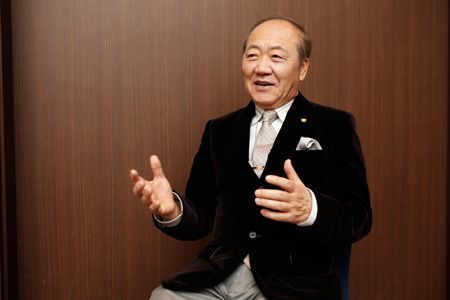
By Kim Tae-gyu
This is the sixth of a series highlighting successful ethnic Korean entrepreneurs overseas. The series is supported by e-Bay Korea, JTI Korea, Korea Post and World OKTA. ― ED.
It is difficult to rise to the pole position in the world of business. However, it is much more difficult to remain ahead of the pack because the front runner becomes a target of followers.
Here is a very extraordinary example where a company has topped the podium for a quarter of a century ― Sonette has been a runaway leader in the global cap business since the late 1980s, headed by its founder Cho Byung-tae.
The 65-year-old said that the company would be able to rule the industry down the road by introducing genuine one-size-fit-all caps next year across the world, which its competitors cannot copy.
The chief executive, who has carved Sonette’s own category of headwear with the Flexfit brand, jockeys to revolution Cho’s life-time dream, having crossed the Pacific in the mid-1970s to make a career for himself in the United States headwear market dominated by Jewish merchants.
His firm Sonette, which was originally Thomas Promotion, was a global trailblazer in achieving the grandiose scheme as it came up with Flexfit caps in 1996 with elastic bands and it became an industry norm over the next one and a half decades.
“The first-generation Flexfit has three sizes ― one for kids, one for small adults and the other for big adults. Since three sizes cover all 10 previous sizes, we call them three-10,” said Cho who is widely known as Thomas in the U.S.
“And we came up with the second-generation Flexfit in 2007, which is dubbed two-10 because merely two sizes cover all demands. The third-generation Flexfit is a bona-fide one-size-fit-all items called one-10.”
Unlike its predecessor, the second-generation Flexfit did not rely on bands. Instead, it depends on the elasticity of the caps’ fabrics, which experts point out is unrivaled technical breakthrough.
With the third-generation types, Cho marched one step further, coming up real one-size-fit-all models based on unique fabrics called spondex.
Flexfit has been a Cho’s baby, which catapulted the New York-based Sonette to the international leading position for a long time.
The world’s wholesale market size for sports caps is estimated to be in the neighborhood of $1 billion a year and Sonette accounts for more than 15 percent of them ― it chalked up $160 million in turnover last year.
Cho is not content with the past laurel because he aims to almost double its sales and market share by 2015, which will be the 40th anniversary of Sonette, which was founded in 1975.
“We are striving to attain $300 million in sales by 2015 for a market share of 30 percent and I am pretty optimistic about achieving the goal in consideration of the technical competitiveness of Flexfit products,’’ he said.
“The patent for the first-generation Flexfit will expire in a couple of years but those for the second- and third-generation Flexfit will be protected for longer than a decade. In particular, the third-generation product will change the headwear market once and for all.”
Hard times
Currently, around a half of professional sportsmen wear caps made by Sonette in the United States and the proportion is almost 100 percent for Korean baseball players with the sole exception of the Lotte Giants, according to Cho.
But hard times came first in his success story and over the worst period, he even thought of drowning himself in the Hudson River of New York.
Initially, Cho was a handball coach at a Korean middle school, which gave him somewhat of a stable livelihood. Yet, the entrepreneurial DNA deep inside did not allow him to be content with the status quo.
He took a flight to New York with his wife and two young kids with a plan of opening a training school for taekwondo, the Korean martial art of empty-handed self-defense, to earn his living.
It took little time for him to realize the idea was not viable as the market was already dominated by Westerners with stronger physique. An Asian with a small frame and a poor command of English was not a match.
He had no luxury to afford to waste much time because his war chest was shallow at just $500. He instantly resorted to plan B ― he knew something about the cap business since his older brother ran a cap manufacturer in Korea, Yupoong, that is still the sole provider of Sonette’s headwear.
He struggled to find his feet in the early days.
To sidestep the import quota system, he imported caps made of leather and linen, but they were not designed to stand 45 days of delivery in containers ― they rotted away or were completely wrinkled.
In the initial years, he suffered deficits amounting to $300,000, which prompted him to think about walking away from the business, and as is often the case, opportunities popped up when things were most difficult.
“During the cold winter season of New York in 1977, an idea abruptly struck me of putting well-printed company logos on caps, which was unprecedented at the time,” the teacher-turned-businessman said.
“Budweiser was the first contractor and the idea proved to be a big hit. Thereafter, a string of brands tried to strike deals with me, including Marlboro, GM, Ford, IBM, Nike and Adidas.”
The caps offered boons to Sonette, then Thomas Promotion, and he got a double bang by racking up a success, thanks to embroidered caps with stitched logos or trademarks. The two cash cows boosted the firm’s bottom line throughout the 1980s.
Endless innovations
In 1990, the United States jettisoned the import quota system, which prodded brisk imports of dirt-cheap Chinese caps, which were priced much lower than conventional products including Cho’s.
“At first, their quality was really bad. But through the years, they caught up and we felt a sense of urgency. We needed killer products and what we fixed our eyes on were fitted caps,” Cho recollected.
“We developed the first-generation Flexfit in 1994 and got a patent two years later. It greatly underpinned our bottom lines. Before the expiry of its patent, we developed the second- and third-generation Flexfit items to remain ahead of the curve.”
In particular, he took pride in the third-generation Flexfit, which he says include all of the cutting-edge technologies imaginable with regard to headwear. He said, “You will see them next February.”
And he does not stop pushing the envelope as far as caps are concerned and still keeps the time-honored principle of channeling up to 20 percent of its sales to research and development.
“The third-generation Flexfit will bring stable cash flow for the next 15 years as it would be protected under the patent system. But I am still agonizing over ideation on what would be the future of the caps,’’ he said.
“I delved into merely the headwear industry. But my successors may tap into related businesses. For example, highly flexible fabrics would be good ammunition for the apparel market.”
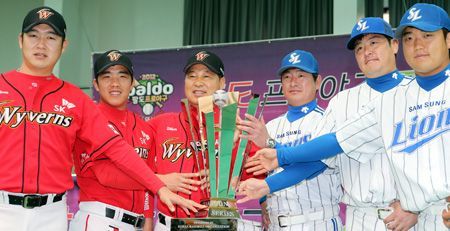
Coaches and players of the Samsung Lions and the SK Wyverns touch the trophy before the best-of-seven Korean Series last month. All of them wear Flexfit caps. The Lions beat the Wyverns 4-2. / Yonhap
World OKTA
His immediate goal is to reach $300 million in sales by 2015 but Cho noted that there is a far more significant target in his life, which has something to do with his ethnic background.
What he really wants is make a contribution so that Korea Inc. will be able to join the rank of the world’s top five economies. Currently, it is a fast-growing country that reached $1 trillion in annual trade last year as the ninth in global history.
“Korea’s becoming one of the world’s top five economies is more important than our firm’s object of recording $300 million in sales by 2015. I think that the former aiming would be attainable in a decade,’’ he said.
“Toward that end, I think that Korean merchants and traders in offshore nations can contribute and I will do my best. Just as singer Psy makes a global splash, Korean merchants can emulate him in business.”
Psy is a Korean pop star who has become a global celebrity with one comic single, “Gangnam Style.” The big hit skyrocketed the rapper into global stardom with big audiences across the world.
With such a mantra, Cho headed the World Federation of Overseas Korean Traders Association (World OKTA), the organization for successful Korean merchants and traders overseas, for two years from 1996 to 1998.
As soon as he took charge of the World OKTA, he cleared up the debts of the entity with his own money and in October 1997, Cho hosted the conference of Korean businesspeople for the first time. A large proportion of the expenses were also covered by funds, which came from his own purse.
“During my two-year stint at World OKTA, I traveled 27 countries to set up an office of the organization. In addition, put forth efforts to establish World OKTA branches in such U.S. cities as Los Angeles, Washington and Atlanta,’’ the CEO said.
“Korean entrepreneurs carry out proactive activities in more than 170 countries. In the not-so-distant future, I hope that the Korean network would be enlarged enough to compete with those of Chinese and Jewish.”