Korean IT powerhouses challenge global tech titans in AI market

Naver joins AI race with HyperCLOVA X, Kakao to launch KoGPT soon
By Baek Byung-yeul
Naver, Kakao, LG, SK Telecom, KT and other IT companies here are aggressively launching or plan to introduce generative AI services to counter the growing influence of ChatGPT and other AI services introduced by global big tech firms.
Services by local companies can display robust performance here ― compared to ChatGPT provider OpenAI, Google and Microsoft ― if they provide customized services that meet the needs of Korean users, industry officials say.
One of the latest Korean AI companies to gain traction is Naver, which unveiled its hyperscale AI, HyperCLOVA X, and its associated generative AI service CLOVA X, on Aug. 24. In addition to Naver, LG AI Research unveiled its hyperscale AI platform, EXAONE, in July.
Kakao, known for its KakaoTalk mobile messenger, will unveil KoGPT in October. What makes Kakao's generative AI different is that it will be connected to KakaoTalk, the most popular messenger among Koreans. The company said KakaoTalk and its AI service will be combined to make it easier to use transactional services such as ordering, booking and payments.
Later this year, mobile carrier SK Telecom will unveil a generative AI service based on its AI service A. (A dot) and KT will unveil its Mi:dm service.
IT and telecommunications companies are not the only ones entering this business. Game company NCSOFT is developing a large language model (LLM) called VARCO to improve the efficiency of game and related content development, and AI startup Upstage is building a private LLM for security-conscious corporate customers.
Evaluating CLOVA X, Naver's conversational AI service, experts said the HyperCLOVA X-based service has sufficient competitiveness because it is more optimized for Korean users compared to foreign-made services.
They also said that it remains to be seen whether services offered by Korean companies in the domestic market will be able to attract a large number of users compared to the products of global big techs, as the market is still in its infant stage. However, they also said that generative AI is the path that Korean tech companies must take as it can help users improve work efficiency and make it easier to do creative work.
“Since it is a model that came out after ChatGPT, it shows a similar user interface, so CLOVA X doesn't look new, but there are cases where it produces better results than ChatGPT for Korean users,” Kim Keun-kyo, head of Brand & Communication at Upstage said. “There are expectations in the market that CLOVA X is optimized for domestic data.”
“While Naver has launched its service, it's still too early to make any predictions about the domestic generative AI market. However, the market is promising,” an official at a local IT company said on condition of anonymity.
“Metaverse technology was initially in the limelight, but now the spotlight has faded a bit, but generative AI can be used in various fields, so domestic companies will continue to try to grow this technology into their core business,” the official added.
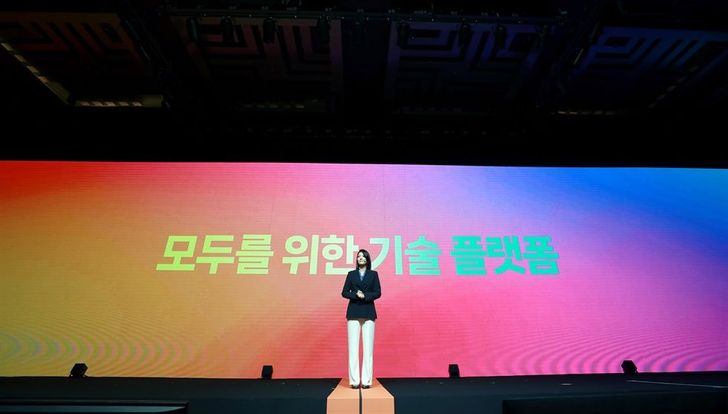
Naver CEO Choi Soo-yeon introduces the company's hyperscale AI HyperCLOVA X and related services during Team Naver DAN 23 conference, at the Grand InterContinental Seoul Parnas hotel in southern Seoul, Aug. 24. Courtesy of Naver
Experts said domestic companies are trying to achieve success with their generative AI services in the business-to-business (B2B) market, where they offer their platforms to companies, after receiving positive responses from the business-to-customer (B2C) market.
For example, game company Smilegate recently signed a memorandum of understanding with Naver Cloud, the developer of HyperCLOVA X, to collaborate on technology.
“Through the collaboration, Smilegate will leverage Naver's diverse AI technologies and services to help Smilegate with its virtual person creation, creative AI tools and analytical AI tools,” Han Dae-woong, director of the AI Center at Smilegate, said. “We will conduct various tests and research using Naver's technologies that are open to us, including HyperCLOVA X, and if the results are good, we plan to expand further.”
Not only platform developers but also IT service companies such as Samsung SDS and LG CNS are seeking business momentum in the generative AI business as they are working on developing services that help their business customers easily adopt various kinds of generative AI services.
Next month, Samsung SDS, the IT service arm of Samsung Group, will invite company executives, experts, and partners to learn about the company's strategy in the era of generative AI. During the meeting, the company will present its strategy in letting B2B customers use generative AI services optimized for their needs.
LG CNS, LG Group's IT service arm, is also working with companies developing generative AI to launch related services. LG CNS already inked an agreement with Microsoft to utilize the U.S. tech giant's generative AI and invested in U.S.-based AI company, Anthropic. Through this, the company plans to help customers utilize AI services.
AI platform providers in other countries are also moving to compete with Korean generative AI service providers.
Alphabet CEO Sundar Pichai unveiled in May an upgraded version of Bard, Google's generative AI service, and announced that it will be available in Korean and Japanese first, in addition to English, before expanding to more languages.
"They're incredibly dynamic and exciting regions, which are at the cutting edge" of technology, Pichai said during a conference in California, May 10.
The CEO also wrote on Google's blog that if Korean users want to find a coding bug, they can talk to Bard in Korean, showing that the market here is high on their service priorities.
"Let's say you're working with a colleague in Seoul and you're debugging code. You can ask it to fix a bug and help out your teammate by adding comments in Korean to the code. It first recognizes the code is recursive, then suggests a fix. It explains the reasoning behind the fix, and it adds Korean comments like you asked," he wrote.