New superconductor developed by Korean scientists draws global attention

The photo shows a part of LK-99, a room-temperature superconductor released by researchers led by Lee Suk-bae, CEO of Quantum Energy Research Centre, and Auh Ho-keun, honorary professor of Hanyang University, floats in the air above a round magnet. Courtesy of Quantum Energy Research Centre
By Baek Byung-yeul
A superconductor, which has no electrical resistance at extremely low temperatures or under high pressure, has emerged as a red-hot issue across the globe after Korean scientists recently claimed they developed one that can be used at room temperature, according to industry experts, Thursday. While this would be a dream technology, if proven true, it is expected to bring revolutionary changes, they said. But they added that it is still too early to call it a success, because the discovery needs to be verified more accurately.
On July 22, researchers led by Lee Suk-bae, CEO of Quantum Energy Research Centre, and Auh Ho-keun, honorary professor of Hanyang University, published two papers about LK-99, a superconductor that can be used at room temperature, on an open-access repository of electronic preprints and post-prints site run by Cornell University.
At the time of publication, many experts here and abroad questioned the authenticity of their claims, because the paper had not undergone proper verification processes. However, since the paper detailed the recipe for making LK-99, scientists around the world researching superconductors began experimenting with the recipe to replicate what the Korean scientists did.
The interest of scientists around the world in room-temperature superconductors is not just a curiosity as researchers at leading institutions and schools around the world, including Argonne National Laboratory in the U.S., the College de France and China's Beihang University, have begun to replicate the paper's experiments.
Since the recipe for making a room-temperature superconductor was unveiled to the public, many researchers have been replicating it. But so far, no one has officially succeeded in replicating LK-99.
Regarding their development, Kim Hyun-tak, one of the researchers who took part in the paper, told a local news outlet Thursday that the researchers will make a formal presentation at next year's American Physical Society.
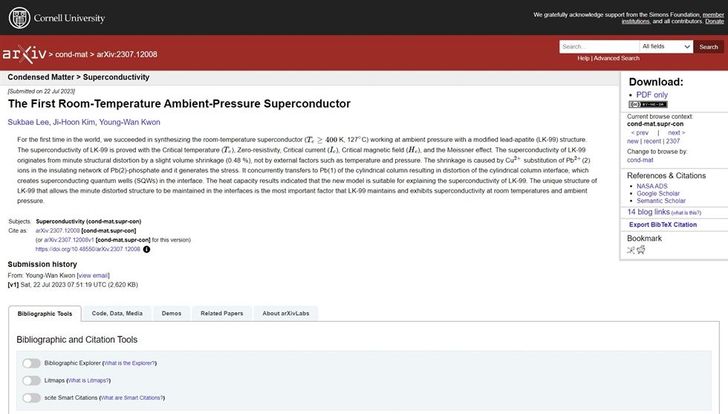
Seen is a paper on room temperature superconductors by researchers led by Lee Suk-bae, CEO of Quantum Energy Research Centre, and Auh Ho-keun, an honorary professor at Hanyang University, published on arXiv, an open-access repository of electronic preprints
Experts said the enthusiasm around the world is due to the fact that room-temperature superconductors would revolutionize the way we live, as they would be able to transmit electricity without heat loss, something that many scientists have been trying to do, but no one has succeeded.
Even if the room-temperature superconductor can be demonstrated, experts said there is still a long way to go before it can be commercialized. They added that the paper needs to be thoroughly verified to be proven true.
Not only overseas, but domestic researchers have also been working on verification. The Korean Society of Superconductivity and Cryogenics organized a verification committee, Wednesday.
“If the room-temperature superconductor is verified, it will be a revolutionary research finding that will have a great impact on the field of science and technology,” Choi Kyeong-dal, president of the society, said. “However, it is concerning that this verification is being released without academic review and that it is having an economic and social impact.”
The verification committee later told Yonhap News that LK-99 is not a room-temperature superconductor, claiming that “it didn't show the Meissner effect, which is a characteristic of a superconductor.”
Superconductivity is a phenomenon in which a material shows the Meissner effect, which means that it loses electrical resistance and repels internal magnetic fields, the verification committee explained.
Kim Kyung-wan, a professor at the Department of Physics at Chungbuk National University, said that LK-99 is a great discovery that needs to be thoroughly verified before it can be proven true, and if it is, the scientists who discovered it will be awarded the Nobel Prize.
“So far, the consensus of experts is that even if the experimental results in the paper can be reproduced, it's too early to say that this is a superconductor that can be used at room temperature because it needs to be verified further,” the professor said.
But if the room-temperature superconductor proves to be true, he said, it would be a game-changer because superconductors, which are materials that are only used in situations where temperatures are reduced to extremes or under tremendous pressure, could be easily used in everyday life.
“If proven true, it would change our society in many ways. For example, when electricity is supplied by a power plant, the transmission efficiency can be increased to close to 100 percent because there is no power loss when electricity is supplied through wires made of superconductors,” the professor said.
“MRI scans also use a magnetic field generated by passing an electric current through our body to measure various things, and if superconductors could operate at room temperature, they would be able to perform with much less power consumption. This would make it much easier to use electricity and magnetism in everyday life.”