INTERVIEW Eco-friendly packaging material maker hopes to shift industry paradigm

Everchemtech CEO Lee Seong-min speaks during a recent interview with The Korea Times at the company's head office in Hwaseong, Gyeonggi Province. Korea Times photo by Choi Won-suk
Everchemtech hopes natural source-based coating material will challenge Japanese dominance
By Kim Yoo-chul
HWASEONG, Gyeonggi Province _ The food packaging industry is at a major tipping point as consumer perceptions of product covering materials are changing and their interactions with companies are also increasing.
In a recent analysis, titled “European Consumer Packaging Perceptions Survey,” over 70 percent of respondents said they are willing to pay more for environmentally-friendly packaging and actually changed the products they purchase due to concerns over harmful materials used as covering materials.
Adapting to such changing perceptions requires the industry to reassess how it manufactures packaging materials and where to focus new investments.
In the EU, for example, all packaging should be reused or recycled by 2030, according to the region's pursuit of switching to a circular economy with a greater emphasis on future recycling technologies. The EU Parliament also expects tighter controls on packaging will help its member states reduce packaging waste per capita by 15 percent by 2040 compared to 2018.
Experts say a mono-material packaging structure is viewed as the most preferred environmentally-friendly packaging type.
As any exposure to oxygen accelerates the decay of food, manufacturers prefer to use barrier film in packaging to keep edible products fresh for longer periods of time. But barrier film, based on multi-payer packaging structures, is difficult to separate during the recycling process, making it less reusable.
But one Korean company hopes its natural source-based coating material could become a game-changer in the packaging materials industry currently dominated by Japanese companies such as Kuraray, Toppan, Toray, DNP and Mitsubishi.
“Nexrier is a gas-blocking biodegradable barrier material that is made from protein-derived byproducts, such as milk and cheese. I can say this material could be widely applicable in manufacturing high-barrier packaging materials with enhanced recyclability,” Lee Seong-min, chief executive of Everchemtech, the developer of Nexrier, said in a recent interview with The Korea Times at its head office in Hwaseong, Gyeonggi Province.
“We were contacted by more than 100 companies in the EU, China, the U.S. and South Asia, as well as Korea, for technological partnerships. We are prepared to help our existing and new clients expand their commercial production lines.”
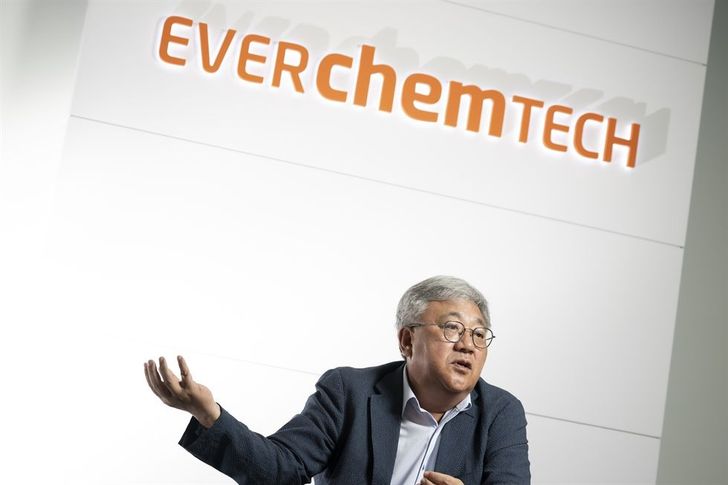
Everchemtech CEO Lee Seong-min answers questions during a recent interview with The Korea Times at the company's head office in Hwaseong, Gyeonggi Province. Korea Times photo by Choi Won-suk
The Nexrier packaging material won the top prize at this year's Worldstar Global Packaging Awards given by the World Packaging Organization (WPO). The WPO said Nexrier is derived from a natural protein, does not require multi-layers due to its excellent blocking ability and was shown to generate no hazardous substances during tests by the U.S. Food and Drug Administration (FDA).
Lee added that the food packaging materials market has a high entry barrier, which means Everchemtech will be positioned to sustain profits and revenues if volume production is ensured.
Films with barrier properties for flexible packaging are commonly and usually manufactured from multi-materials with combinations such as polythene-ethylene vinyl alcohol-polyethylene (PE-EVOH-PE) and polythene terephthalate-polyvinylidene chloride-polythene (PET-PVDC/PE), in addition to aluminum laminates or metallized films.
But those types of plastic must be separated before recycling. EVOH, for example, is viewed as the right fit in terms of cost and reducing the impact on the environment thanks to its effectiveness in blocking oxygen, which helps packaged food remain fresh for longer periods.
“Everchemtech is in discussions with 11 paper-producing companies about supplying the Nexrier material. Due to environmental concerns, the usage of recyclable paper will be expanded in product packaging with global companies leading such initiatives,” Lee said, adding that the Korean company aims to report 21 billion won in revenue and 5 billion won in operating profit this year, up from 15.3 billion won and 900 million won, each, in 2022.
According to the CEO, the recognition of the Nexrier material is the result of its concerted efforts to reduce Korea's dependence on Japan for key materials and components. LG Chem, SKC and Kolon are Everchemtech's top clients.
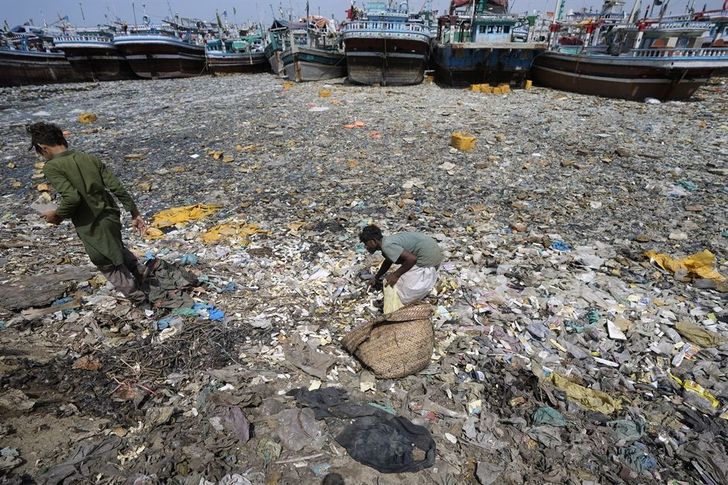
Scavengers collect usable and recyclable materials at a polluted harbor along the Arabian Sea, in Karachi, Pakistan, June 5, World Environment Day. AP-Yonhap
IPO planned for 2024
The CEO said Everchemtech is eyeing an initial public offering (IPO) on the junior and tech-heavy Kosdaq sometime in September of next year at the earliest, as its material could also be used to make advanced displays and high-end batteries.
“We are moving ahead with plans for a direct Kosdaq listing in September 2024 at the earliest. The listing timing could be delayed according to conditions. However, relevant procedures are underway as we recently increased the number of senior-level executives. We are aiming to reach at least 300 billion won in valuation by the time of our listing,” he said.
The concept of a circular economy is also being applied to the battery industry with recycling plants being built in several countries. Now, big electric vehicle battery producers are targeting the use of recycled batteries to minimize waste.
Water is critical for batteries. While a battery itself does not require water to operate, the mining of necessary materials, refining and actual manufacturing require a lot of water. Because fresh water is becoming scarce, miners of battery materials are increasingly asked to address such challenges by reusing water from wastewater sources or even by recycling their own wastewater.
Lee stated that the company is working on developing various recycling projects with Korea's leading battery materials suppliers, such as Daejoo Electronic Materials, to cut the country's reliance on expensive battery materials.
He added, “I would highlight adopting a responsible and affirmative approach to new materials means improving efficiency, reducing costs and meeting sustainability commitments.”