ANALYSIS US could ask S. Korea to join OLED sanctions against China

U.S. Marine Corps F-35B fighter jets are seen at Gwangju Air Base, April 14, in this photo provided on April 16 by South Korea's Defense Ministry. AP-Yonhap
China hopes to keep OLED tools working within its OLED ecosystem ahead of possible US export controls: experts
By Kim Yoo-chul
The United States has implemented unprecedented initiatives in semiconductor policy over the last few years, identifying computer chips as the most crucial element of Washington's rivalry with Beijing.
But the steps Washington has taken to keep China's technological development in check could expand as the Joe Biden administration is eyeing the Asian giant's display industry as the next possible target, two sources contacted by The Korea Times said.
Because the U.S. semiconductor production chain is based off shore, Washington asked its allies including Korea, Japan, Taiwan and the Netherlands to stand together to stay ahead of Beijing in manufacturing advanced semiconductors as China makes rapid progress in defense and technological innovations.
Semiconductors are essential for artificial intelligence, microelectronics, quantum computing, hypersonic technology, machine learning and data science, which are identified by Washington as strategically important for national security. China is also prioritizing those areas, aiming to beat the U.S. and its allies. Such efforts by China have already appeared on the U.S.' radar.
Such initiatives pursued by Washington culminated in the passage of the CHIPS Act, which includes around $52 billion in federal incentives for U.S.-based chip manufacturing, the launch of the Chip 4 alliance and export controls in 2022. Both the Japanese and Dutch governments accepted the U.S.' requests to restrict the sale to China of advanced lithography machines used to manufacture high-end semiconductors.
Because Samsung Electronics and SK, two of the world's largest memory chip manufacturers, are set to apply for U.S. federal funding, the South Korean chip duo is fated to follow Washington's regulations that limit the overall chip output capacity growth of funding recipients in China to 5 percent annually and 10 percent for legacy chips over the next decade. This would also curb Chinese President Xi Jinping's drive to boost chip self-sufficiency, according to political analysts in Seoul.
The U.S. Department of Trade approved a one-year waiver for Samsung and SK, both of which have operated massive chip production facilities in China. Talks are underway between Washington and Seoul officials to extend the waiver as the grace period expires in October this year.
Right now, China lags behind the U.S. by at least two or even more generations in the area of semiconductor technology. As a result, it is vital for China to receive substantial support from Samsung and SK over the next few years to get ahead of the U.S.
Semiconductors are of strategic importance for advanced civilian and military applications. But displays, specifically organic light-emitting diode (OLED) screens, are increasingly viewed as a crucial technology for national security, according to the sources.
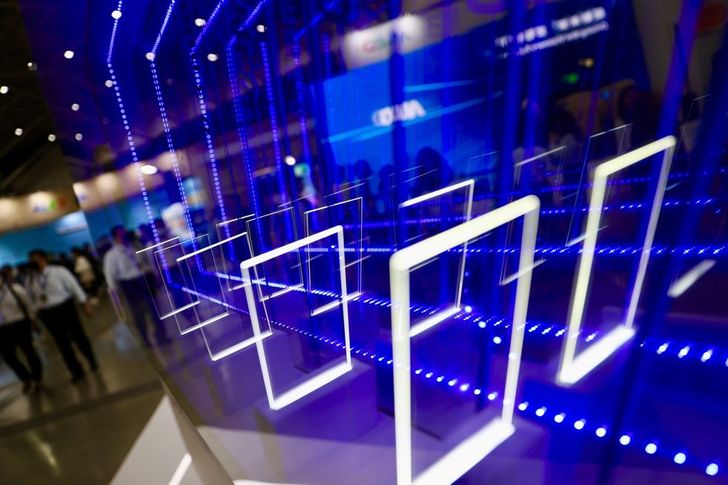
Various parts of an LED display panel are seen during the Touch Taiwan 2023 Exhibition in Taipei, Taiwan, April 21. With enhanced brightness, better color accuracy and a longer lifespan than conventional LED and OLED displays, micro-LED display technology has emerged as a potential solution for the future generation of displays. EPA-Yonhap
“The key rationale behind Washington's decisions for export controls for equipment to produce advanced semiconductors is that high-end chips using more advanced technology constitute the core parts of everyday products at the heart of U.S. economic life and are also needed for national security within the geopolitical context. As halting China's high ambitions for OLED dominance could set the stage for U.S. growth or the growth of its allies in that area, it's possible for the U.S. to apply similar export controls on OLED displays as it did so in chips,” a senior government official, who is familiar with Seoul's trade policies, said in a telephone interview.
OLED is what technology experts call an “emissive” technology as it does not use backlights and utilizes numerous pixels that emit their own light.
Thanks to the nature of the technology, OLED is flexible and provides an enhanced contrast ratio with a wider viewing angle, making them the right fit for helmet mounts used in military, commercial vehicles, airplanes and jet fighters. The Pentagon is regularly checking on how to extend the life expectancy of F-35 stealth jet fighters' OLED helmet-mounted displays.
China has become the world's largest display market since last year, followed by Korea, home to the world's leading display makers such as Samsung Display and LG Display. The Chinese government is aiming to keep OLED machine tools working within its supply chain system as a step to defend against possible sanctions imposed by Washington. The U.S. export bans in chip equipment systematically targeted Chinese chipmakers such as YMTC and SMIC.
Possible sanctions, but not priority
“Two years ago, Washington officials seriously reviewed the possibility of restricting the sale of OLED display-making tools and materials needed with the help of Korea, Japan and Taiwan. But because OLED could be replaced by conventional LCDs and LCD-variant LEDs, while China is also home to several fine display manufacturers, Washington decided to put more of its priority on squeezing China's chip industry. Still, there is a possibility of the Biden administration shifting its focus to OLED, because there are no signs of a truce between Washington and Beijing in ending their contest,” an aide to former President Moon Jae-in said.
In 2019, Korea tried to restrict exports of OLED equipment to China. However, the efforts did not materialize. Officials at Seoul's trade ministry said they have no official comments regarding the country's updated stance on this matter.

Chinese President Xi Jinping visits LG Display's manufacturing base in Guangzhou, south China's Guangdong Province, April 12. Xinhua-Yonhap
The point is that China's semiconductor ambitions still rely on the technologies of the U.S. and its like-minded allies. Given China's huge dependence on Taiwan-made customized chips and the advantages of the U.S.' top Asian allies in chip manufacturing equipment, Washington officials reached a consensus that they possess many punitive economic measures at their disposal.
“We have to recognize that unlike the display industry, there are a lot of major U.S. semiconductor companies such as KLA, Lam Research, Intel, Micron Technology, Qualcomm, Applied Materials and others involved in the semiconductor industry. The launch of the CHIPS Act, IPEF and Chip 4 alliance, therefore, does make sense for Washington policymakers in terms of highlighting the Biden administration's efforts to maximize U.S. leverage. But when it comes to the OLED industry, I doubt China will struggle to master OLED production even without input from the U.S. and its allies, as China already has quite a stable display ecosystem,” Koh Young-hwa, a researcher of the Center for Korean Studies at Peking University, said.
Like semiconductors, the industrial ecosystem which is controlled by companies in Northeast Asia, U.S.-based Universal Display dominates the sector for a collection of blue, green, and red dopant materials for OLEDs. Japan's Canon and Nikon are leaders in equipment needed to manufacture OLED displays. Also, Korea is home to the world's top-tier OLED manufacturers.
“If Washington wants to target China's OLED industry and to constrain China's production of OLED displays, then Seoul, Tokyo and Taipei may back it up,” a former Samsung executive said asking not to be identified. Samsung Display and LG Display operate massive OLED factories in the Chinese cities of Tianjin, Yentai, Nanjing and Guangzhou.
While Chinese President Xi Jinping's recent visit to LG Display's display cluster in Guangzhou is viewed as Beijing's unofficial request to Seoul for expanded contribution, the bottom line is that top Washington policymakers are not ready to ask their allies to expand the existing export control of specific semiconductor production parts to OLED equipment.
“I think OLED technology is unlikely to be high on the agenda for export controls and other restrictions as the military applications of OLED are limited,” Zack Cooper, a former U.S. official worked at the White House National Security Council, responded.
“OLED may be more advance that other similar technologies, but can be easily replaced with legacy technologies. So I doubt that the United States will look to limit OLED technology,” the senior fellow at the American Enterprise Institute added.