SK hynix suffers $2.54 bil. loss in Q1 on memory chip bust

SK hynix's chip production facility in Icheon, Gyeonggi Province / Courtesy of SK hynix
Chipmaker expects conditions to improve from Q2
By Baek Byung-yeul
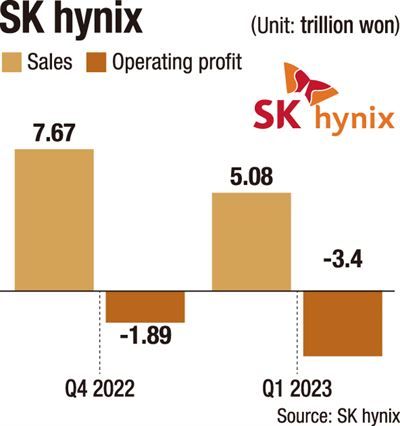
SK hynix posted an operating loss of 3.4 trillion won ($2.54 billion) in the first quarter of this year, suffering a loss for the second consecutive quarter due to deteriorating semiconductor industry conditions, the memory chipmaker said, Wednesday.
However, the company added it expects global chip market conditions to recover in the second quarter after bottoming out in the first three months of this year.
Also, the company aims to sell more high-capacity memory chips, targeting the growing data center server market, which has seen increasing demand for high-priced memory chips due to the popularity of generative AI services like ChatGPT.
In its first quarter earnings announcement, SK hynix said sales totaled 5.08 trillion won, down 58 percent from the same period last year. The operating loss of 3.4 trillion won is the second consecutive quarterly loss, following an operating loss of 1.89 trillion won in the fourth quarter of 2022. It is also the largest quarterly loss since becoming an affiliate of SK Group in 2012.
“In the first quarter, demand for chips continued to weaken due to financial market turmoil and concerns about a global economic downturn. As customers continued to adjust their inventories along with the seasonal slowdown, DRAM and NAND shipments declined significantly quarter-on-quarter and prices across all applications continued to decline,” Kim Woo-hyun, chief financial officer of SK hynix, told investors during a conference call.
However, the CFO said the company expects the market to gradually recover from the second quarter because inventory levels of its clients are shrinking, while memory chip manufacturers are cutting production.
“With the ongoing uncertainty in the global economic environment, memory chip demand is expected to be somewhat lower than it was at the start of the year. However, memory chip inventories of customers have been declining throughout the first quarter and the industry's inventory levels are expected to gradually decline as supply cuts begin to take effect in the second quarter,” Kim said.
The CFO also revealed the company is betting big on data servers for AI services that use enormous amounts of data, which eventually require high-capacity and high-priced memory chips.
“Competition to launch large language model services and generative AI technologies, such as ChatGPT, as well as a significant increase in demand for high-capacity modules above 128GB among DDR5 products used in high-performance servers, are expected to drive server-oriented memory demand growth this year,” Kim said.
An analyst agreed with SK hynix's revitalization plan, saying there is light at the end of the tunnel.
“SK hynix has revealed plans to cut production until inventories are reduced. Demand was weaker than expected at the end of last year, which means further cuts than planned three months ago,” Hwang Min-seong, an analyst at Samsung Securities, said. “The cuts are to reduce wafer inputs. Micron has already increased its cuts from a 20 percent reduction to a 25 percent reduction. SK hynix also expects a reduction of 30 percent.”