Nuri placed on launch pad before liftoff Thursday

Nuri space rocket is placed on a launch pad at Naro Space Center in Goheung, South Jeolla Province, Wednesday, a day before its liftoff. Courtesy of KARI
Final liftoff decision still pending
By Baek Byung-yeul
Nuri space rocket was placed on a launch pad in preparation for its liftoff Thursday, the science ministry and the Korea Aerospace Research Institute (KARI) said Wednesday. The schedule was postponed by one day due to strong winds.
The ministry and KARI, which oversee launches, announced that the homegrown space rocket was placed on the launch pad at 11:30 a.m., Wednesday. The Nuri departed from the assembly center at Naro Space Center in Goheung, some 470 kilometers south of Seoul, at 7:20 a.m. and arrived at the launch site at 8:30 a.m. Officials, however, held off a final decision for liftoff after discovering technical problems.
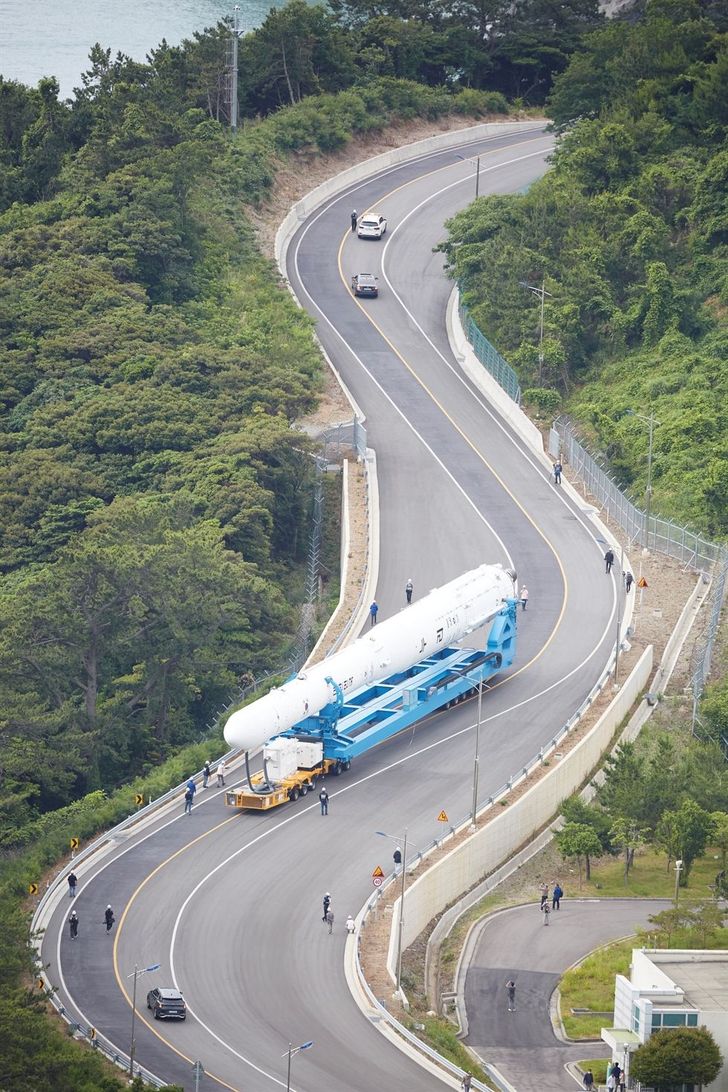
A transportation vehicle carries Nuri space rocket from the assembly building to the launch pad, Wednesday. Courtesy of KARI
The assembly building is located just 1.8 kilometers from the launch pad. But the transportation vehicle carrying the Nuri moved slowly at just 1.5 kilometers per hour. Technicians conducted follow-up steps in the afternoon, such as connecting the rocket to the launch tower, which is also known as an umbilical tower.
The umbilical tower supplies electricity, fuel and oxidizers through cables plugged into the Nuri.
The Nuri was scheduled to be positioned on the launch pad on Tuesday for liftoff on Wednesday. But the authorities decided to delay the schedule by one day on Tuesday as strong winds at the launch site raised safety concerns.
The science ministry will hold a meeting on Thursday morning to decide whether to charge the Nuri's propellant tank and convene another meeting in the afternoon to decide whether to launch the space rocket. Currently, the Nuri is scheduled to be launched at 4 p.m.
“We will review technical preparations, weather conditions and the possibility of collision with space objects to decide the final launch time of the Nuri,” the science ministry said.
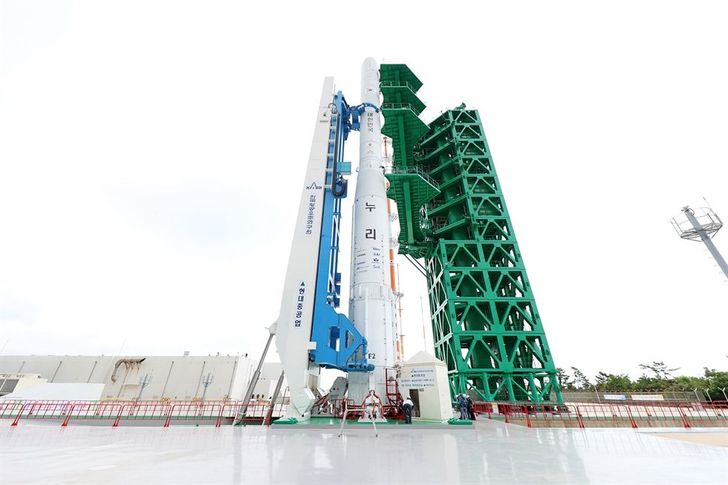
Nuri space rocket is positioned on the launch pad at Naro Space Center in Goheung, South Jeolla Province, Wednesday. Courtesy of KARI
The three-stage space rocket is designed to push a 1.5-ton satellite into a low orbit of between 600 kilometers and 800 kilometers above the Earth. Thursday's launch will be its second trial, following a failure in October 2021.
During its first launch, the Nuri flew to a target altitude of 700 kilometers, but failed to put a dummy satellite into orbit as its engine burned out 46 seconds earlier than expected.
KARI conducted a two-month-long investigation and concluded that the failure stemmed from the loosening of a device that anchors a helium tank, which was mounted inside the oxidizer tank in the third stage of the rocket.
To prevent a repeat of the same mistakes, Jang Young-soon, director of KARI's Launcher System Development division, told reporters on June 10 that the institute “improved the helium tank by strengthening the anchor on the lower support and reinforcing the thickness of the manhole cover.”
If Nuri is successfully launched, Korea will become the seventh country to launch a space rocket with its own technology, following Russia, the United States, France, China, Japan and India, which possess the capability of placing an over 1-ton satellite into orbit.