LG, Vogue discuss sustainable fashion

Vogue Polska Editor-in-Chief Ina Lekiewicz, left, speaks with BAT Poland and Baltics General Manager Asli Ertonguc during the Vogue Business Fashion Environment Summit, held at the Museum of the History of Polish Jews in Warsaw, Sept. 22. Courtesy of LG Electronics
By Kim Jae-heun
In the ongoing pursuit for sustainable fashion, industry leaders in Poland gathered to bring greater awareness to climate issues and the importance of doing business responsibly at this year's Business Fashion Environment (BFE) Summit, under the theme, “New Beginning: Rethinking Sustainability.”
Organized by Vogue Polska in association with the Boston Consulting Group (BCG), the summit was the second installment of Central and Eastern Europe's largest fashion conference devoted to sustainable development.
LG Electronics in Poland took advantage of the occasion as an official partner of the summit to highlight the company's unwavering commitment to sustainability and eco-friendliness.
According to the “Consumers Adaptation to Sustainability in Fashion” report jointly published by BCG and Vogue Polska in May, 75 percent of Poles consider sustainable development an important issue, yet more than half of those surveyed only associated the recycling and upcycling processes with sustainable fashion.
The study also suggested that one in four Poles typically do not buy organically produced clothing, on account of its higher prices and concerns about quality.
At the same time, the clothing, footwear and accessories manufacturing industry is responsible for 5 percent of carbon dioxide emissions and 20 percent of global wastewater.
During the conference session, “Why Brands Matter?,” Tomasz Wawszczyk, the B2C business director of LG Electronics Poland, raised the issue of ecology within the environmental, social and corporate governance (ESG) framework, which has been a major focus for LG over the past few years.
Wawszczyk pledged that LG would focus on leveraging innovation to create a more sustainable future, so that all consumers could lead better lives.
LG is more committed than ever to supporting sustainability by integrating the U.N. Sustainable Development Goals into its business strategy, such as pledging carbon neutrality by 2030 and a complete transition to renewable energy by 2050.
Sustainability is integrated into LG's product development, which is why the company's flagship OLED TVs require fewer plastic components than conventional TVs, since no backlight is required.
OLED TVs contain zero hazardous substances, such as cadmium or iridium, meaning that LG OLED is a natural choice for environmentally conscious customers.
Without question, the pandemic has made the public more aware of the human impact on climate change.
According to BCG, more than 67 percent of those surveyed believe that human activities are harming the climate, and that environmental degradation threatens humanity.
Companies are sensing this situation too, with MIT reporting that since early 2020, 87 percent of companies with more than 10,000 employees have either increased or maintained their commitment to developing a more sustainable supply chain.
“As an opinion leader in the fashion industry, we're able to take direct action against the waste and pollution caused by the making and disposal of our clothes, like securing more sustainable supply chains or switching to circular production,” said Kasia Jordan Kulczyk, the publisher of Vogue Polska.
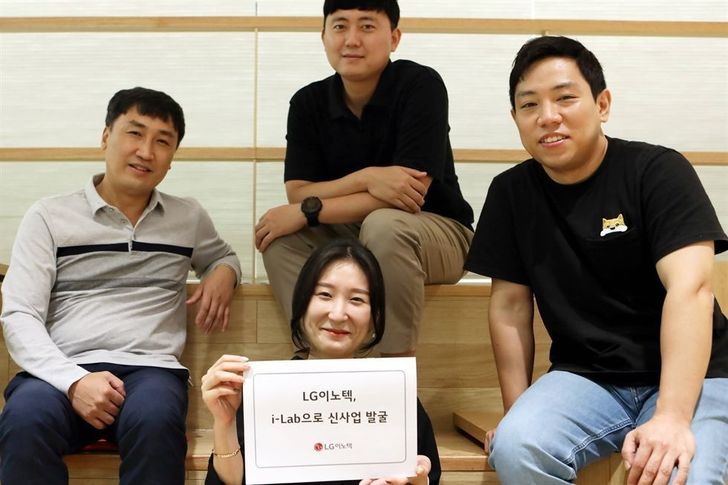
I-Lab program's first season winners pose for a picture at LG Innotek's headquarters in Magok, Seoul, Oct. 15. Courtesy of LG Innotek
LG Innotek opens second season for i-Lab
LG Group's electronic components maker, LG Innotek, said Monday that it has started the second season of its “i-Lab” program, which began last August. I-Lab is short for “innovation Lab,” where teams of company executives and employees share ideas to discover new growth engines.
Anyone in the company can suggest ideas for i-Lab, and 100 teams have participated in this program since last year. There have been 140 ideas submitted for the company's new growth engine in the fields of robot engineering and metaverse technology.
Employees' ideas are collected in an open audition online and people can vote on the best ideas shared. They can also give advice and make comments on the project freely in real time.
The top 10 projects that obtain the most votes will be evaluated by the company's top executives, including the company's chief technology officer. The winning project will have its participants form a separate team to develop the project and work on it, with the support of specialized consultants from outside.