INTERVIEW 'Trump politicized Meng Wanzhou case'

Huawei CFO Meng Wanzhou exits court at the conclusion of a hearing in Vancouver, Canada, Aug. 18. Reuters-Yonhap
Huawei says US trying to increase leverage against China with CFO's extradition case
By Baek Byung-yeul
A high-profile hearing of Meng Wanzhou, chief financial officer (CFO) of Chinese telecommunications giant Huawei Technologies, ended in a Canadian courtroom Wednesday (local time), drawing to an end the case that has provoked unprecedented conflict between the United States and China.
Over the next two months, Associate Chief Justice Heather Holmes will deliberate whether to extradite the Huawei executive to the U.S. as the justice is slated to announce her decision on Oct. 21.
Alykhan Velshi, Huawei Canada's vice president of corporate affairs, said Thursday that former U.S. President Donald Trump politicized her case as the CFO has been used as a bargaining chip in trade related negotiations between the world largest powers.
“We have contested her extradition on a number of grounds. The first ground that we raised is we said that president Trump politicized her case. This is a political prosecution,” Velshi said during an online interview with The Korea Times.
“The evidence we cited is that in the days following her extradition he gave a speech in a news conference to Reuters where he told Reuters that he would be willing to intervene in her case if it got him a better trade deal with China.”
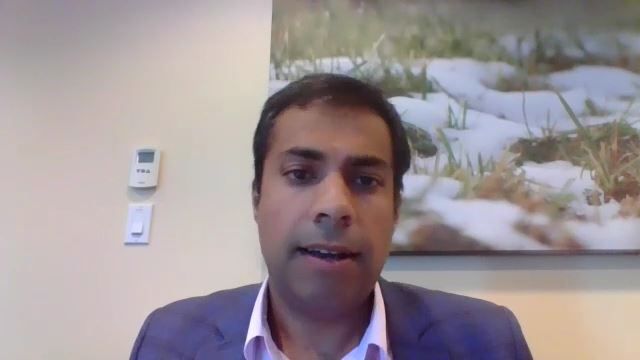
Alykhan Velshi, vice president of Huawei Canada, speaks during an online interview with The Korea Times, Thursday. Courtesy of Huawei Korea
The vice president went on to say that it is inappropriate for Meng to be placed on the cutting board over whether or not to extradite her to the U.S. when the case is interfered with by political considerations.
“We have said that this would poison the atmosphere showing that she's being used as leverage, as a bargaining chip, and it is inappropriate for the Canadian judicial system to extradite someone when there is political interference at that scale,” he said.
The CFO is a daughter of Huawei Founder Ren Zhengfei. In Dec. 1, 2018, she was arrested by the Canada Border Services Agency at the request of the U.S. Since then, Meng has been under house arrest over the past two and half years.
The U.S. wants the CFO extradited to New York to face a fraud charge, alleging Meng made false statements to the British HSBC in 2013, significantly understating Huawei's relationship with Skycom, known to have operated in Iran. As a result, HSBC provided financial services to Huawei and Skycom and violated the U.S. financial and trade sanctions on Iran, putting the bank at risk of economic deprivation. The US therefore charged Meng with defrauding HSBC.
China saw the arrest of Meng as a part of U.S. efforts to obstruct the development of the Chinese tech firm as Huawei has been a leader in global telecommunications markets, including the super-fast 5G network market. After she was placed under arrest, the U.S. government moved to ban the purchasing of equipment made by Huawei and another Chinese tech firm ZTE.
When asked if Meng's extradition issue will be resolved through diplomatic negotiations with the U.S. and China, not a legal procedure, Velshi said “it is obvious that this has come up in U.S-China meetings, Canada-China meetings as well.”
“This is about trying to get leverage in trade fights like we've always understood and acknowledged that reality but at the end of the day we can't control what happens between governments and we can't control what happens with diplomats. This is a prosecution that began in Washington D.C. and in many ways it is playing out in Washington D.C. while Meng's proceedings play out in Vancouver, it's what makes this so unusual and so political and so inappropriate,” he said.
The vice president further mentioned that the U.S.' hampering of Huawei reminds many people of the trade war between Japan and the U.S. back in 1980s. Due to concerns about losing balance in trading with Japan, the U.S. began imposing huge tariffs on Japanese electronic products including semiconductors.
“The U.S. has tensions with companies all the time. If you think about the 1980s, there were big campaigns against Japanese companies. Now we're having tensions with Chinese companies,” he said.
Velshi admitted that the U.S.' hampering of Huawei caused negative impact on the company, but he added he believes the so-called “Huawei ban” would make the firm stronger and more resilient.
“It's no secret that the U.S under President Trump has tried to hurt Chinese companies including Huawei. Has that affected our business? Yes, you see it in our smartphones sales. At the same time we survived. If you would have looked at a lot of the media coverage around the time president Trump brought in his chips and semiconductor bans, people were predicting that this would destroy Huawei, like this would be the end of Huawei. And this clearly did not happen,” he said.